From Smiling Buddha to Nijjar Row: A 75-Year Timeline of India-Canada Relations
Over 75 years of diplomatic history, India-Canada relations have swung from post-independence goodwill to nuclear fallout, a terrorist bombing, a formal strategic partnership and then one of the worst bilateral crises in recent memory.
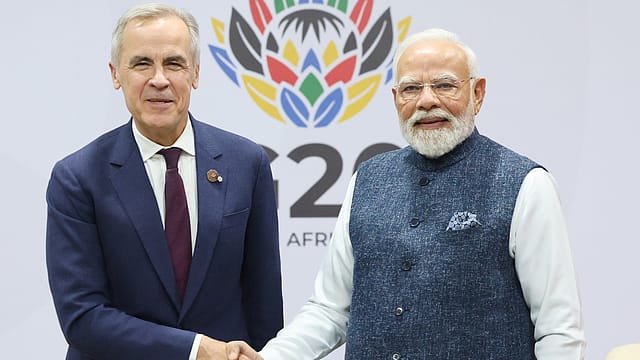
Canada's Prime Minister Mark Carney’s India four-day official visit begins today. This marks his first official visit to India since becoming PM in March 2025 and is seen as a major reset for bilateral relations.
Here’s a more detailed insight on India-Canada relations.
When did India and Canada establish diplomatic relations?
India and Canada established formal ties shortly after India's independence, grounded in their shared membership in the Commonwealth. The two countries have over 75 years of diplomatic relations. An early milestone was their joint participation in the Colombo Plan in 1950 -- a Commonwealth cooperation initiative for economic development in South and Southeast Asia -- which set the tone for early bilateral engagement.
How did nuclear politics fracture the relationship?
The first major rupture in India-Canada relations came in 1974. Canada had supplied India with nuclear technology under a civilian cooperation agreement. When India conducted its first nuclear test -- codenamed "Smiling Buddha" -- Canada suspended all nuclear cooperation, viewing the test as a violation of the spirit of that agreement.
Reportedly, it took until 2010 and the signing of a fresh nuclear cooperation agreement for this dimension of the bilateral relationship to be formally repaired.
How did the Air India bombing shape Indian suspicions of Canada?
The 1985 Air India Flight 182 bombing killed 329 people, linked to Sikh extremists on Canadian soil. India's frustration over Canada's handling of investigations seeded lasting distrust about Canada’s willingness to act against anti-India elements - a tension that would explode decades later.
Survival Instinct
22 May 2026 - Vol 04 | Issue 72
India navigates global economic turmoil with austerity and smart diplomacy
What is the formal framework of the strategic partnership?
Bilateral relations were formally designated a “Strategic Partnership” in 2018. The framework is built around Ministerial Dialogues on foreign policy, trade and investment, finance, and energy.
At the working level, officials engage on counter-terrorism, security, agriculture, education, and science and technology. A Canada-India Science and Technology Cooperation Agreement, signed in 2005, underpins research collaboration across both public and private sectors.
How significant is the Indian diaspora to this relationship?
The Indian diaspora is the most powerful connector between the two countries. According to Canada's 2021 federal census, more than 1.8 million Canadians are of Indian origin, and India is Canada's largest source country for immigration. Reportedly, in 2024, there were 392,810 active Indian student permit holders in Canada alone.
How large is the trade relationship?
According to the Government of Canada, two-way goods and services trade between India and Canada reached $30.9 billion in 2024, placing India as Canada's seventh-largest trading partner. Canada's key exports include vegetables, mineral fuels, and wood pulp; India's top exports to Canada are pharmaceuticals, machinery, and electronics.
Free trade negotiations, first launched in 2010, remain inconclusive despite periodic revival.
What caused the 2023 diplomatic collapse?
In September 2023, Trudeau alleged Indian government agents were linked to the killing of Hardeep Singh Nijjar -- a Canadian citizen designated a terrorist by India - in British Columbia. India rejected the claims. Both sides expelled diplomats, India suspended visas and recalled its High Commissioner, marking the sharpest bilateral breakdown in decades.
What does the recovery look like?
Following Trudeau's resignation, both sides signalled a reset. Prime Ministers Carney and Modi met at the G7 Summit in June 2025, high commissioners were reinstated, and a Trade and Investment Ministerial Dialogue followed in November 2025. India-Canada relations are recovering - but fault lines around Khalistan-linked groups remain unresolved.
Where do India-Canada relations stand today?
The strategic partnership architecture remains in place, trade ties are growing, and the diaspora continues to be the strongest bridge. But structural trust deficits - rooted in decades of disagreement over Sikh extremism, compounded by the 2023 crisis - mean India-Canada relations will likely need sustained political will from both sides to become the deep partnership both countries once envisioned.
(With inputs from yMedia)