Pakistan’s Prisoner - The Descent and Despair of Imran Khan
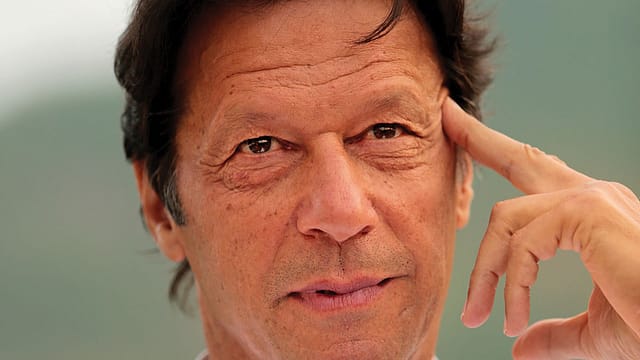
HONESTY IS NOT QUITE THE BEST POLICY IN HIGH society. It prefers scepticism. For the local Anglophiles whose day began in the evenings of Lahore, the classical city where Imran Ahmed Khan Niazi grew up, honesty was gauche, and naive. That made Imran Khan a paradox. Born into privilege but deeply rooted in a Pashto culture inherited from his Niazi tribe, where honour is a defining virtue, he was temperamentally transparent. He had nothing to hide. Deceit invited disdain. The cultural affinities of the English-speaking elite, he said, had created a distance between the ruling class and the people. His presence was always in competitive demand at parties held on the snob heights of Lahore’s high society, but he was never quite ‘one of us’. He remained an outsider with an entrance ticket to the inside.
Imran means exalted, and that was his destiny. Success was in his genes. He was a star of his school cricket team at Lahore’s Aitchison College and then a Blue at Keble College Oxford. He was named captain of Oxford in 1974. Despite family wealth, looks and talent, cricket in the blood, and a cousin Javed Burki who scored a Test century against England, fluttering hearts on the sofa wherever he went, he forgot to learn snobbery.
It was not unusual to hear, as I once did at a party in Lahore, a young lady with flickering eyelids put it about that she had just sniffed away an offer of marriage from Pakistan’s most eligible bachelor. There were oohs and aahs, and many a well-done. The Khan might rule the playing fields across the British sports empire, but he was always kept at a fling distance in romance, never close enough for marriage. This young lady became a trifle invisible when Imran arrived later. The gossip reached him. He replied with a bemused smile. Imran was ever bemused and benign, never mean or malign. He was always happy to move away from the central whirl for a quiet chat, all too often interrupted by a socialite seeking his attention.
He was confidently sober at a time when high society was very high indeed and affability was measured in pegs or puffs. Imran Khan, always the cynosure, lived by his own rules. He never drank alcohol or did drugs. He did not consider religion a weakness of proles; he was a believer, and proud to be so. As he writes in his memoir, his parents were “easy-going Muslims”. His father took him to the mosque every Friday. They fasted during Ramadan. The family joined the annual urs to the shrine of a mystic Sufi pir, Mian Mir Sahib, legendary for both Muslims and Sikhs, where music and dancing were part of devotion. “That is the kind of Islam that the austere Wahhabi branch, which has influenced the Taliban, opposes,” writes Imran in Pakistan: A Personal History. The young Imran had two questions about paradise: “Would I be able to play cricket in heaven? And would I be able to shoot?”

Public life was an alternative career path after his stupendous success as a cricketer and captain. If the ascent was glorious, the peak was heroic. He was nearly 40 when in 1992 he led Pakistan to an impossible victory in the cricket World Cup. What the world did not know was that he played the tournament with a ruptured cartilage in his shoulder. For six months after that tour he could not lift a glass with his right hand without numbing pain.
His second life began with fund-raising for the construction of the Shaukat Khanum Memorial Hospital, named after his beloved mother, who had died of cancer. His close friend Princess Diana would later visit the hospital, which became functional in 1994. The next year he married Jemima Goldsmith. It was a brave decision, given the hardline attitude of fundamentalists, for Jemima was Jewish, daughter of Sir James Goldsmith. (London’s most exclusive nightclub Annabel’s was named after her mother.) Imran Khan was a man of deep convictions. That was a year in which nothing could go wrong. In November 1995 Ian Botham sued Imran for libel for allegedly calling him and Allan Lamb “uneducated racists”. The trial came up before a biased judge. The cost of failure was bankruptcy, given legal fees in London. As Imran Khan has written, defeat would have forced him to ask his father-in-law for money, a prospect he hated. Imran Khan won.
I FIRST MET IMRAN in the 1980s, and we kept in touch. Imran Khan had an obvious interest in politics and wanted to understand power from a nonpartisan perspective. He had seen the beginning of military dictatorship under General Ayub Khan; the drunken disaster of his successor General Yahya Khan; the meteoric streak and burnout of Zulfikar Ali Bhutto; the steely decade of General Zia-ul-Haq; and the turbulent tenures of the next generation, Nawaz Sharif and Bhutto’s daughter, his Oxford contemporary Benazir. Imran Khan believed that he could save the country he loved through the institutionalisation of democracy and he was the right person to deliver the change.
Envy had already sired vicious enemies. They exploded when he entered politics in 1996. They would attempt assassination later, but their campaign against him began with character assassination. He was vilified as a dullard. For years a newspaper in Lahore carried a satirical column titled ‘Im the Dim’. It was malice dressed in good English. Imran Khan may not be an academic intellectual, but he is intelligent and sincere. For evidence simply read his autobiography, published in 2011, which is full of astute observation and analysis. He describes the difference between General Zia and General Pervez Musharraf in their deference to America: unlike Musharraf, Zia never allowed the CIA to spread its network across Pakistan. He notes, wryly, that to become leader of Pakistan you need assistance from the Three As: Allah, Army, and America.
Imran Khan is not a capitalist, socialist or fundamentalist. Although he might like himself a trifle more than necessary, he is not a narcissist. Honesty is his proclaimed qualification for public life. When he needs to be less than candid, you can hear the fumble in his voice. This is a handicap in an oligarchy where its component parts—army, subservient politicians, industrialists, bureaucrats, ideologues or middlemen—are never certain about the compromise he will accept. It is now accepted that the last word remains with the army. Imran always threatened to make the last word his version of integrity.
It might seem odd to attribute honesty to someone imprisoned for corruption, but the case itself is proof of Imran’s rectitude. He was initially convicted of selling official gifts he had received from foreign countries, like watches, perfumes, jewellery, dinner sets. The corrupt in Pakistan do not sell gift watches and perfume to make money. They steal from state resources. They gouge money out of contracts and graft. Corruption is a smooth lubricated machine. It may be evidence of his probity that his enemies could not jail Imran for something more substantial than state gifts, and financial culpability in a trust that he had set up for his charitable work.
Greed is not a temptation for him. Imran Khan’s weakness is a sense of entitlement. But if entitlement were a punishable offence, Pakistan’s prisons would be full of celebrities.
Imran Khan’s genes have a dominant strain: the saviour syndrome. He is convinced that he was born to lead the impoverished Pakistani people, misled during eight decades of mirage, towards a prosperous horizon. Perhaps the messiah within was always waiting for crucifixion on false charges.
In a less ecclesiastical analysis, Imran Khan took advantage of the army’s implicit support to come to power in 2018 but did not know how to read the army when in office. The Pakistan army has seized exclusive rights to the saviour franchise since 1958, with the coup of General Ayub Khan, and will not tolerate competition. Zulfikar Ali Bhutto, blinded by hubris, realised this too late; he was hanged by General Zia in a judicial assassination. His charismatic daughter Benazir was killed on the streets of Rawalpindi by the usual anonymous assassin when General Musharraf was in power. The army has tolerated Nawaz Sharif and his brother Shehbaz because they have been useful as a footbridge during fallow periods. In 2018 it turned to Imran Khan as a last resort, assuming that two decades of frustration would keep the maverick pliable.
The inevitable rupture came in 2022. Defections and manipulation were used to subvert Imran Khan’s majority in Parliament on April 10; the next day Shehbaz Sharif became prime minister. In October Imran Khan was disqualified from holding public office. In November he survived a gun attack on his convoy and accused the Inter-Services Intelligence (ISI), headed by General Asim Munir, of plotting his murder. In May 2023, Imran Khan was arrested from inside the Islamabad High Court by the National Accountability Bureau. A short spell of bail ended in August. He returned to prison. His health and spirits are under strain as he faces a life-and-death combat with the effective ruler of Pakistan, Asim Munir.
The charges against Imran Khan include what has been described as an “unlawful” marriage. On January 1, 2018 he wed his third wife, the heavily curtained 44-year-old Bushra Riaz Wattoo, mother of three children from her previous husband. This marriage, by Islamic rites, might be intriguing and worthy of a television series but to send a prime minister to years in prison for getting the date wrong as per the technical requirement of her post-divorce code is absurdity. The case collapsed. Bushra is free but constrained. Imran remains in prison for the unforgiveable crime of opposing the army and its puppets.
Bushra, who drapes herself in a burqa to advertise her Islamic credentials, but occasionally permits photographers a fleeting glimpse of her hidden beauty, turned spiritual in her twenties. She became a devotee of the mystic Baba Farid of Pakpattan but also began to dabble in what are called the dark arts since no one understands them. Imran Khan met her after she had acquired a reputation for divination through dreams and could predict an auspicious moment. He became mesmerised. She convinced him that he would never become prime minister unless he married her and followed a few strange rituals. She divorced her first husband. He had left his second wife. Their marriage took place on January 1, 2018. On August 18, 2018 Imran Khan became the 22nd prime minister of Pakistan.
Bushra Bibi made, it has been reported, one accurate if not terribly profound prediction in January 2018: power comes and goes. In Islamabad it goes more often than it comes, unless you are in the army. The exalted Imran Khan seems destined to fester in jail until Asim Munir loses his perch at the pinnacle of the Pakistan pyramid.