From Mailboxes to Memory: Why Denmark Has Ended Letter Delivery
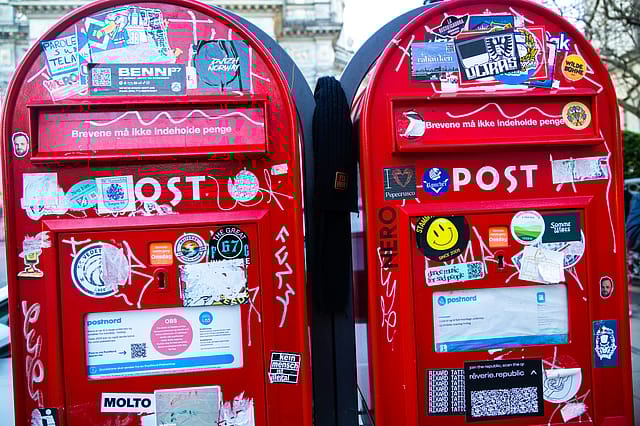
Denmark’s state-run postal service, PostNord, delivered its final letter on Tuesday, formally ending more than four centuries of traditional mail delivery. With that, Denmark became the first country in the world to declare that physical letter delivery is no longer essential—or economically viable—in the digital age.
The decision is rooted in numbers as stark as they are symbolic. According to CNN, letter volumes in Denmark have collapsed by over 90 percent since 2000. A similar decline is visible globally. In the United States, the Postal Service delivered nearly half the volume of mail in 2024 compared to 2006. Emails, messaging apps, video calls, and government portals have quietly replaced envelopes and stamps.
Earlier this year, PostNord began dismantling one of Denmark’s most recognisable urban fixtures: its red mailboxes. About 1,500 were removed nationwide. When the company later announced that the retired boxes would be sold for charity, something unexpected happened. Hundreds of thousands of Danes tried to buy one. Prices jumped to 1,500–2,000 Danish kroner per box.
The frenzy revealed what statistics cannot: letters may be obsolete, but they are not unloved.
LIFE WITHOUT LETTER
For those who still need to send physical mail—legal documents, international correspondence, or personal notes—letters will now be dropped at kiosks inside retail stores. From there, private courier firm DAO will take over domestic and international deliveries. PostNord, meanwhile, will continue parcel operations, buoyed by Denmark’s booming e-commerce economy.
Survival Instinct
22 May 2026 - Vol 04 | Issue 72
India navigates global economic turmoil with austerity and smart diplomacy
Denmark’s transformation has been swift and deliberate. Most public services—from healthcare to tax filings—are now fully digital. “Almost every Dane is fully digital,” PostNord spokesperson Andreas Brethvad said, noting that electronic communication has overtaken letters in both relevance and volume.
For PostNord, the final delivery is less a shutdown than an admission: letters no longer belong to the centre of modern life. Parcels will continue to move, fuelled by e-commerce. Couriers will fill the gap. The machinery of logistics will hum on. But the quiet ritual of waiting—for ink, paper, and human touch—has reached its terminus.
Denmark may be the first to formally close the chapter, but it is unlikely to be the last. Across Europe, postal operators are grappling with the same arithmetic: collapsing volumes, rising costs, and a generation that has never licked a stamp. In Germany, France, the UK, and even Japan, letter traffic has been shrinking year after year, propped up more by nostalgia than necessity. The question is no longer if letters will disappear—but who dares to say it out loud next.
INDIA ON A DIFFERENT CURVE
India, however, remains on a different curve. While digital payments, Aadhaar-linked services, and instant messaging dominate urban life, physical letters still matter in rural India, especially for courts, banks, and government notices. India Post delivered over 3 billion letters last year, and its vast network doubles as a financial and welfare lifeline.
Yet even here, the shift is unmistakable. As DigiLocker, e-courts, and digital land records scale up, the letter’s relevance is thinning. Denmark’s farewell may feel distant today, but it offers India a glimpse of its own future, one where the postman’s knock slowly gives way to a notification ping.
What Denmark’s final letter marks, then, is not the death of communication, but the end of an era that once moved slowly, deliberately, and with permanence. In choosing speed over sentiment, the country has drawn a clear line between memory and modernity. The red mailboxes may now belong to museums and living rooms but the silence they leave behind will echo far beyond Denmark’s borders.
(ANI and yMedia are the content partners for this story)