From Airports to $96-Billion Deals: How India is Playing its Davos Card
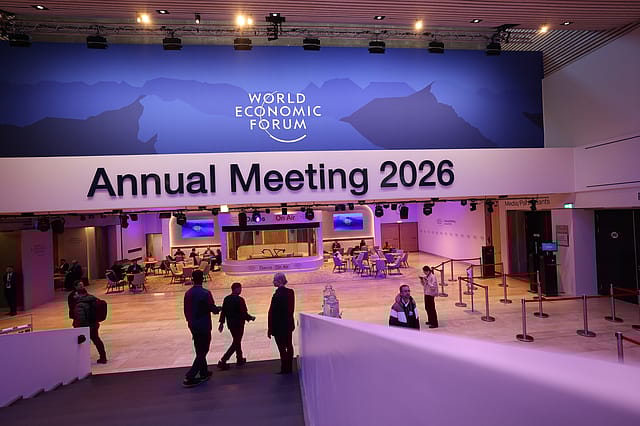
On the snowy sidelines of the World Economic Forum in Davos, India’s pitch to the world started not with grand theories, but with a map of runways.
Civil Aviation Minister Ram Mohan Naidu laid out a vision that was both symbolic and concrete: India plans to have up to 350 airports by 2047. From just 74 airports in 2014 to 164 today, and another 50 planned in the next five years, the ambition is unmistakable. Airports, Naidu argued, are not just infrastructure assets; they are gateways to growth, trade, jobs and regional inclusion.
India is already the third-largest domestic aviation market globally, growing at over 10–12% annually, driven not by chance but by policy, capital infusion and a deliberate push to democratise air travel. With nearly 1,700 aircraft on order, Naidu pointed out, no other country currently matches India’s aviation pipeline.
The message at Davos was clear: if you want to understand India’s growth story, start with how fast it’s building ways to move people, goods and capital.
From there, the story widened.
Maharashtra: Turning Davos Conversations into $96 Billion Commitments
If airports were the vision, Maharashtra brought the execution.
On Day One of WEF 2026, the Mumbai Metropolitan Region Development Authority (MMRDA) signed 10 MoUs worth $96 billion (₹8.73 lakh crore)—one of the largest single-day investment hauls at Davos. These agreements are expected to generate 9.6 lakh direct and indirect jobs, spanning infrastructure, logistics, fintech, AI, sports innovation, education and sustainability.

India's Action Hero
27 Mar 2026 - Vol 04 | Issue 64
Riding the Dhurandhar Wave
Chief Minister Devendra Fadnavis called the deals the blueprint for “Mumbai 3.0”, positioning the region as the engine driving Maharashtra toward its $1 trillion economy ambition. Deputy CM Eknath Shinde underscored the broader vision: transforming Mumbai, Thane and Kalyan into a globally competitive, technology-driven urban cluster.
The scale was striking. A $45-billion MoU with SBG Group for logistics and digital infrastructure; $25 billion with Panchshil Realty for fintech districts and integrated townships; innovation and sports cities, AI labs, digital twins and net-zero industrial clusters. All these were stitched into a single metropolitan roadmap.
Davos, for Maharashtra, is deal-making.
Madhya Pradesh: Manufacturing, Renewables and the Case for Quiet Scale
Away from the flashier announcements, Madhya Pradesh made a different kind of pitch: methodical, manufacturing-led and future-facing.
At the Madhya Pradesh State Lounge, the state delegation held high-level discussions with Everstone Group, focusing on manufacturing, renewable energy and food processing. Officials highlighted the state’s growing automobile and EV ecosystem, industrial clusters around Indore, Ujjain and Bhopal, and strong capabilities in textiles and garments.
The emphasis was on clean energy manufacturing—solar panels, batteries, ingots and wafers—backed by investor-friendly land frameworks near Bhopal and Hoshangabad. For Everstone, which prioritises scalable, long-term platforms, Madhya Pradesh positioned itself as a steady, high-capacity manufacturing base rather than a speculative bet.
The takeaway: India’s industrial growth story isn’t only about metros. It’s increasingly about quietly scalable states aligning policy, land and demand.
GIFT City: Selling India as a Global Financial Gateway
While states pitched factories and infrastructure, GIFT City pitched something more abstract but equally critical: capital flows.
On the opening day itself, the GIFT City delegation met with global heavyweights including Euroclear, Qualcomm, Invesco, Marsh McLennan, AB InBev, HCL-Software and Lulu Financial Holdings. The conversations centred on regulatory frameworks, long-term partnerships and positioning GIFT City as a credible global financial and technology hub.
Group CEO Sanjay Kaul framed Davos as a dual opportunity: to showcase India’s international financial services centre and to signal that India is ready to host sophisticated global financial operations. GIFT City, he said, is not just a domestic project. It is India’s gateway for global capital and capabilities.
Taken together, India’s Davos playbook in 2026 reveals a pattern.
Start with hard infrastructure, back it with large-ticket commitments, support it with manufacturing depth, and anchor it with global financial architecture. From runways to real estate, factories to finance, India’s pitch was about preparedness.
(yMedia and ANI are the content partners for this story)