Fresh Attacks Rock Middle East With Iran’s Isfahan Targeted In New Raids
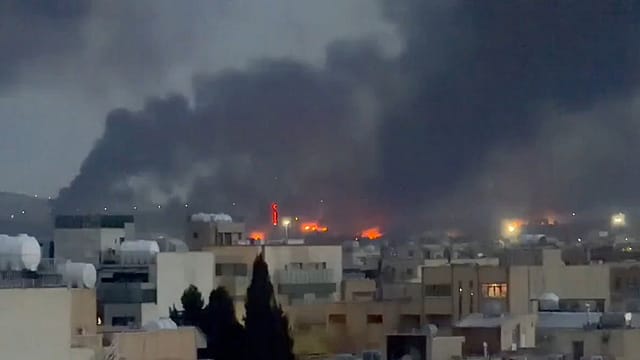
Fresh hostilities in the Middle East unfolded early Sunday as the central Iranian city of Isfahan was targeted by further raids while missile interceptions and drone strikes were reported across several parts of the region.
Al Jazeera reported that Isfahan was struck during the early hours of Sunday morning.
Visual evidence from the scene, including videos and images verified by the news outlet, showed clouds of thick smoke rising over the city as dawn broke. One video clip captured military jets flying low over the area.
Meanwhile, Israeli air defences intercepted two separate waves of missiles aimed at the southern regions of the country within the last hour.

The Modi Years
02 Oct 2026 - Vol 05 | Issue 40
A Nation Rebuilt
According to Al Jazeera, citing Israel's Ynet News, the aerial threats were neutralised before they could cause harm to populated areas.
The Israeli Home Front Command confirmed that there were no casualties resulting from the incidents. The military, however, remains on high alert as projectile launches continue to threaten various parts of the territory.
Sirens were also activated across central Israel. Al Jazeera, drawing on reports from Ynet News, said the alarms were triggered by a projectile launched from Lebanon, which was subsequently intercepted by defence systems.
The incidents come amid escalating hostilities involving the Islamic Republic, Israel and the United States.
Iran's Islamic Revolution Guards Corps said it had carried out the 51st wave of Operation True Promise 4, launching a barrage of missile strikes against US military installations throughout the region as a reprisal for continuing American-Israeli hostilities, according to state broadcaster Press TV.
The IRGC said the phase of the offensive used a strategic mix of liquid-fuel and solid-fuel missiles.
The weapons were directed at US terrorist army forces stationed at the Al Kharj Air Base in Saudi Arabia, a facility the IRGC claims has served as the "origin of aggressions against the Islamic homeland."
State media reported that the Al Kharj base functioned as a critical staging ground for US F-35 and F-16 fighter jets involved in recent incursions into Iranian territory.
The site reportedly houses fuel supply aircraft and serves as the primary hub for American AWACS surveillance planes.
At the same time, an operation conducted by the Khatam al-Anbiya Central Headquarters saw the fiftieth wave of strikes target several other US terrorist army bases across the Middle East.
The targeted locations included the Al Dhafra Air Base and Fujairah in the UAE, Jufair in Bahrain, Ali Al Salem Air Base in Kuwait, and the Al Azraq Air Base in Jordan. Early warning radar systems designed to protect the Zionist regime were also engaged.
How did the IRGC Aerospace Force carry out drone strikes on US bases
A spokesperson said the operations were carried out by the IRGC Aerospace Force using explosive and precision-strike drones.
The official said "our lethal drones are pursuing, point by point, the hiding places of terrorist soldiers of the US army in the region," adding that the military would "precisely target every single American terrorist in the region" after gathering intelligence.
Iranian authorities also reported additional developments in the air defence campaign.
Tehran announced that four more enemy drones had been intercepted and destroyed in recent hours, bringing the total number of downed enemy aircraft to 118 since the start of the conflict.
The IRGC Public Relations department claimed that the "defeated American-Zionist enemy" has shifted its focus to "cowardly attacks on civilian industries" after failing to overcome Iran's armed forces.
The organisation said that over the last 48 hours civilian factories had been targeted, leading to the deaths of "a number of dear workers who were engaged in production and earning lawful sustenance were martyred while fasting."
How severe is the civilian damage in Iran amid US and Israeli bombardment during the conflict?
In response, the IRGC demanded that the "defeated American regime" evacuate all US industrial facilities in the region and advised residents near factories with American shareholders to leave temporarily.
Diplomatic pressure also intensified as Iranian Foreign Minister Abbas Araghchi called on neighbouring states on Saturday to expel US forces from the Middle East.
He said the regional US security umbrella "has proven to be full of holes and inviting rather than deterring trouble," urging neighbours "to expel foreign aggressors."
The humanitarian impact of the conflict continues to grow. Iran's Red Crescent Society reported that more than 24,500 civilian structures across the country have been damaged by US and Israeli bombardment.
The damage includes nearly 20,000 homes, 4,500 businesses and 69 schools. Authorities said 154 people have been confirmed dead while hundreds of students and teachers were injured.
Operation True Promise 4 was launched following the February 28 aggression by US and Israeli forces, which targeted mosques, hospitals and schools.
Since then, the IRGC said it has deployed a wide range of weapons systems, including Fattah hypersonic missiles and Khorramshahr-4 missiles capable of carrying warheads of up to two tonnes.
(With inputs from ANI)