Frank O Gehry (1929-2025): The Architect of Guggenheim Museum Bilbao
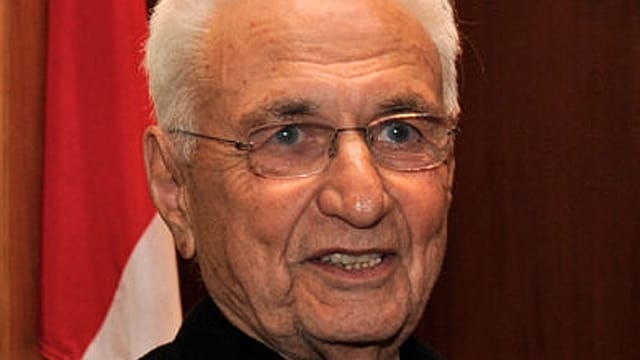
Titanium, the preferred metal for prosthetics, is light and strong as well as biocompatible and resistant to the elements. Frank Owen Gehry, who died at home in Santa Monica, California, on Friday, December 5, at 96, revived the fortunes of a forgotten industrial powerhouse with, largely, titanium. He even bequeathed a term to urban planning: the “Bilbao effect”. The artefact in question is the Guggenheim Museum Bilbao, a building that shocked and awed the world when it opened in 1997 with its distorted titanium-wrapped silvery forms seeming to rise out of the ground, or the watery moat surrounding it, bent out of shape and yet alive, challenging the eye to imagine it in an impossible 360-degree perspective. It telegraphed one message above all: architecture had returned to its emotional core, screaming, and unashamed to proclaim its wild exuberance.
Gehry designed many art-redefining structures after Bilbao but he was already famous. In 1978, he had finished building his own house in Santa Monica by tearing up and rebuilding a simple wood-frame bungalow with corrugated metal, chain-link fencing and plywood. He was a pioneer among architects in embracing computer-enhanced design and among his more famous works are the Walt Disney Concert Hall in Los Angeles (2003), the Fondation Louis Vuitton in Paris (2014), the Lou Ruvo Center for Brain Health in Las Vegas (2010), Hotel Marqués de Riscal in Elciego in Spain (2006), the New World Center concert hall in Miami (2011), etc. While these were all post-Bilbao creations, buildings like the Dancing House in Prague (1996) or the fish sculpture in Barcelona, El Peix (1992), or the Vitra Design Museum (1989), in Germany with its contorted white stucco forms, had already broadcast how architecture could use violent shapes and crude, clashing forms to extract a new aesthetic out of these. The result has often been called a new Baroque. And his buildings resembled sculptures more than architecture.

The Abandoned Kejriwal
01 May 2026 - Vol 04 | Issue 69
Brain drain from AAP leaves Arvind Kejriwal politically isolated
Not everybody was enamoured of him though. Critics thought he was too famous for his own good or that he made architecture more about the architect’s celebrity signature, or “brand value”. But for all that, it couldn’t be denied that Gehry was doing something new or rediscovering what architecture had lost through much of the 20th century, with ugly utilitarianism in the socialist sphere of influence and a postmodernism that had run out of ideas and ceased to be original in the West. The clashing forms of his works, with their hint of violence done to them, reflected the postwar social upheavals Gehry had lived through. He was “rebelling against everything” he had told the <New York Times>, not least the starkness of modernist architecture that to him didn’t feel connected to life. His own works defy the easy binary of beautiful and ugly. Rather, they grab the viewer attention and hold on to it. The result is an experience, a complicated one not easy to define. But it’s been known to leave people changed.

Two attributes of Gehry’s work, by his own admission, go back to his childhood. His love of everyday materials came from working in his grandfather’s hardware store as a child and the recurrence of the fish imagery owes to the live carps his grandmother would bring home from the market and he would play with till it was killed to make gefilte fish.
Frank Gehry was born Frank Owen Goldberg in Toronto to a Jewish family of very modest means which moved to warmer Los Angeles in the 1940s on the advice of his near-alcoholic father’s doctor after a heart attack blamed on an argument between father and son.
Having begun late, Gehry was still evolving late into is career, taking up 3D modelling. In 1989, at 60, he received the Pritzker Architecture prize for lifetime achievement, a kind of architecture Nobel. And that was almost a decade before Bilbao. The citation noted: “His designs, if compared to American music, could best be likened to Jazz, replete with improvisation and a lively unpredictable spirit.”
In the last analysis, Gehry was that rare thing: a genuine rebel. An original.
When critics called the Walt Disney Concert Hall, with its cocoon-shaped interior and a metalled exterior looking like sails in the wind, things like a “pile of broken crockery” or a “fortune cookie gone berserk”, Gehry retorted in the <New Yorker> “At least they’re looking!”
Bilbao will be grateful for a long time. As will architecture, which was redeemed as an instrument of a city’s economic and cultural rebirth.