Explained: Why the India-US Critical Minerals Deal Is Strategically Important
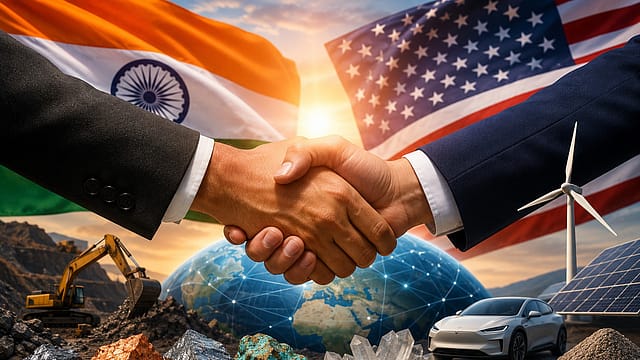
India and the United States have signed a landmark bilateral framework focused on securing the supply, mining, and processing of critical minerals and rare earth elements — resources that are increasingly central to the global technology, clean energy, and defence sectors.
The agreement, announced after bilateral discussions and the Quad Foreign Ministers’ meeting, reflects growing strategic coordination between New Delhi and Washington as both countries seek to reduce dependence on concentrated global supply chains dominated by China.
What Was Announced?
External Affairs Minister S. Jaishankar confirmed that India and the US had formalised a new framework to deepen cooperation across the critical minerals ecosystem.
“We are today signing a bilateral India-US framework on securing supplies of mining and processing of critical minerals and rare earths,” Jaishankar said.
The agreement aims to expand collaboration not only in mining and extraction, but also in processing, recycling, financing, and long-term supply-chain management.

Look Who's Talking Regime Change
23 Oct 2026 - Vol 05 | Issue 43
Why Critical Minerals Matter
Critical minerals and rare earth elements are essential components used in advanced technologies including electric vehicles, semiconductors, batteries, solar panels, smartphones, aerospace systems, and military equipment.
As countries push toward clean energy transitions and advanced manufacturing, control over these materials has become a major geopolitical and economic priority.
The issue has gained urgency because China currently dominates much of the global rare earth processing and refining market, giving Beijing significant leverage over global supply chains.
Against this backdrop, India and the US are attempting to build alternative and more resilient supply networks.
Quad Focus on Supply Chain Security
Jaishankar said the issue of critical minerals was also prominently discussed during the Quad Foreign Ministers’ meeting, underlining how supply-chain resilience is becoming a central strategic issue in the Indo-Pacific.
“Very timely and critical,” Jaishankar said while describing efforts to secure these resources through bilateral partnerships, the Quad framework, and broader coalitions of like-minded nations.
The Quad grouping includes India, United States, Japan, and Australia, all of which are seeking to diversify supply chains in strategic sectors.
What the Framework Covers
According to Jaishankar, the partnership will extend across the entire value chain of critical minerals and rare earths.
“It will strengthen resilient and diversified supply chains, help us to collaborate on financing and with the effective management of critical minerals and rare earths,” the External Affairs Minister added.
The agreement is expected to encourage investments, improve technological collaboration, and create mechanisms for long-term resource security between the two countries.
The framework could also help India strengthen its domestic processing capabilities — an area where many countries remain dependent on external suppliers despite possessing mineral reserves.
Strategic Signal to China
Although China was not directly named during the announcement, the move comes amid widening global concerns over excessive dependence on a single supplier for strategically important materials.
Over the past few years, several Western countries and Indo-Pacific partners have intensified efforts to establish alternative supply chains for semiconductors, batteries, and rare earth processing.
The India-US framework is likely to be viewed as part of that broader geopolitical realignment.
Washington Calls India a Strategic Partner
US Secretary of State Marco Rubio described the agreement as a concrete example of the growing strategic partnership between Washington and New Delhi.
“I have spoken often during my time here over the last few days about the strategic alliance between the United States and India and how important that is for our national interest in the United States. And today is a tangible example of it,” Rubio said.
He added that both countries share strategic interests in ensuring reliable long-term access to critical minerals that are essential for innovation-driven economies.
Why This Agreement Matters
The India-US agreement signals that critical minerals are no longer just an industrial or trade issue, but a major geopolitical priority tied to national security, economic resilience, and technological leadership.
For India, the framework could accelerate efforts to become a more significant player in global supply chains while supporting domestic manufacturing ambitions.
For the US, closer cooperation with India offers another pathway to reduce dependence on concentrated global suppliers and strengthen Indo-Pacific partnerships at a time of intensifying strategic competition.
(With inputs from ANI)