EXPLAINED | Musk’s Texas Bet Failed. What Happens to Tesla, SpaceX and His AI Plans?
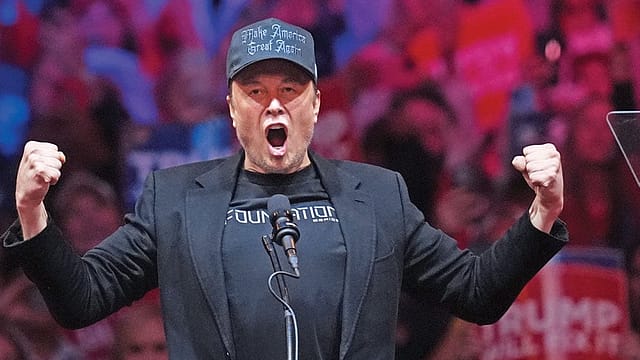
Elon Musk had a suggestion after the election: “Data centers in space looking pretty appealing right now.”
Back on Earth, his companies face a more complicated political map. Texas voters elected Democrats to the US Senate and governor’s mansion, while Democrats won control of both chambers of Congress. Musk had poured hundreds of millions of dollars into Republican efforts.
His businesses now face questions about how they win public contracts, use public resources and expand. Understanding the consequences starts with separating the powers of a governor, Congress and the president.
What exactly happened in Texas?
Democrat James Talarico defeated Republican Ken Paxton for a US Senate seat. Gina Hinojosa defeated Republican governor Greg Abbott. Those are separate offices with different responsibilities.

The Era of Forever Wars
30 Oct 2026 - Vol 05 | Issue 44
Coping with an explosive Middle East
Talarico goes to Washington to legislate and participate in federal oversight. Hinojosa takes charge of the state executive. Her campaign promise to pause data-centre approvals therefore deserves particular attention.
Texas is home to Tesla’s headquarters and SpaceX’s Starbase. Musk has concentrated important parts of his business empire in a state whose incoming leadership is challenging the terms of technology-led expansion.
Did Musk really spend $224 million on one Senate race?
That description compresses two different figures.
A New York Times analysis published on November 2 counted approximately $212 million supporting Paxton through Musk’s donations or America PAC’s disclosed spending. Another $12.3 million went to Texas political groups, taking the wider Texas total to roughly $224 million.
The same analysis put his disclosed federal and state political contributions during the cycle at $474 million. Its federal records ran only through October 14, so these were incomplete pre-election estimates.

Much of the money moved through political groups. A super PAC can accept unlimited contributions to fund independent political activity. Spending classified as independent cannot be coordinated with a candidate’s campaign. Supporting Paxton through such groups is different from handing his campaign a $212 million cheque.
Why are data centres at the heart of this?
A data centre houses computers that store information and run services, including AI. Those machines need electricity and cooling. Larger projects can require new power infrastructure and substantial water supplies, depending on their design.
Hinojosa wants approvals paused until lawmakers establish community protections. Her platform also calls for ending large tax giveaways. The immediate business questions concern how long approvals remain frozen, what conditions replace the pause and who pays for supporting infrastructure.
There is an important complication: Abbott had already restricted some approvals. The Texas Tribune reported pauses affecting grid connections and environmental permitting during an audit. His administration also sought information on water use, incentives and developers’ own power supplies.
The incoming governor could extend or reshape those restrictions. The backlash over resource use had already forced action under Republican leadership.
How does that affect SpaceX’s AI ambitions?
SpaceX acquired xAI in February 2026. The company confirmed the acquisition in an announcement, making the connection between rockets and AI a matter of corporate structure.
Geography matters, too. Reuters reported that its Colossus facilities are near Memphis, while planned expansion includes facilities at Starbase in Texas. A Texas restriction cannot automatically be applied to its entire computing network.
The scale explains the stakes. SpaceX reported 1.7 gigawatts of rated power capacity for computing at September-end. On its October earnings call, Musk said he would be surprised to bring on less than 13 gigawatts by the end of 2027. These are company-wide figures, with the latter an ambition.
The commercial risk is delay. Computers ordered for a new facility cannot earn their expected revenue there until the building has the necessary approvals and power. Financing, construction and equipment commitments can continue consuming money while the operating date moves.
That is the mechanism to watch. A campaign promise alone cannot establish which individual project will be delayed or by how long.
Where does Tesla fit in?
Tesla needs computing power for its own ambitions. Its October quarterly update said it planned to reach 400 megawatts of AI training compute by year-end, supporting software for vehicle and humanoid-robot autonomy.
The company also reported deploying Cybercabs in its Austin Robotaxi fleet. That connects its future products to computing infrastructure and regulatory decisions, beyond the factories assembling cars.
Vehicle safety was already under examination before this election. In October 2025, federal regulator NHTSA opened a preliminary evaluation into reported traffic violations involving Tesla’s FSD driver-assistance system, including red-light and wrong-way incidents.
Tesla’s latest update explicitly says FSD (Supervised) requires active driver supervision and does not make the vehicle autonomous. Political scrutiny of such systems sits alongside the regulator’s technical work.
Can Democrats take away SpaceX’s government contracts?
Congressional control gives Democrats stronger tools to examine government spending and contracting. Committees can seek documents and testimony through investigations connected to their legislative responsibilities.
Before the vote, Democratic lawmakers had signalled interest in Musk’s government contracts and his leadership of the Department of Government Efficiency, according to the New York Times.
SpaceX’s public business involves operational commitments. NASA’s September announcement of three additional astronaut missions put its Commercial Crew contract’s total value at $5.92 billion, with performance running through 2030. That is the value of that contract, not SpaceX’s annual government revenue.
An investigation does not itself terminate it. Any change requires a separate contractual, administrative or legislative process. NASA’s need to transport astronauts also remains a practical consideration.
Can Trump still shield Musk?
Trump remains president. He retains executive authority and can veto legislation. Overriding a veto requires two-thirds support in both chambers, a much higher threshold than winning a simple majority.
But presidential support does not remove Congress’s investigative powers. Nor does the presidency directly control every state approval involved in a Texas construction project.
Musk, therefore, faces several negotiations at once: with congressional committees, federal agencies and state authorities. Each has a different set of powers and procedures.
Why does this matter to India?
India is attracting the same infrastructure. A February government backgrounder listed Google’s proposed one-gigawatt AI hub in Visakhapatnam among major technology investment commitments.
The Texas dispute supplies questions Indian states should ask while courting projects: who funds grid upgrades, how cooling affects local water supplies, what tax concessions cost and how residents participate in decisions.
It would take separate investment decisions to turn American delays into Indian gains. The immediate lesson concerns how governments negotiate the costs and benefits of hosting AI infrastructure.
How soon could Musk’s political defeat hit Tesla and SpaceX?
January brings the change in political power. New congressional terms begin on January 3, 2027, and Hinojosa takes office on January 19.
For Musk’s expansion plans, the squeeze could come through longer waits for approvals, fewer tax breaks or higher bills for connecting projects to the grid. Those changes could push back new computing capacity and make it more expensive to build.
In Washington, congressional investigations could require documents and testimony about his companies’ federal dealings. Musk could face tougher scrutiny while negotiating the permissions and costs of his next expansion.