EXPLAINED | How Did Serbia’s Students Defeat Aleksandar Vučić?
In Belgrade, the traffic stopped again.
Crowds filled the streets. Car horns sounded. People danced and fireworks lit the sky. After almost two years of protests, Serbia’s students were celebrating an electoral victory.
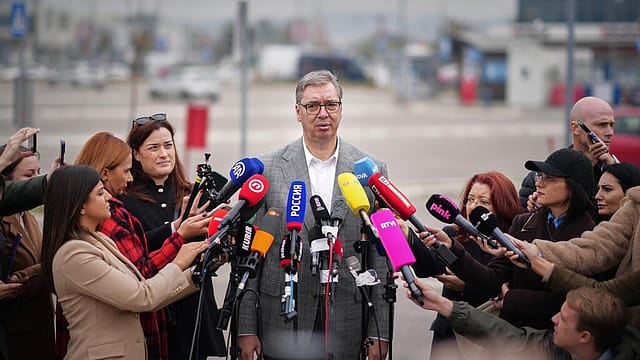
Aleksandar Vučić, the politician who had dominated their country for more than a decade, had conceded.
“We still do not have final results… it is clear that we have lost these elections,” he said on October 25.
The movement that began with demands for answers about a collapsed railway station canopy had defeated his political camp.
“This will be a free state,” its leading candidate, Ilija Srdanović, said.
Losing Memory
16 Oct 2026 - Vol 05 | Issue 42
The making of a medical and social emergency
The celebrations carried enormous expectations. Meeting them will require decisions about who governs, how power is exercised and what accountability means after years of confrontation.
FIRST, WHAT EXACTLY HAVE THE STUDENTS WON?
A parliamentary election.
Serbians were electing representatives to the 250-member National Assembly. In his concession, Vučić estimated that the Student List would secure between 135 and 140 seats, against approximately 105 for his camp.
Those were preliminary projections, rather than certified final results. But the significance was clear: 126 seats constitute a majority, putting the student-backed movement on course to form a government.
A concession acknowledges defeat. The formal process still involves final results, the constitution of parliament and the election of a government.
Under Serbia’s Constitution, the president proposes a prime ministerial candidate after consulting representatives of the elected lists. Parliament then votes on the proposed programme, prime minister and ministers. A majority of all deputies must approve.
WASN’T VUČIĆ THE PRESIDENT? HOW COULD HE LOSE A PARLIAMENTARY ELECTION?
He had already resigned from the presidency.
Vučić stepped down on September 27 to pursue the prime minister’s job through the parliamentary election. Having been elected president twice, he could not seek another presidential term.
He had previously served as prime minister from 2014 to 2017 before moving to the presidency. His party’s participation in government stretches back to 2012, explaining why reports variously describe 12 years of his personal dominance and 14 years of SNS rule.
His plan was to return to the office that runs the government. The parliamentary defeat has blocked that route. This was therefore a defeat of his bid to continue governing through another office.
HOW DID A RAILWAY STATION BECOME THE CENTRE OF A NATIONAL REVOLT?
On November 1, 2024, a concrete canopy collapsed at Novi Sad railway station. Sixteen people ultimately died.
The station had undergone renovation. For protesters, the disaster raised questions that reached well beyond a single structure: who authorised the work, how public money was spent and whether powerful people would face scrutiny.
The tragedy became a symbol of alleged corruption and negligence.
That gave the movement a concrete starting point. Its demand concerned something every citizen should be able to expect: a public building that is safe, and authorities who explain themselves when it fails.
Vučić and SNS have repeatedly denied corruption. Establishing responsibility for the disaster remains a matter for investigation and judicial proceedings. The election determined who should govern; it did not deliver individual criminal verdicts.
WHY DID THE PROTESTS KEEP GROWING?
They developed a structure capable of sustaining participation.
The movement was organised through student assemblies, or plenums. Its constituency expanded to include farmers, actors, judges and others beyond university campuses.
There were practical methods used behind that expansion: door-to-door campaigning, peaceful marches, coordinated messaging and rotating public representatives to reduce individuals’ exposure to smear campaigns.
That helps explain the movement’s durability. Anger can bring people to one demonstration. Repeated meetings, local networks and shared responsibilities make it easier to organise the next one.
Over time, participation also gives people opportunities to discover how widely their concerns are shared. A protest becomes politically stronger when people see neighbours, colleagues and families joining it.
ARE STUDENTS ABOUT TO RUN THE COUNTRY?
“Student-led” describes the movement’s origins and organisation. Its parliamentary candidates come from a much wider pool.
They include doctors, academics, actors, farmers and sporting figures. Srdanović, the first candidate on the list, is a cardiology professor from Novi Sad.
Other prominent candidates include former basketball star Dejan Bodiroga and former central bank governor Dejan Šoškić.
The list’s leading name is not automatically its choice for prime minister. That decision remained unresolved in the reporting available after the election.
The approach allowed the students to offer voters a governing alternative drawing on professional experience across society. It also creates an immediate challenge: agreeing who will lead that diverse group and how decisions will be made.
WHAT HAVE THEY PROMISED TO CHANGE?
Their programme targets the relationship between political loyalty and public institutions.
It includes action against corruption, removing officials who broke rules while suppressing protests, ending the appointment of party loyalists to lead public enterprises, and freeing the public broadcaster from political control.
These promises concern everyday exercises of power: who gets a public job, who investigates wrongdoing and whose voice reaches the television screen.
Delivering them requires more than replacing officeholders. Recruitment rules, transparent procurement, credible investigations and independent oversight must continue working after the political attention moves elsewhere.
The standard will be whether institutions can scrutinise the new government as effectively as its supporters wanted them to scrutinise the old one.
DID A SURGE IN TURNOUT MAKE THE DIFFERENCE?
Participation was strikingly high.
BBC reported that 64.9 per cent of voters had cast ballots by 6 pm, two hours before polling closed. That was an interim figure, rather than the final turnout.
Long queues formed across Serbia and at overseas polling stations. The mobilisation suggests the movement persuaded people that this election offered a meaningful opportunity for change.
It does not establish which individual groups delivered the victory. That requires detailed results and subsequent analysis.
Nor does the opposition’s victory settle every question about electoral conduct. Independent monitors reported irregularities, including suspected pressure on voters and attempted vote-buying. Those reports require examination alongside the result.
DOES THIS MEAN SERBIA WILL NOW TURN AGAINST RUSSIA?
That conclusion runs ahead of the evidence.
Vučić maintained relations with Russia and China while pursuing Serbia’s stated ambition of joining the European Union. Each relationship carries substantial interests: investment, energy, trade and diplomacy.
The incoming movement has provided fewer details about foreign policy than about domestic reform. Before the election, Reuters reported criticism of its reluctance to spell out positions on EU membership and Kosovo, alongside its stated opposition to sanctions on Russia.
A mandate against corruption does not automatically answer those questions.
European leaders have welcomed the result. How the new government handles its international relationships will become clearer through appointments and policy decisions.