Donald Trump Signals Imminent US-India Trade Deal, Calls PM Modi ‘Good Friend’
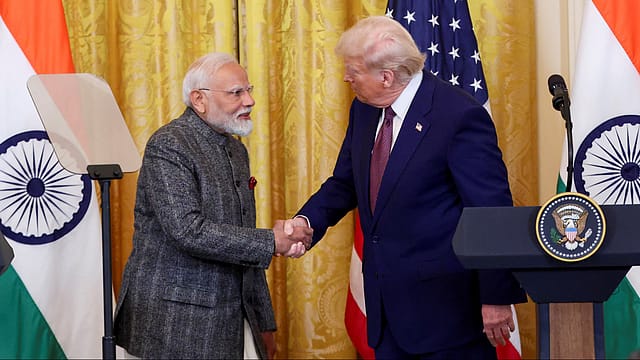
United States President Donald Trump expressed confidence that Washington and New Delhi will soon reach a trade agreement, while describing Prime Minister Narendra Modi as a "good friend".
Speaking to the reporters at White House, Trump said on Thursday, "For years, India took advantage of the United States... They charged us tremendous tariffs and paid nothing…”
“Now it is the exact reverse and we are making a lot of money with India. But we will get to a deal because I like your Prime Minister (Narendra Modi) a lot; he is a good friend of mine, and we get along well. We have a good relationship,” he added.
On Tuesday (local time), the United States announced a fresh slew of additional tariffs of 10 per cent and an additional duty of 12.5 per cent on key global economies, claiming that investigations have revealed goods being imported from 60 countries are produced via forced labour.
The Office of the United States Trade Representative (USTR) listed 54 economies including India-- which it claimed have failed to impose and effectively enforce a prohibition on the importation of goods produced with forced labour.
Which Countries Face Additional US Tariffs Under Section 301 Provisions?
The list includes countries such as Australia, China, India, Israel, Japan, Qatar, and Russia. Other countries listed included Saudi Arabia, Singapore, South Korea, Sri Lanka; Switzerland, Taiwan, Thailand, Turkiye UAE, and the United Kingdom.

Global By Design
29 May 2026 - Vol 04 | Issue 73
Is the future of fashion Indian?
According to the USTR, economies that already have some form of forced labour import prohibition, or have committed to implementing such measures through trade agreements, could face an additional tariff of 10 per cent. Other economies may face a 12.5 per cent additional duty.
The proposed action also includes a textile mechanism that would allow a certain volume of apparel and textile imports from some economies to enter the US at a reduced Section 301 tariff rate.\
As per the USTR, the action comes under Section 301 of the Trade Act of 1974, which allows measures to be taken over 60 economies over their acts, policies and practices related to the failure to what it called impose and prohibit goods produced with forced labour--calling it unreasonable and a burden on US commerce.
The USTR flagged 6 economies for having failed to effectively enforce a prohibition on the importation of goods produced with forced labour. These include the European Union, Pakistan and Canada.
(With inputs from ANI)