Can Justice Drive Growth? CJI Surya Kant's 'Nyanomics' Pitch Wants BRICS to Find Out
What makes a country prosperous?
Is it natural resources? Geography? A large population? Cheap labour?
Chief Justice of India Surya Kant believes the answer lies somewhere else.
In the predictability of a contract. In the trust that a dispute will be resolved fairly. In the confidence that institutions will function when tested.
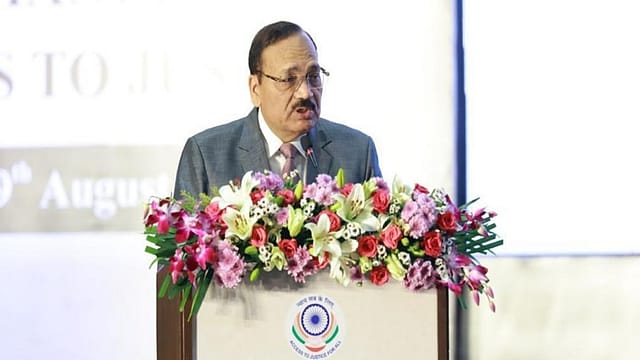
And that is why, standing before legal experts, judges and policymakers at the 11th BRICS Plus Legal Forum in New Delhi on Saturday, the Chief Justice introduced a new term.
"Nyanomics."
A blend of Nyaya (justice) and economics, the concept seeks to explain something economists and investors have long observed: countries with stronger legal systems often create stronger economies.
The Modi Years
02 Oct 2026 - Vol 05 | Issue 40
A Nation Rebuilt
But that was only half the idea.
The other was "Nyay Setu"—literally, a bridge of justice—designed to connect the legal systems of BRICS Plus nations and make judicial cooperation more deliberate, structured and practical.
What Is 'Nyanomics' and Why Is CJI Surya Kant Talking About It?
The term may be new, but the idea behind it is not.
According to the Chief Justice, economic growth is not built solely on physical assets or natural advantages. It is built on trust.
"I have attempted to coin a term that would perfectly describe the marriage between the rule of law and how it permeates favourable economic conditions—Nyanomics, or more simply the economics of justice," he told delegates.
His argument echoes findings from institutions such as the World Bank and OECD, which have repeatedly linked strong legal institutions, contract enforcement and judicial efficiency to economic development and investor confidence.
The message was simple: when businesses trust courts, investments become easier. When contracts are enforceable, trade expands. When legal systems are predictable, economies grow.
In other words, justice is not merely a constitutional ideal. It can also be an economic asset.
Why BRICS Plus Is Paying Attention to Courts
The timing of the proposal is significant.
BRICS has evolved far beyond its original identity as an economic grouping of Brazil, Russia, India, China and South Africa.
Following its recent expansion, BRICS Plus now represents more than 40 per cent of the world's population and roughly 40 per cent of global purchasing power parity (PPP) output, according to data frequently cited by BRICS institutions and international economic reports.
As trade, investment and infrastructure projects increasingly cross borders, legal disputes inevitably follow.
A company in India may sign a contract with a partner in Brazil. An investor in the UAE may fund a project in South Africa. A technology firm in China may seek arbitration involving parties across multiple jurisdictions.
The question then becomes: how can legal systems cooperate more effectively?
That is the challenge Surya Kant's proposals are attempting to address.
What Is 'Nyay Setu'?
If Nyanomics is the philosophy, Nyay Setu is the mechanism.
"If there is one phrase you absorb into your vocabulary this morning, let it be Nyay Setu," the Chief Justice said.
"A bridge of justice that connects 11 legal traditions which have mutually agreed that trust should be cultivated deliberately rather than awaited passively."
The idea is ambitious.
Rather than treating legal systems as isolated islands, Nyay Setu imagines them as connected institutions learning from one another.
In an era where commercial disputes increasingly cross national boundaries, such cooperation could become more important than ever.
The Two Big Proposals: A Judicial Fellowship and a Shared Legal Library
The Chief Justice's vision was accompanied by two concrete suggestions.
The first is a BRICS Plus Judicial Fellowship.
Under the proposal, judges from member countries would spend short periods observing courts in other jurisdictions. The goal would be to better understand different legal traditions, judicial practices and dispute-resolution mechanisms.
The second proposal is a shared jurisprudence repository.
Drawing on India's extensive digitisation of court records and judgments, the idea is to create a common legal resource that allows courts across BRICS Plus nations to access and learn from important rulings delivered elsewhere.
"A judgment written in New Delhi, Brasilia, or Pretoria need not wait years to inform a bench elsewhere facing an identical question," Surya Kant said.
The proposal reflects a broader global trend. Courts across jurisdictions increasingly look to comparative law and international legal developments while addressing complex issues ranging from technology regulation to commercial disputes.
Why Lawyers Say This Matters
The broader theme of legal cooperation was echoed by SS Naganand, Vice President of the Bar Association of India.
According to Naganand, legal relationships deepen naturally as economic relationships grow.
As investments become more complex and businesses operate across borders, countries need dispute-resolution systems that are efficient, affordable and accessible.
"The establishment and development of the BRICS Legal Forum provides an excellent opportunity to understand each other's legal systems, learn from each other's experience and explore how we can make dispute resolution between our countries simpler and more effective," he said.
Naganand also highlighted the Bar Association of India's initiative to establish a BRICS Arbitration Centre in New Delhi, aimed at strengthening cross-border dispute resolution among member countries.
Why This Matters for India's BRICS Chairship
The proposals come at a significant moment.
India is chairing BRICS in 2026 for the fourth time, after previously holding the position in 2012, 2016 and 2021, according to official BRICS and Ministry of External Affairs records.
New Delhi has chosen "Building for Resilience, Innovation, Cooperation and Sustainability" as the theme of its chairship, reflecting the people-centric approach articulated by Prime Minister Narendra Modi at the 2025 BRICS Summit in Rio de Janeiro, according to government statements.
Against that backdrop, Surya Kant's intervention is notable because it broadens the conversation beyond economics and geopolitics.
It suggests that the future of international cooperation may depend not only on trade agreements and investment flows, but also on something less visible.
The quality of justice.
Because if Nyanomics is right, the rule of law is not just about what happens inside a courtroom.
It may also help determine what happens outside it—in factories, boardrooms, startups, infrastructure projects and economies across the world.
(With inputs from ANI)