Trump Says He Will "Finish Up" Iran War the "Nice Way or Not-So-Nice Way"
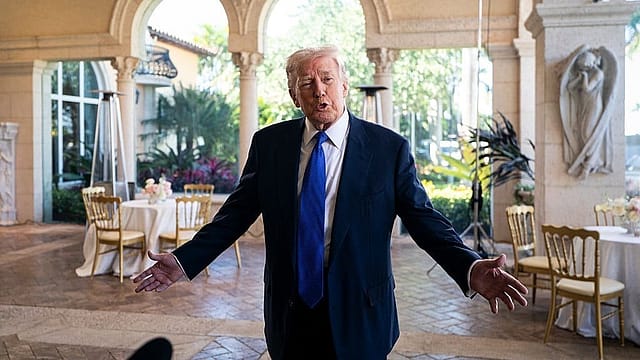
US President Donald Trump said on Tuesday that the Iran war will be brought to an end, with the only question being whether it happens the "nice way" or the "not-so-nice way."
Speaking at Sparrows Point in Maryland, Trump claimed Iran's military had been severely weakened and described the country as the former "bully of the Middle East."
"We're doing extremely well in the Islamic Republic of Iran, very well. They have no military. It's shot; the whole place is shot," he said.
"But we have to finish up. And it's only a question of which way do we want to do it, the nice way or the not-so-nice way? And pretty soon you'll find out."
The Modi Years
02 Oct 2026 - Vol 05 | Issue 40
A Nation Rebuilt
Trump was at Sparrows Point to announce a new shipyard as part of efforts to rebuild the US maritime industrial base. Defence Secretary Pete Hegseth said it would be "the largest US shipyard since World War II."
The project involves a $3.7 billion investment from Anduril Industries and up to $2.9 billion from the US Navy, under a contract tied to production outcomes. "America is going to remain the undisputed naval superpower of the world," Trump said.
"WALL OF STEEL"
Turning to the US naval blockade of Iranian maritime traffic, Trump rejected the word. "They call it a blockade, I call it the wall of steel," he said. "Not one ship has gotten through to Iran. The only ships that go through are the ones that we let go through, and it's had a huge impact."
He also said the Navy was making sure Iran would never have a nuclear weapon, calling it "already fait accompli."
His remarks echo comments on Saturday outside the White House, where he said he would make a decision on Iran and that it would be "the easy way or the hard way."
HOW THE WAR GOT HERE
The war began on February 28, when the US and Israel struck Iran, killing Supreme Leader Ayatollah Ali Khamenei. Iran retaliated with missile and drone attacks, and its Revolutionary Guard declared the Strait of Hormuz closed, drawing shipping lines out of the waterway. Trump has repeatedly said the war was won. On March 9 he called it "very complete, pretty much."
US and Iranian delegations met in Islamabad but failed to reach agreement, and Trump imposed a naval blockade on Iranian ports on April 13. A June 14 agreement to end the war and reopen the strait was announced, and Trump said he had authorised lifting the blockade. It was reinstated in July.
WHAT THE BLOCKADE HAS DONE
The blockade had halted new Iranian oil exports from the Persian Gulf, leaving Iran dependent on dwindling floating stockpiles. Tehran had lost revenue at around $4.8 billion. Hegseth has said the Navy can maintain the blockade indefinitely.
Iran disputes Trump's account of who controls the strait. It says it effectively controls much of the waterway and has said it intends to impose a toll system.
Fuel prices have become a political problem for Trump ahead of next month's midterm elections, with diesel costs among the issues in play.
THE SHIPPING TOLL
Commercial shipping has paid a price throughout the conflict. On Tuesday, India condemned a projectile strike on the Panama-flagged vessel MT On Peace in the strait, in which 12 of the 19 crew, including 11 Indians, were injured.
With inputs from ANI