Burials Above, Hope Below: Nepal Digs for 46 Workers as Flood Toll Crosses 1,100
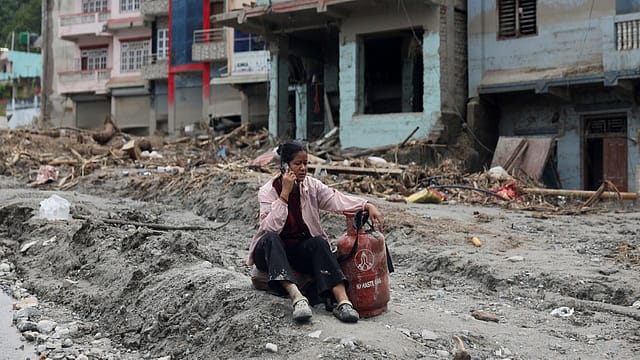
Above the ground, Nepal has begun burying its dead. Below it, rescue workers are still searching for the living.
A week after a glacial collapse unleashed a devastating flood through Nepal’s northern mountains, rescuers believe that 46 workers trapped inside a chamber at the Rasuwagadhi hydropower project may have survived.
“In Rasuwagadhi, we think 46 people are trapped in a room-like structure in the tunnel,” Nepal Electricity Authority board member Amshu Kiran Shahi told Reuters on Wednesday. The room is believed to contain food and water. Rescue teams have not yet been able to reach it through the layers of mud, rock and debris deposited by the August 26 flood, but officials have not surrendered hope. “We are very confident that they must be alive after one week because they have food and water over there in the building,” Shahi said.

Losing Memory
16 Oct 2026 - Vol 05 | Issue 42
The making of a medical and social emergency
The possibility is slender but powerful. Across Nepal, thousands of families are waiting for news that may arrive as a rescue call, a name on a hospital list or a request to identify a body.
For the families of Rasuwagadhi’s missing workers, hope currently lies behind a blocked tunnel.
What is the Latest Nepal Flood Toll?
At least 1,114 people have died across Nepal and China, according to the latest figures reported by Reuters, with the vast majority of deaths recorded in Nepal. Nearly 4,000 people remain missing. Some subsequent reports have placed the combined toll in the two countries at 1,204. However, casualty figures remain fluid as bodies are recovered across an enormous disaster zone and agencies reconcile reports from hospitals, districts and neighbouring countries.
An ANI dispatch citing Nepal’s National Disaster Risk Reduction and Management Authority reported 1,204 deaths in Nepal, but also stated that 1,114 bodies had been recovered. In the absence of a reconciled official breakdown, the confirmed toll should be described conservatively as more than 1,100.
Nepal’s Ministry of Foreign Affairs said approximately 3,900 people remained out of contact. Around 590 foreign nationals from more than 30 countries were among the missing, including tourists, trekkers and pilgrims travelling towards Mount Kailash. More than 300 foreign citizens have been rescued. Nepal has also coordinated with Chinese authorities to evacuate approximately 2,500 Mount Kailash pilgrims through the Hilsa and Tatopani border points and via flights from Lhasa. The numbers will change. The scale they describe will not.
A Wall Came Down the Mountain
The disaster began on the morning of August 26 near the Nepal-China border. Part of a glacier near the Langtang Lirung mountain region collapsed into the valley, sending an immense mass of ice, water, rocks and loosened earth into the river system below. The surge moved through the Bhote Koshi-Trishuli corridor, destroying settlements, bridges, roads and hydropower infrastructure.
The flood struck a border crossing at approximately 8.32 am. Reuters reported that a public alert was not issued until 9.13 am, more than 40 minutes later. In a disaster moving through steep mountain valleys, that interval may have represented the difference between escape and entrapment. At least four river-gauging stations near the border were knocked out. Nepalese officials have acknowledged that monitoring systems existed but were not being watched extensively enough to detect their failure immediately.
The country is now preparing to install seismic sensors, cameras and a satellite communication system at Timure in Rasuwa district. The VSAT connection is intended to keep warning stations functioning even when mobile networks fail. It is Nepal’s first concrete attempt to rebuild the warning system destroyed by the flood. The technology may provide downstream settlements only a few minutes of notice during another landslide or glacial surge. In the Himalayas, a few minutes can still be the distance between a house and higher ground.
Tunnels Beneath 2.2 Million Tonnes of Debris
The flood overran several hydropower projects positioned along the mountain river system. At Rasuwagadhi, a 111-megawatt project approximately five kilometres from the Chinese border, thick deposits of debris have blocked access to tunnels and chambers. The Nepali Army attempted to enter the structure earlier but could not locate the room where the workers are thought to be sheltering. Rescue teams are preparing to enter again.
At Upper Trishuli 3A, search personnel required almost six days merely to identify the entrances to some of the buried tunnels. Officials believe dry spaces inside the structures may have protected workers from the first surge. Nepalese, Indian and Chinese personnel are working alongside experts from South Korea and Australia. Teams are using available detection and excavation technology to penetrate mud, boulders and collapsed structures.
According to a preliminary estimate by the United Nations Development Programme, the flood produced at least 2.2 million tonnes of debris, including sediment, rocks and fragments of buildings. That is roughly equivalent to the weight of six Empire State Buildings.
Removing it is not simply a search operation. It is an excavation of an altered landscape. Around 279 people have been rescued from affected hydropower sites, Reuters reported. At least 639 people connected with the projects remain missing. The rescue effort continues even as the statistical probability of survival diminishes. Tunnels that became traps may also have formed accidental shelters. Until every reachable chamber is opened, Nepal is unwilling to declare that possibility dead.
Families Begin Funerals Without Bodies
Elsewhere, hope has collided with ritual. Families who have spent days moving between hospitals, shelters and mortuaries have begun conducting symbolic last rites for relatives whose bodies have not been found. Some have burned straw effigies so that the missing can receive a farewell even in their physical absence.
Temporary burials of unidentified victims have also begun after DNA samples were collected. Nepal has asked the immediate relatives of missing people to provide DNA samples at the Nepal Police Hospital in Maharajgunj or at their nearest district police office.
A 19-member forensic team from India is assisting Nepal Police with identification. Specialists and equipment from China, Singapore and South Korea have also joined the effort. Identification has become a disaster within the disaster. Bodies have travelled considerable distances along swollen rivers, some reportedly reaching India. Families separated during the flood may have registered the same person as missing in different locations. Foreign nationals must be matched with records and relatives scattered across the world. Until DNA supplies an answer, a family may possess neither the relief of survival nor the certainty required for mourning.
The disaster struck a region carrying an unusual mixture of local workers, border traders, trekkers, tourists and religious pilgrims. Mount Kailash in Tibet is sacred to Hindus, Buddhists, Jains and followers of the Bon tradition. Pilgrims travelling through Nepal towards the mountain were caught when roads, bridges and border infrastructure collapsed.
Approximately 590 foreign nationals from 34 countries remained missing, according to the Nepalese foreign ministry update cited by ANI. Other international compilations have placed the number slightly higher as authorities continue reconciling lists. Governments are asking relatives to provide photographs, passport details, travel itineraries and DNA profiles. Every corrected name reduces one list and reshapes another. For many families abroad, the last trace of a missing relative is a hotel booking, a telephone signal or a photograph taken on the way to a sacred mountain.
The Warning Nepal Could Not Hear
Prime Minister Balendra Shah has described the flood as evidence of the escalating climate danger confronting the Himalayan region. The immediate trigger was a glacial collapse, although scientists continue to investigate the precise sequence of ice failure, landslides and water accumulation. The broader vulnerability is clearer. Rising temperatures are accelerating glacial retreat, destabilising rock faces and increasing pressure around glacial lakes and natural barriers.
A 2020 assessment identified 47 potentially dangerous glacial lakes across Nepal, India and China. United Nations officials now believe the real number may be considerably higher. Millions of people live along river systems that begin in these rapidly changing mountains. The danger crosses borders long before the water does.
Nepal had sought greater real-time cooperation with China over glacier movement, water levels and high-altitude hazards before the catastrophe. Since the flood, Beijing has shared satellite imagery, hydrological information and data on upstream barrier lakes, according to Reuters.
The flood has exposed how disaster warnings are divided by geography while Himalayan river systems are not. A glacier can collapse in one jurisdiction, destroy a border post in another and carry bodies into a third country. Climate adaptation here cannot end at a customs gate.
Seven days after the flood, Nepal is living by two clocks. The first belongs to the missing. With each passing hour, the likelihood of survival falls. Rescue teams continue digging because tunnels, dry chambers and pockets within collapsed structures can preserve life beyond ordinary expectations. The second belongs to the mountains. Sensors must be restored, rivers monitored and information shared before unstable slopes or newly formed barriers unleash another surge.
There are burials to complete, bodies to identify, pilgrims to evacuate and communities to rebuild. Nearly 4,000 names remain suspended between casualty lists and rescue registers. Somewhere inside Rasuwagadhi, 46 workers may have food, water and a room that held when the mountain above them did not. Nepal is still digging towards them.
With inputs from ANI & agencies