Beyond current violence, India awaits a post-poll Govt in Bangladesh
The chain of violent events in Bangladesh following the murder of Inqilab Moncho leader Osman Hadi that resulted in the death by lynching of a Hindu youth Dipu Das created fresh tensions in India-Bangladesh ties but New Delhi remains focussed on the February elections that it hopes will deliver an elected and accountable government in Dhaka.
On Friday, ministry of external affairs spokesperson Randhir Jaiswal while condemning the murder of Das and expressing grave concern over “unremitting hostility” against minorities like Hindus, Christians and Buddhists at the hands of extremists said India supports free and inclusive elections in Bangladesh.
Jaiswal’s comments on the scheduled elections came in the context of the return of Bangladesh Nationalist Party (BNP) leader Tarique Rehman after 17 years of self-imposed exile. “As you are aware, India supports free, fair, and inclusive elections in Bangladesh. This development (Rehman’s return) must be seen in or should be seen in that context,” said Jaiswal.
Tarique Rahman’s return
Seen as political heir to his mother, the ailing former Prime Minister Khaleda Zia, Rehman’s return to Dhaka was greeted with a strong outpouring of BNP supporters. India’s call for an “inclusive” election does indicate support for the participation of the banned Awami League as well as BNP but the view in New Delhi is that a government led by an established party will be a welcome development.
The initial public support for Rahman indicates that BNP could well be the front runner in the February election, well ahead of Jamaat-i-Islami and other smaller groups. If Awami League is not in fray, a government led by BNP is very much on the cards and it is felt that this would bring back a measure of predictability to India’s diplomatic interactions with Dhaka. It is unlikely that Awami supporters, who are currently lying low, will back radical parties.

Iran After the Imam
06 Mar 2026 - Vol 04 | Issue 61
Dispatches from a Middle East on fire
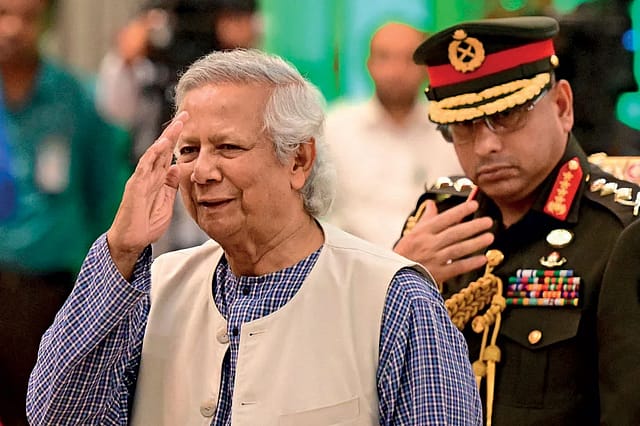
The overthrow of Awami League leader Sheikh Hasina, living in India since she fled Bangladesh last year, led to the installation of a weak administration headed by Nobel Laurette Mohammad Yunus who remains hostage to radical political activists and has encouraged anti-India elements. In a situation where mob rule often prevails, the possibility of an elected government headed by a regular political party would be a marked improvement.
A Predictable Government
The death of Hadi, a known India-baiter, exposed the inability of Yunus to reign in inflammatory rhetoric and anti-Hindu violence with Jaiswal stating that 2,900 incidents have been recorded since the interim government took charge. Hadi intended to contest the February elections and his brother’s charge that a section within the interim government orchestrated the killing points to the atmosphere of distrust and violence in Bangladesh.
The proper conduct of elections in Bangladesh – so that the results are representative if not perfect – is India’s top priority. The possibility of outbreaks of violence being used as an excuse to put off elections indicates how fragile the situation in Dhaka is. Despite his claims that he is committed to holding elections, Yunus has an interest in hanging onto office to secure his interests and play the balancing act with student factions with who he has had on-off relations.
However, political parties and more particularly the Bangladesh Army are insistent on the elections being held and while Yunus might find himself without much choice but to go along the shooting of Hadi demonstrate the challenge at hand. Besides Yunus’s own calculations, the covert actions of Pakistan, which enjoys a new found access, are complicating factors.