Bangladesh: Unsteady Authority
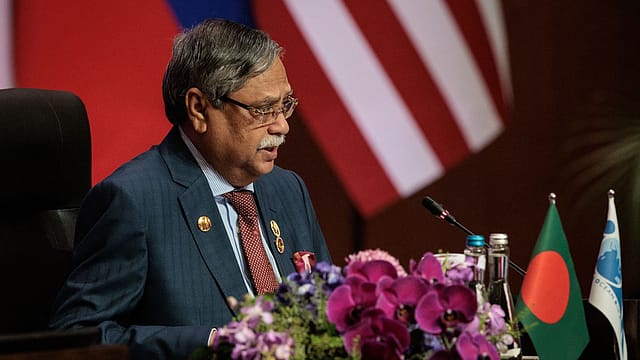
The history of the presidency in Bangladesh is certainly a subject that researchers and political analysts will need to work on. Now that President Mohammad Shahabuddin has resigned, it becomes rather important for citizens to reflect on the way the presidency has evolved or, more precisely, has suffered through the many stormy periods in Bangladesh’s history since the liberation of the country fifty-five years ago.
The record of the presidency speaks for itself. Three men have wielded the powers of the presidency, in circumstances where parliamentary or cabinet government was suspended or simply shown the door. Bangabandhu Sheikh Mujibur Rahman, named President by the Mujibnagar government in April 1971 while he was incarcerated in Pakistan during the War of Liberation, divested himself of his presidential role on 12 January 1972 and assumed office as Prime Minister under a Westminster form of government. Justice Abu Sayeed Chowdhury took over as President.

Losing Memory
16 Oct 2026 - Vol 05 | Issue 42
The making of a medical and social emergency
In January 1975, though, the Fourth Amendment to the Constitution brought about a change in the form of government, with Bangabandhu taking office as a powerful President, particularly in light of the Baksal system inaugurated in the country. Politics went back to the presidential form, a reality which was upheld by the two men who ascended to power, in that order, through an overturning of the constitutional process. General Ziaur Rahman, having emerged as the strongman in the post-November 1975 period, assumed the presidency in April 1977; and General Hussein Muhammad Ershad seized power from Justice Abdus Sattar, the President elected after Zia’s assassination, in a coup in March 1982.
Within moments of the violent coup d’etat of 15 August 1975 which led to the assassination of the Father of the Nation and his family, Khondokar Moshtaq Ahmed, the Minister for Commerce, seized the presidency --- but lasted less than three months --- per courtesy of the rogue soldiers who committed the carnage at 32 Dhanmondi. On 6 November 1975, in a counter-coup led by General Khalid Mosharraf, Moshtaq was forced to resign. Justice Abu Sadat Mohammad Sayem, the country’s Chief Justice, was installed as President. The following morning, Mosharraf and his fellow officers were murdered by renegade soldiers and General Zia assumed power.
Sayem stayed on as President till April 1977, when Zia ensured his departure and himself became President, following which he had his assumption of the presidency validated through a controversial referendum. At the presidential election in June 1978, Zia defeated General M.A.G. Osmany and was sworn in as Bangladesh’s elected head of state. Much a similar circumstance occurred in the 1980s, when General Ershad removed his handpicked President, Justice Ahsanuddin Chowdhury, and assumed the mantle of the presidency. In 1988, in an election boycotted by the Awami League and the Bangladesh Nationalist Party, Ershad was declared elected as President, which office he held till December 1990.
Many have been the episodes, some pretty interesting ones, in the fluctuations of presidential authority. Justice Shahabuddin Ahmed, the Chief Justice of the Supreme Court, replaced General Ershad in 1990, albeit as Acting President, and organised general elections which brought the BNP to power in February 1991. He then returned to his role as Chief Justice. Shahabuddin was elected President for a full term when the Awami League returned to power in 1996 and stayed in office till the end of his term. Meanwhile, the country had returned to the parliamentary form of government, with the presidency reverting to its largely ceremonial position.

Speaking of the episodic nature of the presidency, Justice Abu Sayeed Chowdhury resigned from office in late 1973 and was replaced by Mohammadullah, the Speaker of the Jatiyo Sangsad. Mohammadullah remained in office till January 1975, when Bangabandhu went back to being President. Under Moshtaq, Mohammadullah served as Vice President and later joined Ziaur Rahman’s Bangladesh Nationalist Party. For his part, Abu Sayeed Chowdhury came back to government when he was appointed a minister without portfolio by Bangabandhu on 8 August 1975. Following Bangabandhu’s assassination a few days later, Justice Chowdhury stayed on in the Moshtaq regime, as Foreign Minister when Dr Kamal Hossain, who had been on an official trip to Europe at the time of the coup on 15 August, declined to return home and join Moshtaq. Chowdhury abandoned the Moshtaq regime in late October 1975 while he was away from Bangladesh.
Dr AQM Badruddoza Chowdhury, a physician and founding member of the BNP, was at the Chittagong Circuit House when President Zia was assassinated in a putsch on 30 May 1981. He made a safe exit from there and subsequently aligned himself with Begum Khaleda Zia as she took charge of the BNP. Elected Bangladesh’s President by the BNP majority in Parliament in 2001, Dr Chowdhury declined, from a belief that the head of state ought not to demonstrate partisanship in conducting affairs of state, to visit the grave of General Ziaur Rahman. The move infuriated the BNP leadership, who then exercised pressure on the President to resign. He did and forever became a pariah for his former colleagues in his erstwhile political party.
President Iajuddin Ahmed, another BNP appointee at Bangabhaban, earned public opprobrium when in October 2006, following the exit of the BNP government in preparation for a new general election under a caretaker administration, he appointed himself Chief Advisor of a new caretaker government in addition to being head of state, rather than following the prescribed rules relating to the formation of the caretaker government. In January 2007 the military intervened, compelled him to declare a state of emergency and relinquish the office of Chief Advisor. The parliamentary election of December 2008, under a new caretaker regime, brought the Awami League back to power.
There have been Presidents who have served the nation with dignity and self-assurance. One can cite the instances of Zillur Rahman and Abdul Hamid, two veteran Awami League politicians. The BNP’s Abdur Rahman Biswas, elected President following the election of February 1991, steered the country back to parliamentary democracy. In 1996, with fresh elections ahead, he boldly crushed an army rebellion ostensibly led by the chief of staff, General Nasim, and ensured that nothing unconstitutional interrupted the course of democracy in the country.
Four individuals have so far had the opportunity to serve as Acting Presidents of Bangladesh. In 1971, with President Sheikh Mujibur Rahman under arrest in Pakistan, Vice President Syed Nazrul Islam officiated as Acting President in the Mujibnagar government. Islam was again Vice President from January 1975 to early November 1975, when he and three of his colleagues were murdered in Dhaka Central Jail.
Justice Shahabuddin served as Acting President, having earlier been appointed Vice President by President Ershad when Vice President Moudud Ahmed resigned prior to Ershad’s resignation on 6 December 1990. Between the resignation of President Badruddoza Chowdhury and the election of Iajuddin Ahmed to the presidency in 2002, Jatiyo Sangsad Speaker Jamiruddin Sircar officiated as Acting President. Now that President Mohammad Shahabuddin has left office, it is the current Speaker, Hafizuddin Ahmed, who will exercise presidential authority until a new President is elected by Parliament.
The nation now waits for a new President to be elected, one who can command the respect of all across the political divide. Names of prospective candidates for the office have been flying around. For citizens, it is now a matter of waiting and seeing how the situation pans out.