Araqchi Says Iran’s Nuclear Stance Unchanged; Calls for New Hormuz Protocol
Iran’s stance against the development of nuclear weapons will not significantly change, Foreign Minister Abbas Araqchi told Al Jazeera in remarks relayed by Iranian media on Wednesday, while cautioning that the new supreme leader has yet to publicly express his views on the matter.
Former Supreme Leader Ayatollah Ali Khamenei, who was killed early in the U.S.-Israeli war against Iran, had opposed the development of weapons of mass destruction in a fatwa, or religious edict, issued in the early 2000s.
Western countries, including the U.S. and Israel, have for years accused Tehran of seeking nuclear weapons, while Iranian authorities have maintained that the nuclear programme is solely for civilian purposes.

Rise of the Pivotal Power
18 Sep 2026 - Vol 05 | Issue 38
The BRICS declaration is a strategic victory for Modi
Araqchi said fatwas depend on the Islamic jurist issuing them and added that he was not yet in a position to judge the jurisprudential or political views of Mojtaba Khamenei, Iran’s new supreme leader.
He said he believed that after the war comes to an end, countries bordering the Gulf should draft a new protocol for the Strait of Hormuz to ensure safe passage through the narrow waterway under conditions aligned with Iranian and regional interests.
What Did Iran Tell the UN About Alleged Violations by the U.S. and Israel?
Iran shut the vital energy gateway, through which a fifth of global oil and liquefied gas passes, saying it "won't even allow a litre of oil" to reach the U.S., Israel and their partners.
The Iranian Ambassador and Permanent Representative to the United Nations has formally addressed the global body, asserting that Israel must be held accountable for "ongoing aggression against Iran."
According to state broadcaster Press TV, the envoy’s letter accused the Israeli regime of the "violation of the country's sovereignty and territorial integrity," resulting in civilian deaths and the destruction of vital infrastructure.
In a direct communication sent on Tuesday to UN Secretary-General Antonio Guterres and the President of the UN Security Council, Amir Saeid Iravani emphasised that the "UNSC must accept its fundamental responsibility towards protecting international peace."
He called for a formal investigation into "egregious violations of the UN charter and international law by the US and the Israeli regime," and warned that the "UN Charter must not be weakened by the Israeli regime's normalisation of use of force."
Why Does Iran Call the Attacks a "Brazen Violation of International Law"?
Highlighting the broader regional impact, Iravani said such actions represent a dangerous trend of "aggression towards regional countries."
The letter reaffirmed Iran’s commitment to the UN Charter and international law, while stating that the nation "continues to exercise its inherent right to protect its sovereignty, national integrity, and civilians against any aggression."
Iravani also stressed the "international responsibility of governments to prevent their territory to be used for aggression," calling for "the observance of good neighbourliness" and urging neighbouring states to prevent the "continued use of their territories against the Islamic Republic of Iran."
The correspondence described the military actions as a "brazen violation of international law," and said the UN has a "statutory obligation to condemn the aggression categorically and unequivocally."
He urged the Council to hold the "aggressors accountable in accordance with Chapter 7 of the UN Charter."
How Are the U.S. and NATO Allies Responding to the Strait of Hormuz Crisis?
Providing an assessment of the conflict’s toll, the letter claimed that since February 28, the Israeli regime and the U.S. have killed "at least 1,348 civilians," including "233 women and 202 children."
It also alleged that "19,734 civilian infrastructure" sites have been compromised, including "16,191 living units, 1,617 commercial buildings, 77 medical centres and pharmacies, and 65 schools."
On Tuesday, Iran’s parliament speaker tweeted that the situation in the Strait of Hormuz will not return to its pre-war conditions.
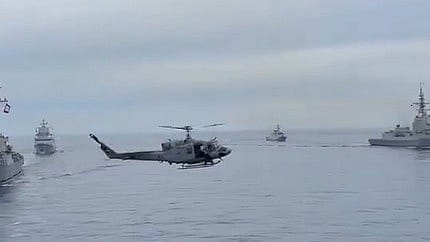
The U.S. has sought to build a naval coalition to escort vessels navigating the strait, with most NATO allies indicating reluctance to get involved in military operations against Iran.
France, a NATO member, said it would only consider a joint international coalition to secure passage through the strait following a ceasefire and prior negotiations with Tehran.
Araqchi said an end to the war would only be conceivable if the conflict is permanently over throughout the region and Iran receives compensation for damages incurred.
Asked about Iranian strikes in the Gulf that targeted U.S. military bases and affected residential or commercial areas, Araqchi said this was because U.S. forces relocated to urban areas.
He acknowledged that regional countries are "upset and their people have been harmed or bothered" by Iranian strikes, but added that the blame lay entirely with the U.S. for starting the war on February 28.
(With inputs from ANI)