A Quiet Revolution
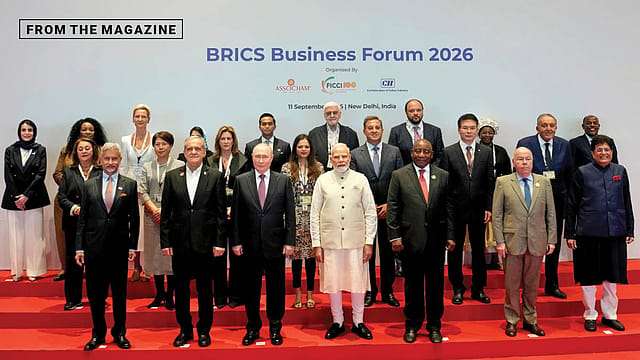
In the action-packed days that marked the 18th BRICS Summit in New Delhi, a chapter of empowerment and success was being scripted under the aegis of the grouping’s Women’s Business Alliance (WBA), an organisation that now has national chapters in almost all member states.
Ideated at a gathering of leaders in Novosibirsk in 2017, the BRICS WBA had come a long way to the New Delhi summit this month. What was once a dream is now an idea that has taken root in all BRICS countries. Speaking at the BRICS Summit on September 13, Avarna Jain, Chairperson of the BRICS WBA, said that “Across BRICS women are building businesses, creating jobs, driving innovation and contributing to growth. The next step is to enable more women entrepreneurs to move from participation to leadership; from small enterprises to scale, and, from success in one market to opportunities across BRICS.”
The occasion was the presentation of the BRICS WBA’s 2026 annual report. Jain, who is Vice Chairperson of Saregama India Limited and Chairperson of RPSG Lifestyle Media, went on to describe women’s empowerment as an economic strategy and not a sectoral issue. The idea has broad resonance in India where the Narendra Modi government has made women’s empowerment a cornerstone of growth through several initiatives that have been rolled out over the years. This theme also resonated in the BRICS Declaration and the WBA was described in glowing terms in the final document: “We note the strong engagement achieved to date across BRICS countries in the WBA’s 2026 programmes. We encourage BRICS National Chapters to continue strengthening intra-BRICS cooperation on women’s economic participation, including through knowledge-sharing and joint initiatives.”
The Modi Years
02 Oct 2026 - Vol 05 | Issue 40
A Nation Rebuilt
The annual report has four broad themes. These are: creating the conditions for women-led enterprises to grow; expanding access to capital and innovation; strengthening resilience through women-led solutions; and taking what works to scale across BRICS. All these themes and the output of the various working groups in the WBA have an obvious appeal in a world beset with uncertainty. The ideas of resilience and scaling up what works across BRICS can go a long way in boosting growth in a diverse group of countries such as the BRICS.
The BRICS WBA has six working groups dedicated to charting a roadmap across a broad range of sectors: innovative development; healthcare; creative industries; food security and environmental safety; inclusive economy and tourism. These sectors cover a vast range of economic activities across all the 11 member countries.
Of special interest to a country like India is the creative industries sector. Jain leads the working group devoted to the sector. By one estimate, India’s creative economy involves 10 million livelihoods and contributes to around 20 per cent of the country’s output as measured on a Gross Value Added (GVA) basis. The span of the creative economy is wide and ranges from advertising, arts and crafts, design, fashion, film, photography, music, performing arts, publishing and television-radio, among a host of other activities. The way economic growth is measured in India often leads to this sector’s contribution being underplayed. But the numbers speak for themselves. Government estimates peg the animation and visual effects sub-sector at an estimated Rs 108 billion, gaming at Rs 232 billion, and live entertainment at Rs 100 billion. These are only some of the sub-sectors. In 2024, the sector was estimated to be around Rs 2.5 trillion and is expected to grow up to Rs 3.06 trillion by 2027.
This sector represents one of India’s unquestioned strengths. Historically, creative industries have been strong in the country. With a large youth population that consumes cinema, music and other products of the creative economy, the growth of this sector is one benefit of India’s demographic dividend. Each BRICS country has its own set of strengths. For India, its creative economy is something unique that it brings to the BRICS table. This is apart from the many other sectors where India is a leader.
Another interesting area where women entrepreneurs are now very active participants is the startup sector. The WBA lists 69 women-led startups in India alone under its umbrella. These include ventures in AI, ecology, education, food security and agriculture, health and medicine, innovation and infrastructure, information technology and sustainable development. These ventures need support in the form of capital, skills, technology and business networks, a point that Jain emphasised in her remarks at the BRICS Summit on September 13.
The point about women’s empowerment is well-taken and has a sound economic logic to it. The issue is that very often the necessary support to nurture women’s enterprises and initiatives lags the stated intentions. Perhaps the time has come that specialised financial institutions and skill initiatives ought to be launched at the BRICS level for women-led enterprises. The BRICS WBA is a much-needed initiative for creating business networks, an essential ingredient if these ventures can reach the scale they can potentially touch. Similarly, the point about women empowerment as an economic strategy makes intuitive sense. Women account for 50 per cent of the population but are often relegated to low productivity sectors such as agriculture in much of the Global South. It makes immense sense to invest capital and technology in women-led enterprises instead of further investments in “saturated sectors”. The growth potential in the former, it goes without saying, is far greater. That is the goal of the BRICS WBA as it marches ahead in these key countries across different continents.