EXPLAINED | Why South Korean education minister resigned over exam cheating scandal
A student who carried a phone into the exam hall was supposed to hand it in. The authorities wanted a way to find phones that candidates had kept. On Thursday, November 19, they used South Korea’s disaster warning system to send three alerts nationwide. A handset set to silent could still sound the alarm. To make a concealed phone ring in one classroom, the government was prepared to make phones ring in homes and workplaces across the country.
The first alert was scheduled for 8.30 am, ten minutes before the exam began. President Lee Jae Myung had also asked officials to consider sending alerts during testing. By 3 pm, three had gone out. The technology could reveal that a phone was present. What the candidate had done with it was a question for investigators.

The Wealth Issue 2026
06 Nov 2026 - Vol 05 | Issue 45
Portraits of Dreamers and Doers under 35
How did a tax exam land half a million university applicants under suspicion?
The trail begins with Han Won-seok, 34, and an exceptionally good result. In April, Han answered 159 of 160 multiple-choice questions correctly in the first stage of South Korea’s tax accountant qualification exam. His score was 397.5 out of 400. He subsequently topped the qualification exam and wrote online about his preparation. His marks drew scrutiny. On November 15, four days before the university entrance test, he admitted using a miniature camera, a smartphone and AI assistance to cheat.
The distinction between the two exams matters. The admission of AI cheating came from the tax exam. The approaching university exam suddenly gave the government four days to answer an uncomfortable question. What assurance could it give a teenager sitting the biggest test of her school career that the person at the next desk would have to do the work unaided? The presidential office convened an emergency meeting and ordered a wider review of suspected AI-assisted cheating in national qualification exams.
Why does South Korea rearrange a working day for the Suneung?
Suneung is the Korean name for the College Scholastic Ability Test, or CSAT. It is a major route into university in a country where the institution a graduate attends can influence early career prospects. For the 2027 admissions cycle, 551,864 candidates registered at 1,312 test centres. The full timetable ran from 8.40 am to 5.45 pm. That is how an examination held in November 2026 came to be called the 2027 Suneung.
Consider what the state had arranged before the cheating scare. It adjusted public transport and work schedules to ease the journey to test centres. Flight schedules were altered to limit noise. The premise was that a traffic jam or an aircraft overhead should have as little influence as possible on a candidate’s score. Then, on the eve of the exam, students were still receiving new instructions about what they could wear and carry.
Why did ordinary spectacles and shirt buttons become a problem?
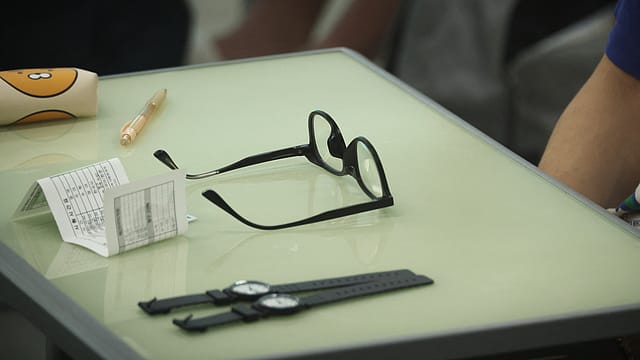
Early speculation about Han centred on smart glasses. His confession identified a miniature camera. That distinction offered little comfort to a supervisor faced with a roomful of candidates wearing prescription spectacles. Officials ordered eyewear inspections. Students had to cover buttons on clothing that could conceal a camera. Even the rules concerning pencils were being updated on Wednesday, the day before the test.
For a teenager who needs glasses to read an exam paper, the practical question was suddenly whether wearing a familiar pair might invite an inspection or a delay. Some students worried about thick frames being mistaken for smart glasses. One candidate quoted by Yonhap in the supplied report chose contact lenses for exam day. That small decision captures a cost the official misconduct tally cannot measure.
Of the 111 candidates flagged, how many did the alarms expose?
Fifty-four. This is the most revealing figure in the education ministry’s November 20 breakdown. Of the 111 cases involving prohibited electronic devices, 54 were detected through the alerts, 52 by other means and five involved candidates observed using smart devices. The final figure superseded earlier counts issued while reports were still arriving.
You can draw two conclusions from those numbers. The alarms found devices that candidates had failed to surrender. The published breakdown does not establish how many candidates used AI to generate answers during the Suneung. Even the five observed using a device would require further evidence to support that finding. Carrying a prohibited phone can itself trigger disciplinary proceedings. Proving that somebody obtained outside help answers a different question.
Why did Education Minister Choi Kyo-jin resign if the alerts found phones?
Choi’s resignation statement identifies the failure he accepted responsibility for. His ministry had been unable to prepare in advance, and changes introduced immediately before the exam had caused confusion and inconvenience for candidates and the public. On November 22, three days after the test, President Lee accepted his resignation. Teachers’ unions had criticised the response as belated.
His own deputy had articulated the government’s dilemma before the exam. Vice Education Minister Choi Eun-ok acknowledged that people might consider the measures excessive. She argued that a loss of confidence in the fairness of the Suneung could cause even greater disruption. The government acted on that fear. The minister ultimately answered for what it asked students to absorb in the final days of preparation.
Who decides whether a candidate loses a result?
An alert made a handset audible. An invigilator recorded an incident. The disciplinary decision belongs to a review process. The vice minister said a committee would consider the cases, with decisions and appeals due to be completed before results are released on December 11. The government also said it would examine suspicious wireless signals logged by supervisors and continue investigating after the exam.
That timetable deserves as much attention as the resignation. A candidate facing the loss of an admissions year needs to know which rule officials say was broken, what evidence they hold and how to challenge the finding. December 11 gives those questions a deadline.
Why is President Lee questioning the exam system itself?
The government’s immediate response focused on what a candidate could take into an exam room. Lee has since called for a broader overhaul of national testing. Han’s case gives that debate a particularly awkward starting point. A man produced 159 correct answers, publicly discussed his preparation and came to investigators’ attention after his almost perfect performance drew suspicion. The score alone could tell examiners very little about how he had earned it.
For universities and professional bodies, the design question is whether an assessment gives examiners enough evidence of a candidate’s own reasoning. Requiring candidates to explain a solution could provide more of that evidence. Doing so consistently for more than half a million applicants would create its own problems of staffing, marking and fairness. Lee’s call opens that argument. It does not amount to an adopted replacement for the Suneung.
What should India’s NEET and JEE authorities take from South Korea?
The most useful Korean lesson for India is the breakdown of the 111 cases. An exam authority that announces it has “caught 111 cheats” tells families less than one that publishes how many candidates possessed a device, how many were seen using it, and how many were proved to have received outside assistance. Those distinctions help an honest candidate understand the rule and help an accused candidate understand the case. South Korea’s ministry supplied enough detail to make the first two distinctions. The number of proven AI-assisted Suneung answers remains an open question.
There is also a simpler test of preparedness. Could a student who wears prescription glasses find out, well before exam week, exactly how those glasses will be checked? South Korea could coordinate flights, public transport and more than 1,300 test centres for November 19. Yet on November 18, students were still learning what to do about the buttons on their shirts. That is the failure Choi’s resignation makes worth examining far beyond Seoul.