23,000 mph and Total Silence: Inside Artemis II’s Most Dangerous Six Minutes before Splashdown
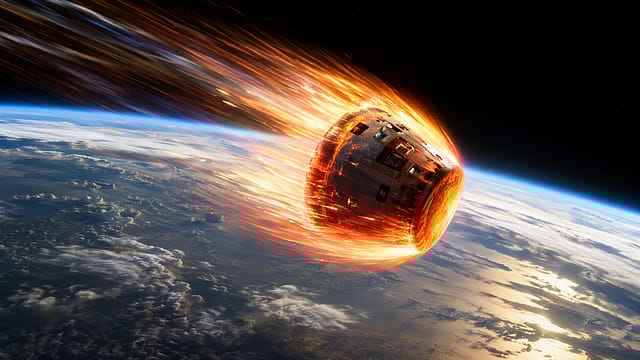
After ten days in deep space, the Artemis II crew is hours away from one of the most technically demanding moments of the entire Artemis mission.
NASA astronauts Reid Wiseman, Victor Glover, and Christina Koch, along with Canadian Space Agency astronaut Jeremy Hansen, are scheduled to splash down off the coast of San Diego today.
Where Will the Artemis II Crew Splash Down?
Orion is targeting a splashdown approximately 8:07 p.m. EDT on April 10, off the coast of San Diego.
The recovery ship USS John P. Murtha is already positioned in the Pacific, with US Navy and US Air Force teams standing by.
What Happens to the Spacecraft Before It Hits the Atmosphere?
The service module, which has powered Orion throughout the Artemis mission, will separate around 7:33 p.m. EDT, roughly 20 minutes, before the capsule reaches the upper atmosphere southeast of Hawaii.
A final trajectory-adjustment burn may follow to fine-tune the flight path one last time.
How Fast Will Orion Be Travelling at Re-entry?
According to NASA, Orion will reach a maximum velocity of approximately 23,864 mph just before the entry interface, roughly 30 times the speed of sound.

Open Minds 2026
26 Jun 2026 - Vol 05 | Issue 26
The power of ideas and arguments in 50 portraits
Orion uses a "skip re-entry" maneuver, briefly exiting the atmosphere to shed extreme heat.
Its heat shield withstands 2,760°C, protecting the four-person crew during their final descent to Earth.
Why Does the Spacecraft Go Silent for Six Minutes?
As Orion descends through approximately 400,000 feet, a planned six-minute communications blackout will occur at 7:53 p.m. EDT.
Plasma generated by peak heating forms a radio-blocking sheath around the capsule, leaving mission control with no contact with the Artemis crew during this phase.
How Much G-Force Will the Astronauts Experience?
As per NASA, the Artemis crew is expected to endure up to 3.9 Gs during a nominal re-entry profile, the equivalent of nearly four times their body weight pressing down on them simultaneously.
How Do Parachutes Slow a Capsule Falling From Space?
After emerging from blackout, Orion will jettison its forward bay cover and deploy drogue parachutes near 22,000 feet.
Three main parachutes then unfurl at around 6,000 feet, dramatically slowing the capsule to a survivable speed for ocean landing.
How Will the Crew Be Rescued After Splashdown?
Within two hours of splashdown, recovery teams will extract the Artemis crew from Orion using helicopters and deliver them to the USS John P. Murtha.
Once on board, the astronauts will undergo post-mission medical evaluations before flying to NASA's Johnson Space Center in Houston.
Why Does This Splashdown Matter for the Future of the Artemis Mission?
Tonight's return marks the end of a reportedly 695,081-mile round journey.
The performance data from Artemis II's re-entry will directly inform NASA's planning for Artemis III, which aims to land humans on the lunar surface for the first time since Apollo 17 in 1972.
(With inputs from yMedia)