What's next for TianGong Ultra, the Chinese robot that outran Usain Bolt?
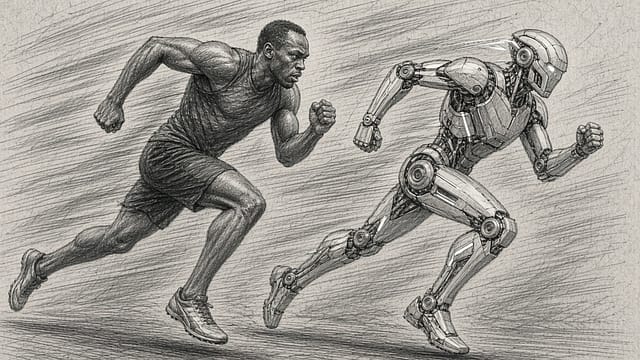
For a few seconds in Beijing, the future looked like it was running on two legs.
A humanoid robot called TianGong Ultra sprinted 100 metres in 8.64 seconds at the World Humanoid Robot Games, finishing well ahead of the 9.58-second men's 100m world record set by Usain Bolt in 2009.
The comparison is spectacular, but it comes with an important caveat: Bolt's mark remains the official human world record. TianGong Ultra was competing in a separate robot event with completely different conditions.
Still, the machine's performance was remarkable. And now, barely two weeks after the race, its engineers are already looking beyond the stopwatch.

The Modi Years
02 Oct 2026 - Vol 05 | Issue 40
A Nation Rebuilt
According to Reuters, Jack Guo, the 34-year-old engineer leading the development of TianGong Ultra and its smaller Omni model, says the next challenge is to turn spectacular performance into something far more difficult: reliability and real-world usefulness.
What is TianGong Ultra and who makes the robot?
TianGong Ultra is a humanoid robot developed by Beijing's X-Humanoid, formally known as the Beijing Humanoid Robot Innovation Centre.
The company was established in November 2023 and is based in Yizhuang, a major technology and robotics cluster in southeast Beijing. Reuters reports that X-Humanoid is backed by both state-owned and private investors, including robotics company UBTech and Chinese technology giants Xiaomi and Baidu.
The company is working on more than the robot's legs. Its teams develop humanoid hardware, motion-control software and artificial intelligence, while also commercialising its own machines.
That makes TianGong Ultra less a one-off racing stunt and more a test bed for a much bigger ambition: building robots that can move through the real world and eventually perform useful tasks.
How fast did TianGong Ultra run compared with Usain Bolt?
The robot's final time was 8.64 seconds, almost a second faster than Bolt's 9.58-second human record.
But the road to that final run was itself a demonstration of how the machine was being developed.
Reuters reports that Ultra used different motion-control programmes in each race. It ran 9.39 seconds in the preliminary round, improved to 8.86 seconds in the semifinal and then reached 8.64 seconds in the final. Engineers worked between races to test and refine the software, sometimes through the night.
The improvement was dramatic.
And it was not always pretty.
Several robots at the Games stumbled or crashed after completing their runs, highlighting the gap between making a machine move extremely quickly and making it do so safely and consistently. Earlier in Ultra's development, Guo told Reuters, the failures were more severe, with components including legs and waists breaking during testing.
Why did TianGong Ultra's engineers keep changing its running programme?
The robot was essentially being taught how to run more efficiently.
Its motion-control systems continuously adjust movements and balance, allowing the humanoid to sprint without an operator manually directing every step.
Ultra arrived at the Games with three different running strategies trained in simulation. One was considered more reliable, while two promised greater speed but had been tested less extensively.
The team eventually used all three across the competition.
That detail is important because the 8.64-second run was not simply a matter of pressing "go". Engineers were repeatedly testing how the robot responded to acceleration, balance, navigation and individual differences between machines.
In other words, the race was as much a software and control-system experiment as it was a sprint.
Could TianGong Ultra run even faster than 8.64 seconds?
Possibly.
Guo told Reuters that Ultra could approach eight seconds before limitations in its hardware begin to become a major constraint. The robot weighs about 75 kg and can exceed 17 metres per second at top speed.
But there is an awkward problem at the other end of the race. Stopping.
At the Games, fast-moving robots had only a relatively short run-off area after the finish line, with a crash mat and barriers used to absorb their momentum. Some machines slammed into the barriers after completing their runs.
For a robot intended to work in a factory, street or disaster zone, that is obviously not enough.
Future versions of Ultra could therefore become lighter, improve their braking ability and adopt a safer running posture, Guo told Reuters.
The next record may not be about how quickly TianGong can accelerate.
It could be about how quickly it can stop.
What is X-Humanoid trying to do with TianGong Ultra beyond racing?
The sprint was never supposed to be the final destination.
Guo told Reuters that the broader objective is to develop reliable humanoid mobility and eventually combine it with AI capable of handling increasingly complex tasks.
He compares today's humanoid robots with early cars: first, engineers have to figure out how to make the physical machine controllable and dependable. Only then can increasingly sophisticated "brains" be built on top of that body.
That explains why something as seemingly frivolous as a 100-metre race can matter.
Teaching a humanoid to run requires it to maintain balance, coordinate multiple joints, respond rapidly to changes and move across different environments. Those capabilities can eventually translate into other forms of mobility.
What jobs could TianGong robots eventually do?
The company's robots are already being tested outside sporting arenas.
At a Foton Cummins engine factory in Beijing, X-Humanoid's Tianyi 2.0 has been trialled moving boxes weighing between 8 kg and 12 kg onto shelves. Reuters describes this as an early-stage industrial exploration rather than a mature commercial deployment.
Guo expects smaller humanoids to find earlier applications in commercial services and light industry.
Ultra, because of its size and mobility, could eventually be used for outdoor inspection or emergency rescue.
Another X-Humanoid robot, Omni, has also been put through demanding mobility tests. In an internal test this year, it climbed from the first floor to the 17th floor of the company's headquarters.
That may tell us more about the future of humanoid robots than the 100m sprint does.
Why does making a humanoid robot run matter?
A robot that can walk in a controlled environment is one thing.
A robot that can run, turn, recover its balance and navigate changing terrain is something else.
That is why the TianGong Ultra experiment matters to the broader humanoid robotics race. China has been investing heavily in the sector, with manufacturers, technology companies, research institutions and government-backed programmes pushing the technology forward.
Hindustan Times noted that the robot's 8.64-second run was part of a broader shift in humanoid robotics from engineering spectacle towards potential commercial and industrial use.
The spectacle gets people watching.
The difficult part begins after the applause.
Is TianGong Ultra actually ready to replace human workers?
No. That is perhaps the most important distinction to make.
The 8.64-second sprint demonstrates impressive speed and advances in robotic movement. It does not demonstrate that the robot can independently perform a complicated job for hours, safely interact with humans, understand unpredictable surroundings or make decisions in the way a skilled worker can.
Reuters' latest reporting makes precisely this gap clear: the industry's challenge is moving from impressive demonstrations to reliable machines that can perform useful work.
Even at the Games, robots that could run extraordinarily fast also had a tendency to fall over.
That contrast captures where the technology stands today.
So what's next for TianGong Ultra?
The next version of TianGong Ultra may be less interested in beating Bolt and more interested in surviving the working day.
Engineers want greater stability, better braking, improved hardware and more reliable movement control. Once those foundations are in place, the harder layer begins: giving the robot the AI capabilities needed to understand complicated tasks and operate with less human supervision.
The 8.64-second sprint gave TianGong Ultra a global headline.
But Jack Guo's next target is considerably less glamorous.
Make the robot reliable. Make it useful. Then make it smart.
That may ultimately prove far more difficult — and far more important — than outrunning Usain Bolt.
(With inputs from yMedia and agencies)