The Saint Who Led the Sinners
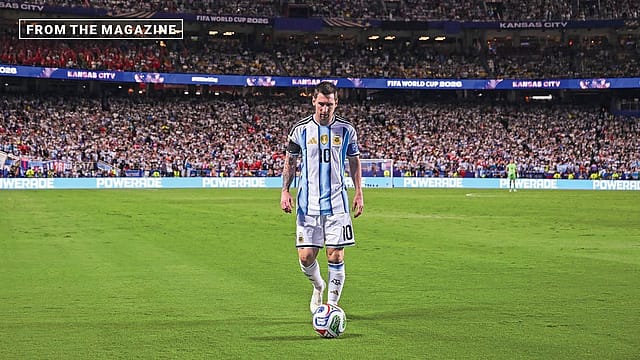
Genius doesn't come with an escort. If it has any self-respect, it ought to leave the same way. Unaccompanied, answerable to none. Lionel Messi tried to leave twice. The first time was on his knees in Lusail in December 2022, weeping into a trophy the football gods had withheld from him for 17 years. The second time was a message posted on social media announcing his retirement from the Albiceleste on August 31.
It had actually been written on July 21, two days after Argentina’s defeat to Spain in the World Cup final, and then held back for six more weeks because grief does not observe the football calendar. Messi’s father Jorge died on August 8, and only after burying him did the son find it in himself to bury the boy who once wore the No 10 for a country that did not always deserve him.
Losing Memory
16 Oct 2026 - Vol 05 | Issue 42
The making of a medical and social emergency
Twenty-one years is a long time to carry a nation’s temperament. Messi first pulled on the Argentina shirt in 2005 at 18. The kid from Rosario had already left home once—for La Masia, Barcelona’s academy of ascetics, where a 12-year-old with a growth hormone deficiency was handed the treatment his own country’s football association wouldn’t fund and Newell’s Old Boys wouldn’t underwrite. Barcelona did. It is one of football’s more delicious ironies that the man who would become the most Argentine of Argentine footballers—obstinate, wounded, familial to a fault—was manufactured almost entirely in Catalonia. La Masia did not just train Messi’s feet; it built the low centre of gravity, the delayed release, the refusal to look up be fore he had already decided where the ball was going, all of which Barcelona’s passing algebra required. Pep Guardiola gave him the false-nine role in 2009 not because Messi asked for it but because the team needed a species of footballer that did not yet exist. Messi became it. Four Champions Leagues, a shelf of Ballons d’Or, the status of Barça’s greatest-ever goal scorer—all of it accrued to a player whose international story, for the better part of a decade, was running in the oppo site direction.
That is the essential cruelty of the Messi story, and no revisionism after 2022 can smooth it over. For years, he was assembled by one country and found wanting by another. The 2014 final lost to Germany. The Copa América finals of 2015 and 2016, both surrendered to Chile on penalties, the second prompting a tearful, short-lived retirement announcement that Argentina talked him out of within days. The accusation, unfair but sticky, was that a player who had never had to carry a team— Barcelona’s supporting cast read like a hall of fame—did not know how to carry one that could not carry itself. Argentina’s failure was dressed up, conveniently, as his.
Then came the correction; not redemption, because redemption implies a debt Messi owed and hadn’t paid. The 2021 Copa América in the Maracanã, of all grounds, against Brazil, of all opponents. The World Cup of 2022, an odyssey that began with a shock defeat to Saudi Arabia and ended with the most complete individual tournament any player has produced at a World Cup— Golden Ball, Golden Boot contender, matchwinner in the group of death and the final alike. Thirty-six years of Argentine hunger, since Maradona’s 1986, ended in a shootout. It was as close to a perfect ending as sport allows.
Except football does not respect endings, only sequels nobody asked for. Argentina returned to defend the trophy in 2026 and reached the final again—this time against a Spain rebuilt, verticalised, and immensely superior, who beat them 1-0 after extra time at the New York/ New Jersey Stadium. The statistics of the evening were not even close: Spain finished with an expected goals tally of 1.94 from 20 shots to Argentina’s 0.2 from two. Messi’s Argentina, for the first time in this five-year renaissance, were beaten not unluckily but comprehensively. That, on its own, would have been an honourable epitaph—a great champion outgrown by a better system, the same story football has told since the Magical Magyars lost to a fresher West Ger many in 1954.
It is what happened after the final whistle that turned an honourable de feat into something closer to disgrace, and where many admirers of Messi had to part company with Argentina. FIFA’s investigation into the post-match brawl produced 21 games of suspension and more than $500,000 in fines for Argentina. Leandro Paredes received a 10-game ban for grabbing Spain’s Eric García by the throat and later throwing Gavi to the ground; Nahuel Molina was banned seven games for striking Rodri; assistant coach Roberto Ayala was suspended for laying hands on two Spanish players in turn. The Argentine federation itself was fined over $300,000 and ordered to play its next two home fixtures at half capacity, penalties that stemmed not only from the scuffle but from a politically loaded ‘Las Malvinas son Argentinas (the Falklands are Argentine)’ banner unfurled after the semi-final win over England, a gesture that had nothing to do with football and everything to do with a wound the country cannot stop picking at, even mid-tournament, even in someone else’s stadium.
None of that was Messi's doing. He was a peacemak er in the chaos, too dignified and too tired to brawl. But a captain’s legacy is porous; it lets in the sins of the team he led even when his own hands are clean. Messi leaves international football as its greatest ornament and its most patient sufferer, a genius who had to wait until he was 35 to be believed in, only for the country he redeemed to spend its last hour on the biggest stage behaving like it had learned nothing from him. Rosario gave the world a saint. Buenos Aires, on its worst nights, still cannot resist playing the sinner.