Sandpapergate: Why Pat Cummins Keeps the Captaincy as Fox Rests Khawaja and Warner
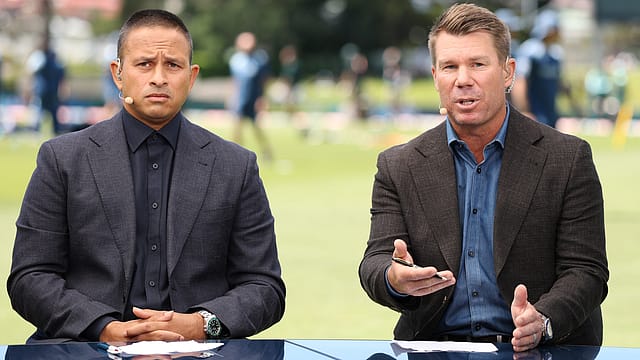
Consider the first time a ball starts to reverse at the MCG. An opener in the commentary box can tell you what to look for in the batter’s feet, why the bat has come down late, how a delivery that seemed to be going past off stump ended up threatening leg. It is one reason to hire Usman Khawaja or David Warner. Both have stood at the other end.
On Saturday, as Australia and England met in a T20 international in Melbourne, Fox Cricket explained why its viewers would have to do without either man for the next few weeks. Khawaja and Warner had become part of a story they could reasonably expect to be asked to explain. Steve Crawley, the Fox Sports managing director, said the pressure to answer every fresh comment was unfair on them and made it difficult to concentrate on the cricket. The broadcaster described the decision as temporary.

The Wealth Issue 2026
06 Nov 2026 - Vol 05 | Issue 45
Portraits of Dreamers and Doers under 35
The previous day in Sydney, Cricket Australia’s interim chair, David Boon, and its chief executive, Todd Greenberg, had met another member of the 2018 touring party. Pat Cummins came away with the board’s unanimous backing to captain Australia. He also undertook to attend an independent forum for players and staff from the South Africa tour. His immediate priority, he said, was the Perth Test against New Zealand. Of the forum he said simply: “I will be there.”
In Perth, Cummins will decide who gets the new ball. At the forum, he will be asked what he knew about an old one. He has the authority of the Australian captain in the first setting. In the second, he is a former teammate of Cameron Bancroft’s, with his own recollection of a tour they made eight years ago.
The difficulty for Australian cricket is that when Cummins speaks about Cape Town, the public hears the captain in both rooms.
THE BOWLER WHO BECAME CAPTAIN
On March 24, 2018, the man responsible for the Australian team at Newlands was Steve Smith. David Warner was his deputy. Cameron Bancroft was the junior opener caught on camera trying to alter the condition of the ball.

Cricket Australia’s investigation found that Warner had instructed Bancroft, and that Smith knew of a potential plan and failed to stop it. Smith and Warner received 12-month bans. Bancroft received nine. Cummins was one of the fast bowlers. The investigation did not find that he had prior knowledge of the plan.
The distinction between the captain then and the captain now helps explain the peculiar position in which Cummins finds himself. He cannot answer for what Smith permitted. He can answer for what he heard, saw and did. Yet few Australians from that tour have spent as much time this month answering questions in public.
On November 13, Cummins faced reporters for more than an hour after Khawaja’s autobiography, Sabr, reopened the issue. He rejected the suggestion that he had been party to a scheme to take sandpaper on to the field. He was emphatic that he did not know it was being used.
It was a striking intervention in part because the bowlers had already addressed the allegation. In May 2021, Cummins, Mitchell Starc, Josh Hazlewood and Nathan Lyon issued a joint statement denying prior knowledge. Bancroft, whose remarks had prompted questions that time, told Cricket Australia he had no new information for it to investigate.
Five years later, Cummins put himself in front of reporters to defend essentially the same position. He could hardly have anticipated a more consequential listener than the man who had carried the sandpaper.
Bancroft said watching the press conference made him feel “angry, betrayed and alone”. He identified it as the immediate reason he wrote his account for The West Australian. Cummins had spoken at length to challenge a claim he regarded as damaging and untrue. One result was a roughly 4,000-word account from a teammate who believed the captain had described a dressing room he did not recognise. After its publication, Cummins maintained his denial.
That sequence is why the vote of confidence was necessary. Leaving the captain to face questions about his future at every appearance would have amounted to a decision of its own. Boon went further than confirming the team sheet, however. He expressly rejected the suggestion that Cummins’ integrity had been compromised. That offers the captain considerable protection going into Perth. It also leaves a former teammate contemplating the forum with a fair question: if my evidence conflicts with the captain’s, what remains open for discussion?
WHAT DID “EVERYONE KNEW” ACTUALLY MEAN?
There is a useful passage in a document published two years before Sabr. In 2024, an independent panel considered Warner’s application to modify his long-term leadership sanction. Its written decision reproduced the Cape Town charge against him. The sequence recorded there begins with a general team conversation about obtaining reverse swing. It then describes a conversation between Warner and Bancroft about artificially altering the ball.
Those conversations concern the same ball and establish different things. A team can discuss getting an old ball to move late in the air. A bowler can tell a fielder whether the ball is moving. Neither exchange, on its own, establishes that the bowler knows the fielder has sandpaper. Equally, if somebody mentions sandpaper within earshot of named teammates, that is evidence of a different order.
Eight years of argument have been conducted over the short distance between they knew we wanted reverse swing and they knew how I was trying to get it.
Bancroft has now put details against his account. He recalled speaking to Cummins, Starc, Hazlewood and Mitchell Marsh about whether the ball was reversing enough. He said he sought feedback from wicketkeeper Tim Paine, who could judge the movement from behind the stumps. He also described an occasion when, in his recollection, team media manager Kate Hutchison objected to what was happening and walked away. That last detail gives a process interested in establishing facts a specific person and exchange to ask about. It remains Bancroft’s recollection; it should not be passed off as Hutchison’s testimony.
Khawaja’s position also deserves more care than a headline can give it. In Sabr, he argued that knowledge extended beyond the three men sanctioned and that the team should have taken collective responsibility. When the ABC’s 7.30 pressed him on whether individual bowlers had known in advance, he declined to confirm that proposition about them.
There is a substantial difference between saying a team allowed three men to take the consequences and saying one can establish precisely what Pat Cummins knew before Bancroft went on the field. The first claim has force without being proof of the second.
Then there is the testimony of a man who had good reason to remember where investigators might find him. Chadd Sayers told SEN that his wife was in South Africa during the family portion of the tour. With interviews expected, he said, players had been told to stay near the hotel. Sayers stayed nearby. The interview never came.
What might he have told them? Sayers remembers the team sitting in the changing room for perhaps 60 to 90 minutes after play at Cape Town, discussing what had happened and how to respond. Asked whether two players had objected to taking collective responsibility, he said his memory of that was vague and declined to name them.
Since the conversation came after the incident, it cannot settle who knew beforehand. It could help explain how the team decided what to say afterwards. The value of interviewing Sayers in 2018 would have been the chance to ask the next question while the answer was fresh. No forum in 2026 can give him back those eight years.
WHAT HAZLEWOOD ACTUALLY PUT ON THE LINE
Josh Hazlewood has supplied the strongest evidence that the dispute could affect the current Test side. Asked by Code Sports whether he would consider stepping away if Cummins lost the captaincy, he said he would have to find himself in that position before deciding, but would have to think about it. It was a conditional answer to somebody else’s hypothetical question. He did not threaten to resign.
What deserves attention is that removing the captain could cause another senior bowler to reconsider his own place. An administrative decision about one player might have consequences for a pair who share the new ball.
Hazlewood offered two reasons for speaking. He wanted to defend the work Cummins had done as captain to create a team in which he believed Cape Town could not happen again. He also wanted to defend his own account. He denied helping devise the sandpaper plan or knowing a foreign substance was being used. His recollection was of batting and bowling groups that tended to sit apart, an ordinary dressing-room detail with some bearing on the extraordinary claim that everybody knew. Hazlewood can speak to where he sat. Bancroft can speak to the conversations he remembers having. Neither had access to everything the other heard.
For Cummins, Hazlewood’s most valuable endorsement concerns the years since. Here is a senior player prepared to say that he trusts the captain and can identify a difference in the side under his leadership. That is relevant evidence when the board asks who should captain Australia next month. Its value diminishes the moment anyone tries to send it backwards in time. A teammate’s confidence in Cummins today cannot establish what either man heard at lunch in 2018. Nor does a disputed memory from 2018, by itself, establish that the present team has lost confidence in its captain.
WHY THE COMMENTARY BOX WAS DIFFERENT
It is tempting to read the weekend’s headlines as a single verdict: Cummins spoke and kept his job; Khawaja and Warner spoke and lost theirs. The facts do not support it. The board and the broadcaster are different employers answering different questions. Fox has described a temporary absence, not a dismissal. There is no basis in the published statements for suggesting Cricket Australia directed it.
Nor are the two absent commentators interchangeable. Warner was the vice-captain whom the original investigation found had enlisted Bancroft. Khawaja was not sanctioned. His intervention was to write an account challenging how responsibility had been apportioned.
What they have in common for Fox is that putting either man on air creates an editorial decision almost immediately. Should a colleague ask him about the latest allegation during an England game? If the answer makes news, should the person whose account he disputes be offered a reply in the same broadcast? How much of a T20 international should be given over to a Test played eight years ago?
Resting them is a defensible answer. It also tells us something about the hold Cape Town still has on the game. Fox ordinarily benefits from the fact that former players know what went on after the dressing-room door closed. On this occasion their proximity made the job harder. A question about reverse swing that would be routine for another commentator could sound, in Warner’s hearing, like an invitation to defend himself. Leaving the question unasked could look like an editorial favour. The broadcaster has bought itself a few weeks. It has not said what will have to change for either man to return.
THE QUESTION THE FORUM MUST ANSWER
When Greenberg announced the independent forum, he made two qualifications. Cricket Australia was not reopening its 2018 investigation, and the outcome would not necessarily be made public. When the board endorsed Cummins on November 21, it had yet to publish the forum’s terms of reference. It had decided who would captain the team before deciding publicly what the people hearing from the team would be empowered to do.
Privacy has a purpose here. Bancroft might reasonably want to tell a former teammate what the last eight years have cost him without seeing the exchange cut into a television clip. Cummins might welcome the chance to ask Bancroft exactly which conversation he remembers and who was present. A facilitator could help two men discover that they agree on a conversation and profoundly disagree about its meaning. That would be worthwhile, even if neither changed his account and the public never saw a transcript.
But Cricket Australia has another responsibility, arising from a document it did publish. In 2018, it announced that only three players had prior knowledge. That finding affected careers, established reputations and became part of the public history of Australian cricket. If the forum hears nothing that changes it, the board should be able to say so. If someone supplies specific, checkable information that might change it, there needs to be a route by which somebody independent can test it. A promise of confidentiality to a player and a promise of accuracy to the public can coexist. The terms need to explain how.
That is the question Boon and Greenberg can settle before a single player enters the room. Who receives a new piece of evidence? Who decides whether it warrants investigation? Who tells Bancroft, Cummins and the public if an earlier finding can no longer stand? Those are fairer questions to put to the board than asking the captain to reconcile six men’s memories at his next press conference.
Cummins has given the clearest undertaking anyone could reasonably ask of him for now: he will turn up. Sayers says that in 2018 he did much the same. Told to stay near the hotel, he waited to be interviewed. Nobody came. The first test of Cricket Australia’s new forum is whether, this time, somebody asks him what he remembers. The harder test comes if his answer gives them a reason to ask another question.