Living on a Prayer & Shai Hope: The Reinvention West Indies Needed
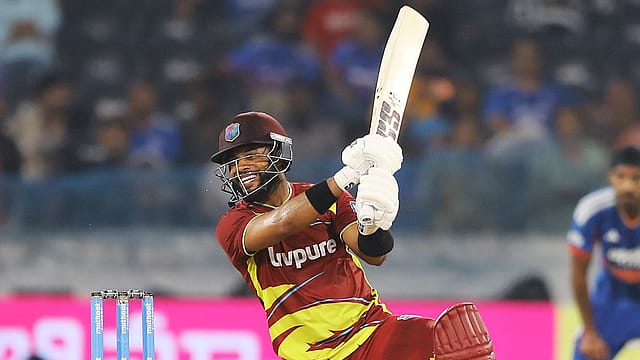
The trophies were becoming a luggage problem.
Shai Hope had just made another hundred against India. Another Player of the Match award was joining the collection. Asked about his extraordinary run, the West Indies captain began worrying, with rather less seriousness, about the journey home.
“Those were a bit heavy; we got to look at luggage weight.”
After Hyderabad, he had 539 runs from seven innings on the tour: four centuries and a fifty. His latest contribution was an unbeaten 102 from 50 balls, with nine sixes. West Indies had levelled the T20I series at 2–2.
For once, a conversation about the weight carried by a West Indies captain could begin with a joke.

Zeroing In on ECI
09 Oct 2026 - Vol 05 | Issue 41
Constitutional legitimacy versus political opportunism
Hope knows the other kind. He has stood before the microphones after his team failed to qualify for a World Cup. He has lost his Test place. He has made runs in one format while his suitability for another remained an argument. He has also been here before: the young man making hundreds, with the possibility of a Caribbean revival gathering around his name.
That happened at Headingley, nine years ago.
The journey from that ground to Hyderabad explains why the latest version of Hope deserves attention. He has had to reconstruct the game that first made people believe in him.
THE FIRST PROMISE
In August 2017, England set West Indies 322 to win at Headingley.
Hope had already made 147 in the first innings. In the chase, he made an unbeaten 118. West Indies won by five wickets, their first Test victory in England for 17 years. He became the first batter to score centuries in both innings of a first-class match at the ground. A venue associated with generations of celebrated English batters had waited more than a century for a 23-year-old Barbadian to do it.
It was an irresistible story. West Indies had suffered a crushing defeat in the previous Test. Here was an answer delivered through batting of patience, composure and ambition.
Even then, the innings contained evidence of adaptability. Analysis of the match showed Hope shifting his scoring towards the leg side as England bowled straighter and shortened their length. He responded to the attack in front of him, rather than trying to reproduce the first innings.
The broader hope was that West Indies had found a batter around whom something lasting could grow. A magnificent match makes that belief easy. The years afterwards would make it harder.
A BOY LEARNING TO ADJUST
Hope grew up in Barbados with his older brother, Kyle, who would also play international cricket. The beach was a short walk from home. After school, the brothers played with a tennis ball or a soft ball.
There was another education in England. A scholarship took Hope to Bede’s School in Sussex, where he worked with former England batter Alan Wells and captained the school side.
He later described the experience as life-changing, recalling the different nationalities around him and the need to understand how other people lived. His father, Ian, had played club cricket before giving it up to watch his sons. His mother, Quinta, played netball and cricket.
These details offer a fuller picture than the familiar shorthand of a naturally gifted Caribbean batter. There was ability. There was also learning: different conditions, different people, different demands.
That capacity to adjust would eventually become central to his career. But it did not spare him a prolonged struggle in the format that had supplied his most famous afternoon.
THE HUNDREDS THAT BECAME A BURDEN
By October 2020, Headingley’s twin centuries remained the only Test hundreds of Hope’s career.
West Indies left him out of their squad for New Zealand. Across 34 Tests, his average stood at 26.27. Since December 2017, it was below 20.
His ODI average, meanwhile, was above 52.
The contrast was stark. The same batter could look indispensable in one format and vulnerable in another. Lead selector Roger Harper explained that continuing to pick an out-of-form player could sometimes do more harm than good. Hope needed time to work on his game.
Headingley had become both an achievement and a recurring question. When would that batter return?
For a player, an exceptional early performance can create a peculiar demand: every later innings is measured against the moment that announced him. The public remembers the heights with perfect clarity. The work of finding a repeatable method receives less attention.
Hope kept building his ODI record. But another challenge was forming around him. In T20 cricket, could he score quickly enough?
THE BATTER WHO CHANGED THE TEMPO
For years, Hope’s T20 reputation lagged behind his standing in one-day cricket.
Before 2024, his T20I record amounted to 493 runs in 24 innings, an average of 22.41 and a strike rate a little above 124. By February 2026, his recent international returns were being cited as evidence of substantial progress.
The change had practical roots.
During his resurgence in franchise cricket in 2023, he moved between roles at the top and in the middle order. He made 223 runs in the Bangladesh Premier League at a strike rate of 137, then averaged 53 and struck at 140 in that year’s Caribbean Premier League.
His setup evolved too: a more open stance, a shorter, quicker backlift and greater willingness to clear the front leg. An IPL contract with Delhi Capitals followed in 2024. A 17-ball 41 against Mumbai Indians offered a glimpse of the expanded game.
His ODI batting was developing alongside it. In 2023, he averaged 69 and, for the first time in a calendar year, scored at better than a run a ball.
This was work on the mechanics and tempo of his batting. He was learning to make more of his ability available in less time. That matters to West Indies because Hope’s evolution offers a practical example to a team searching for consistency. A player’s established identity need not set the limits of what he can become.
THE WORLD CUP THAT VANISHED
His appointment as ODI captain in February 2023 brought a responsibility far larger than his own scoring rate.
Within months, West Indies failed to qualify for the 50-over World Cup.
Scotland beat them by seven wickets in Harare. Earlier defeats by Zimbabwe and the Netherlands had already put their campaign in danger. Against Scotland, West Indies slipped to 30 for four and then 81 for six.
Afterwards, Hope addressed preparation, effort and fielding. Ten catches had gone down during the group stage.
“Fielding is an attitude thing,” he said.
His assessment of preparation was equally severe. West Indies, he argued, could not expect to operate as an elite team on the work they had done beforehand.
That defeat belongs in any serious account of his leadership. His captaincy has contained failure on a historic scale. Hyderabad cannot erase it, and a prolific tour cannot establish that the problems he identified have all been solved.
But his response also gives the profile substance. He named standards his side needed to meet: preparation, sustained effort, consistent execution. Those are less romantic subjects than restoring Caribbean glory. They are also where restoration has to begin.
THE ADVICE ABOUT TIME
Later in 2023, Hope supplied a different scene.
Against England in Antigua, he made an unbeaten 109 as West Indies chased 326. He reached his hundred from 82 balls, then his fastest in ODIs, and finished the match by hitting Sam Curran for three sixes in four deliveries.
Afterwards, he recalled advice from MS Dhoni: “You always have a lot more time than you think.”
For a batter trying to increase his scoring speed, it is an instructive thought.
Time at the crease has to be used. Assessing the attack, finding a favourable over and committing to it can be as important as the ambition to hit harder.
Hope would recall the Dhoni conversation again during this India tour, after his unbeaten 162 helped West Indies overhaul 352 in the final ODI.
The connection across those innings is judgement: staying available to the chase while recognising when it must accelerate. In Hyderabad, that calculation produced nine sixes. The calm appearance survived. The scoring possibilities had widened.
A CAPTAIN WITH COMPANY
In March 2025, Hope assumed the T20I captaincy as well.
The decision extended his leadership across both white-ball formats. Daren Sammy praised his preparation, composure and combination of instinct with analysis.
He inherited a side that had already made progress under Rovman Powell, including home series victories against India, England and South Africa. Hope was taking over work already under way.
Nor has he been winning alone in India. In Ranchi, his unbeaten 102 from 45 balls helped West Indies chase 250 after early wickets. Sherfane Rutherford’s 84 from 37 was essential to that recovery.
In Hyderabad, Rutherford made an unbeaten 49, Shimron Hetmyer supplied a rapid 33, and Keemo Paul took five wickets. That company is crucial to the argument for Hope.
A captain can give an innings continuity, set standards and make room for others to attack. For those qualities to produce victories, teammates still have to deliver.
The encouraging feature of this tour is that Hope’s volume of runs has been accompanied by match-shaping contributions around him. The task is to make that combination recur.
HEADINGLEY IS STILL PART OF HIM
There is another reason to resist reducing Hope to a white-ball reinvention.
He returned to the Test squad in 2025 after an absence stretching back to late 2021. That December, in Christchurch, he made 140 as West Indies fought for a draw against New Zealand. Justin Greaves’ unbeaten double-century and Kemar Roach’s resistance helped complete the escape.
The batter associated with Headingley had found another significant innings in the longest format.
That does not settle the inconsistencies of his Test career. It does make the story more interesting. At 32, Hope has continued adding to his game while reopening an older part of it. His development has crossed formats, with setbacks and returns that resist a tidy upward curve.
For West Indies, that is a credible source of optimism. Here is a senior player whose authority rests partly on having had to change.
MORE THAN A PRAYER
The temptation, after four hundreds on one tour, is to declare Hope the answer to West Indies cricket.
A more persuasive case is narrower and stronger. He is providing an example of the reinvention they need: technique examined, scoring options expanded, responsibility accepted and performance sustained across different demands. His own captaincy record also supplies a warning. The distance between individual excellence and collective renewal can be considerable.
A hundred cannot catch the next chance. A captain’s preparation cannot replace everybody else’s. Revival will require enough players meeting those demands often enough for victories to become a habit.
Hope has given West Indies a substantial contribution towards that work.
In Hyderabad, after his hundred and the win, he could joke about getting the awards home. There is a neat image in that: a captain contemplating the weight of things earned, after years spent answering for things that had gone wrong.
The luggage might need rearranging. West Indies will welcome the problem.