India’s Top Run-Scorer Made Just 86: The Statistic That Defines Their New Zealand Batting Failure
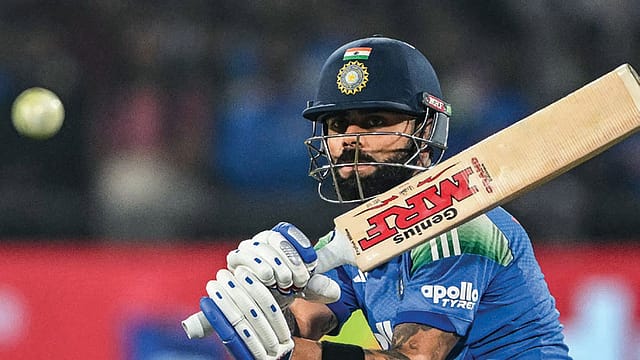
Virat Kohli finished India’s ODI series in New Zealand at the top of the team’s run chart. That sentence usually carries the suggestion of authority, longevity and another productive tour. This time, the number beside his name was 86.
Not 186. Not an average of 86. Eighty-six runs across four innings.
Kohli made 74 from 51 balls in the opening ODI in Auckland. He then scored 7 in Wellington, 0 in the fourth ODI at Mount Maunganui and 5 in the final match at the same ground. His sequence was 74, 7, 0 and 5, giving him an average of 21.50. One innings supplied 86 per cent of his series aggregate. The other three produced 12 runs.

The Wealth Issue 2026
06 Nov 2026 - Vol 05 | Issue 45
Portraits of Dreamers and Doers under 35
That was still enough to make him India’s highest run-scorer.
The figure captures India’s batting failure more sharply than any description of swing, seam or difficult New Zealand conditions. Across a five-match series, with the third ODI abandoned and four Indian innings completed, not one Indian batter reached 100 aggregate runs. India won the two rain-reduced chases, but their batting grew progressively more fragile. They made 143 for five in Auckland, 113 for seven in Wellington, 89 all out in the fourth ODI and 209 all out in the fifth.
There is necessary context. India’s first chase was reduced to 32 overs and their second to 26. The third ODI was washed out. This was not a conventional five-match series in which every leading batter received five full innings. Yet the shortened games cannot explain the two completed innings at Mount Maunganui. Given 50 overs on both occasions, India survived for only 26.4 overs while making 89 and 42.1 overs while making 209.
From 334 at home to 86 in New Zealand
The comparison with India’s two previous bilateral ODI assignments turns a poor series into a startling regression.
During India’s previous away series, against England in July, Shubman Gill made 188 runs in three innings. Rohit Sharma made 175 and Kohli contributed 144. India lost the series 2-1, but their leading batters produced substantial scores. In the deciding ODI at Lord’s, India made 360 for seven while chasing 388. Rohit scored 138, Gill 77 and Kohli 74.
India’s most recent home series produced an even greater contrast. Gill amassed 334 runs in three ODIs against West Indies, averaging 167. He scored two centuries, including an unbeaten 223. Rohit added 225 runs and Kohli made 168. A month later in New Zealand, the leading Indian aggregate was 86.
Gill’s 334 was nearly four times Kohli’s New Zealand total. His 223 not out in one innings was more than two and a half times the aggregate that led India’s chart across the entire New Zealand series. Even Gill’s 188 in England was 102 runs higher than India’s best return here.
The change cannot be attributed solely to personnel. Rohit and Kohli played in all three series. Gill began the New Zealand tour but missed the final two matches. The deeper difference was that India’s established batters stopped building innings together. There was no sustained top-order platform, no individual century and only one score above 50 across the four completed innings. That score was Kohli’s 74 in the first match.
Axar and Ishan finished just behind Kohli
Axar Patel came closest to overtaking Kohli, accumulating 74 runs through scores of 0, 7, 21 and 46. His final two contributions arrived after India’s specialist batters had surrendered control. At Mount Maunganui, he helped lift India from 9 for four in the fourth ODI and then top-scored jointly in the final match. An all-rounder who usually bats in the lower middle order finished only 12 runs behind India’s series leader.
Ishan Kishan made 73 runs from his two opportunities, scoring 27 in the 89 all out and 46 in the final ODI. His returns were modest in isolation, but his average of 36.50 was the best among the Indian batters who appeared in both Mount Maunganui matches. He twice entered amid severe damage and was asked to reconstruct innings rather than exploit a platform.
Shreyas Iyer finished with 67 runs from four innings: 15, 30, 0 and 22. Naman Dhir collected 55 from three innings and twice reached 21 without converting either start. KL Rahul made 34 runs without being dismissed, but appeared only in the two shortened matches. Gill scored 37 in his two innings before leaving the side, while Rohit endured the bleakest series among the senior batters, making 30 runs through scores of 0, 23, 0 and 7.
The distribution tells its own story. Kohli led with 86, Axar followed with 74 and Kishan made 73 despite playing only twice. India’s designated top four failed to provide one batter with a three-figure aggregate. The men trying to repair the innings came uncomfortably close to becoming the team’s leading scorers.
The number India cannot dismiss
Kohli’s position at the top does not make him the sole cause of the failure. His 74 won India breathing room in Auckland, and several teammates were considerably worse. It does, however, give the series its defining number.
India arrived in New Zealand less than a year before the 2027 World Cup in South Africa, Zimbabwe and Namibia. Their coach Gautam Gambhir wanted the tour to test whether the batting could adapt to pace, bounce and a more demanding new-ball phase. The answer supplied by the scorecards was uncomfortable. India’s highest series aggregate was lower than Rohit’s 121 not out in a single innings during the 2025 tour of Australia. It was also lower than the 138 Rohit scored in one innings at Lord’s four months ago.
Kohli’s 86 should, therefore, be read as a collective failure compressed into one statistic. India did not lack merely one dominant innings. They went through an entire ODI series without producing one batter who could assemble 100 runs.
The scoreboard has already completed the argument.