Who is Mohit Ulva? From Village Tennis-Ball Cricket to India’s Last-Ball U19 Asia Cup Hero
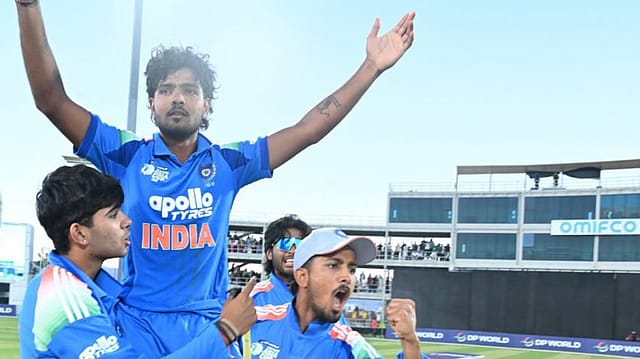
Eight runs separated India from the U19 Asia Cup. One wicket separated Pakistan from it.
Ahmed Hussain ran in for the final over in Muscat with India on 330/9, chasing 338. Four singles and a wide brought the equation down to three runs from the last delivery. Mohit Ulva was on 45.
The 18-year-old fast bowler met the final ball with a boundary.
India finished on 339/9. Mohit walked off unbeaten on 49 from 26 balls after completing one of the most improbable chases in an India-Pakistan final.
The scorecard placed him at No. 10. His batting history should have warned Pakistan that the number was misleading.

The Wealth Issue 2026
06 Nov 2026 - Vol 05 | Issue 45
Portraits of Dreamers and Doers under 35
Only weeks earlier, Mohit had walked in at the same position against Australia U19 and struck 92 from 84 balls. He hit 10 fours and four sixes, shared a 180-run ninth-wicket partnership and helped India recover from 218/6 to 494. He also took 3/37 in Australia’s first innings.
The last-ball four in Muscat turned him into a national name. The innings against Australia had already shown the cricketer behind it.
Who Is Mohit Ulva?
Mohit is an 18-year-old right-arm medium pacer and right-handed batter who progressed through Saurashtra’s age-group system before entering the India U19 setup.
The BCCI selected him for India’s one-day series against Sri Lanka in June 2026. He remained part of the junior side for the home series against Australia and was subsequently chosen for the U19 Asia Cup in Oman.
His primary role is fast bowling. Player databases have classified him inconsistently as a bowler, batter or opener, partly because his limited youth record contains several striking batting performances. His India U19 selection and position in the order present a clearer picture: Mohit is a pace bowler with considerable lower-order power.
Before the Asia Cup final, he had already contributed with both skills during the tournament. Against the UAE, he struck a six from the final ball of India’s innings and then claimed India’s first wicket during the chase. He also recorded figures of 2/45 against Pakistan in the group stage.
The final revealed how much value can sit below the recognised batting order.
How Village Tennis-Ball Cricket Started Mohit Ulva’s Journey
Mohit’s first cricket came through tennis-ball games in his village.
His father, who works with the Railway Protection Force, had a strong interest in the sport and saw enough ability in his son to push him towards structured coaching.
“My father was always interested in cricket,” Mohit told Sportstar during India’s home series against Australia. “When I was young, he saw some qualities in me and thought I could play.”
Mohit’s initial motivation was less solemn. He admitted that he agreed to join an academy because he wanted to escape studying. That decision eventually took him to one of the more demanding cricket nurseries in Jamnagar.
How Ravindra Jadeja’s Childhood Coach Shaped Mohit Ulva
Mohit trained at the Cricket Bungalow in Jamnagar under Mahendrasinh Chauhan, the coach who played an important role in Ravindra Jadeja’s formative years.
The Cricket Bungalow has a distinctive place in Jadeja’s story. Chauhan was a policeman and local cricketer who ran the academy and imposed a physically demanding routine on his trainees.
Mohit encountered the same emphasis on conditioning. Sessions began with 24 or 25 warm-up laps before moving to sprints and cricket drills.
“In Jamnagar, I learnt that fitness is the most important thing as Mahendra Sir worked a lot on it,” he told Sportstar.
Those laps acquire a different meaning when viewed alongside the U19 Asia Cup final. Mohit reached the crease with India deep into a 338-run chase, attacked for 26 balls and handled a last over in which every single carried the risk of a run-out. The technical work supplied his shots. The physical routine helped him retain control at the end of a long, draining match.
Why Mohit Ulva Switched From Off-Spin to Fast Bowling
Mohit did not enter the academy as a fast bowler. He began by bowling off-spin.
Chauhan noticed his lean frame and his ability to run. He suggested that Mohit experiment with pace bowling. The change felt natural enough to become permanent.
“I started doing it and naturally developed into a fast bowler,” Mohit said.
The switch altered his cricketing path. Saurashtra’s age-group structure gave him competitive opportunities, while his batting continued developing beneath the more visible bowling role.
His game now carries an interesting combination. He bowls right-arm medium pace, uses variations and can contribute substantial runs from the lower order. At youth level, where batting collapses are frequent and tail-end technique is uneven, that package can change the balance of a team.
India discovered its value when eight wickets had fallen in Muscat.
What Jaydev Unadkat Taught Mohit Ulva
After his father was transferred to Rajkot, Mohit entered Saurashtra’s cricket system and later spent time in the Saurashtra Premier League alongside Jaydev Unadkat.
The association gave the young pacer access to a bowler who has built a long domestic and IPL career around control, changes of pace and tactical adaptation.
Mohit once watched Unadkat use a slower bouncer and tried the delivery in the nets. Unadkat encouraged him to retain it.
“Never leave this. If you are bowling it well, keep bowling it,” Mohit recalled Unadkat telling him.
The advice offers a glimpse of Mohit’s development. He watches senior players, experiments with their methods and keeps the variation when it suits his own action.
His rise has coincided with Saurashtra becoming one of Indian domestic cricket’s most durable systems. The state has produced players capable of surviving through discipline and finding additional value in skills that initially appear secondary.
Mohit’s batting may become his most important secondary skill.
Why Mohit Ulva’s 92 Against Australia Changed His Profile
The 92 against Australia deserves a central place in Mohit’s story because it removes the possibility of dismissing his Asia Cup innings as a lucky swing.
India were 218/6 in the first Youth Test at Rajkot when the lower order began rebuilding the innings. Captain Lakshya Raichandani made 240. Mohit joined him at No. 10 and transformed the recovery into domination.
His 92 came from 84 deliveries at a strike rate above 109. He struck 10 fours and four sixes before falling eight runs short of a century. India reached 494 and won by an innings and 48 runs.
The innings required more than late-order slogging. Eighty-four deliveries provided opponents enough time to test his defence, short-ball response and shot selection. Mohit still controlled the contest.
In Muscat, the demand was different. India needed immediate acceleration. He scored at 188.46, hitting five fours and three sixes.
Rajkot showed that he could build an innings. Muscat showed that he could finish one.
How Mohit Ulva Won the U19 Asia Cup From No. 10
Mohit entered the final with India on 231/7. The chase deteriorated to 252/8, leaving India 86 runs short with eight overs remaining.
Manal Chauhan launched the counterattack with 47 from 31 balls. Mohit matched him, and the pair dragged India to 309 before Manal became the ninth wicket.
India still needed 29.
Chigurupati Venkata joined Mohit for the last-wicket stand. With 25 needed from 12 balls, Mohit struck the first two deliveries of the 49th over for four and six. Venkata found another boundary. Seventeen came from the over.
The last pair reduced eight from six balls to three from one. Mohit supplied the final boundary and finished one run short of a personal landmark.
The missing fifty gives the innings an unusual shape. It will always be recorded as 49 not out, although its competitive value exceeded most half-centuries.
What Makes Mohit Ulva More Than a One-Match Hero?
Mohit remains an age-group cricketer whose development will be tested by senior domestic competition. Pace, workload, consistency and role clarity will determine how far he progresses.
His early record nevertheless contains evidence of a valuable all-round profile. He made 92 from No. 10 and took three wickets in the same Youth Test against Australia. He later claimed three wickets in a Youth ODI against the same opponent and contributed useful wickets during the Asia Cup. His unbeaten 49 during a 338-run chase against Pakistan then showed that he could absorb the pressure of a continental final and retain enough clarity to find the boundary from its last delivery.
The next stage should give his batting more deliberate attention. A player capable of 92 from 84 balls should not remain permanently hidden behind nine teammates.
India’s U19 Asia Cup campaign arrived with attention trained on familiar surnames. Aaryavir Sehwag finished as the tournament’s leading run-scorer. Anvay Dravid carried another celebrated cricketing name.
The final delivery belonged to the son of an RPF employee who began with a tennis ball, trained through exhausting laps in Jamnagar and changed from off-spin to pace because his coach thought he could run.
Mohit Ulva arrived in Muscat as India’s No. 10. He left as the name attached to the trophy.