How West Indies Brought the Party Home with Caribbean Premier League
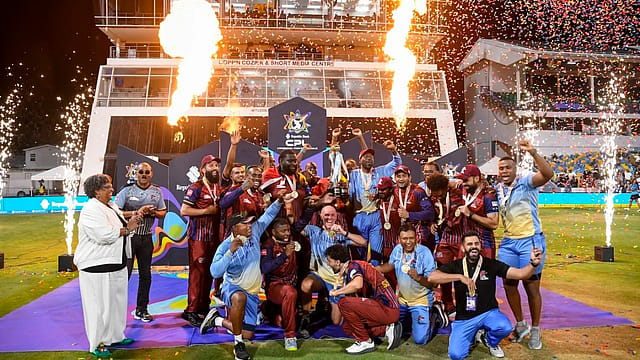
Saim Ayub hit the winning runs. His teammates lifted him into the air. Guyana finally had its night.
At Providence in September 2023, a Pakistani batter helped deliver the Guyana Amazon Warriors’ first Caribbean Premier League (CPL) title. Ayub finished unbeaten on 52 as the Warriors beat Trinbago Knight Riders by nine wickets. A photograph from the celebrations caught him being hoisted by his teammates. The imported talent was part of a deeply local triumph.
Three years later, another overseas batter supplied the finishing blow. Hasan Nawaz struck the winning six at Kensington Oval as Antigua and Barbuda Falcons defeated Jamaica Kingsmen to claim the recently concluded CPL. Alongside him was Trinidadian Amir Jangoo. Their unbroken partnership carried the Falcons to their maiden title on September 20.

Zeroing In on ECI
09 Oct 2026 - Vol 05 | Issue 41
Constitutional legitimacy versus political opportunism
For a region whose cricketers have become attractions in other people’s leagues, there is something satisfying about that reversal. The visitors come here too. The local shirt matters. The celebration belongs to the supporters whose name it carries.
This is where the CPL’s story acquires its force. West Indies lost the supremacy that once made it cricket’s most formidable collective. Its players helped shape T20, won world titles and became sought-after performers across franchise cricket. Even that international renaissance proved vulnerable. Yet the ability to make people want to watch survived.
The CPL gives that ability a recurring address.
When the world feared maroon
For anyone who watched West Indies in their pomp, the names still arrive like a team walking through the pavilion gate: Clive Lloyd, Vivian Richards, Gordon Greenidge, Desmond Haynes. Then the fast bowlers. Andy Roberts. Michael Holding. Joel Garner. Malcolm Marshall.
Success had the weight of repetition. West Indies won the first two men’s World Cups, in 1975 and 1979, and reached the final again in 1983. In Tests, the unbeaten series run that followed the 1980 defeat in New Zealand lasted until Australia won in the Caribbean in 1995. England suffered successive 5–0 series defeats in 1984 and 1985–86.

That consistency created its own theatre. A batter taking guard against the pace attack confronted both the next delivery and the accumulated reputation of the men delivering it. Richards’ arrival carried expectation before he had scored a run. Spectators watched to see how authority would be exercised.
The decline changed that relationship. Great individual performances could still command a room, but they no longer guaranteed a great team. The old names became the standard against which successive generations were judged, and eventually the people asked to explain what had gone wrong.
In July 2025, after West Indies were dismissed for 27 by Australia at Sabina Park, Cricket West Indies sought the counsel of Lloyd, Richards and Brian Lara. Australia had completed a 3–0 Test sweep. A region with that batting inheritance had been bowled out for a total that barely looked like an individual contribution.
The failures had accumulated over decades. Funding, facilities, administration and the competing opportunities available to players all formed part of the problem. The desire to revive the team had to contend with the practical conditions in which cricketers trained and earned a living.
A shorter game, a second crown
T20 created another way to impose yourself on a match.
A batter could change its direction in a handful of deliveries. A bowler who disguised pace or spin could deny an opponent the clean contact on which the format depended. A player capable of contributing in several disciplines could occupy a place that might otherwise require two specialists.
Caribbean cricket assembled an exceptional generation for those demands. Chris Gayle’s hitting offered one form of intimidation; Sunil Narine’s bowling offered another. Dwayne Bravo made changes of pace a weapon. Kieron Pollard and Andre Russell brought the possibility of a late assault that could keep an apparently lost chase alive.
Reducing their appeal to “natural flair” misses the construction beneath it. Power needs a base and a repeatable swing. Deception needs control. Finishing requires choices about which bowler, length and boundary to attack. The apparent ease is part of the spectacle; it should not erase the skill.
In the 2012 World Twenty20 final in Colombo, Marlon Samuels made 78 as West Indies reached 137 for six. Narine took three for nine as Sri Lanka were dismissed for 101. The title required recovery with the bat and precision with the ball.
Four years later came the scene that still supplies the quickest explanation of T20’s hold on a spectator. Eden Gardens. Nineteen needed from the last over. Carlos Brathwaite facing Ben Stokes.
Six. Six. Six. Six.
The first lifted possibility. The next changed the calculation. By the fourth, West Indies had their second men’s World T20 title. Samuels’ unbeaten 85 had kept them in the chase long enough for Brathwaite to finish it.
Here was the thrill of watching a match become something else before the viewer had time to adjust. Caribbean cricket had found another route to the centre of the sport.
The stars travelled. The troubles stayed
The chronology matters. The first T20 world title arrived in 2012. The CPL began in 2013. The league developed alongside an existing reinvention and could draw upon players who already knew how to win in the format.
Nor did the second title restore permanent supremacy. West Indies exited the 2022 T20 World Cup in the first round. In 2023, they failed to qualify for the men’s ODI World Cup for the first time. The 2024 T20 campaign ended in the Super Eight stage.
The troubles continued in bilateral cricket: Australia followed their 2025 Test sweep with a 5–0 T20I series win in the Caribbean. Shorter matches were no automatic refuge.
Meanwhile, the franchise game could continue to value individual Caribbean players highly. The two outcomes are compatible. A franchise can buy a specialist for one role and surround him with the people needed for the others. An international side depends on the depth, availability and balance of its own player pool.
Nicholas Pooran made the distinction painfully visible. In June 2025, he retired from international cricket at 29 after 106 T20 internationals. He had recently played for Lucknow Super Giants in the IPL, and Reuters reported that he was expected to continue in global T20 leagues. His international departure did not amount to the disappearance of his cricket.
For supporters, that can create an uncomfortable experience: delight in a player’s excellence elsewhere, frustration at his absence from the regional side. Describing every such choice as a failure of loyalty avoids the harder questions about careers, opportunity and the institutions responsible for sustaining them.
It also helps explain the value of a Caribbean franchise stage. There is somewhere at home for that cricket to live, even when its relationship with international cricket is complicated.
The pleasure of taking sides
The CPL’s promise of a party has a cricketing foundation. Its strongest attraction is the possibility of recognising a player, knowing what he can do and then having a reason to care whether he does it tonight.
That is why local allegiance matters. West Indies represents multiple nations and territories. The regional team brings them together; the CPL gives supporters another set of colours through which to take sides. An international teammate can become the opponent whose wicket you want.
An overseas player can become your player, too. Ayub’s place in Guyana’s 2023 celebration captures that better than a slogan. The connection is made through the work done in the shirt.
The 2026 final supplied a different piece of theatre. Rahkeem Cornwall scored 20 in the first over of the Falcons’ chase and was bowled off its final delivery. Six balls contained aggression, reward and an abrupt exit. The match then demanded something else: Jangoo and Nawaz supplied the partnership that finished it.
These changes of tempo make viewing rewarding. The next ball might extend the assault or end it. The batter who follows must interpret a different situation. A familiar player carries a history into that uncertainty, making the anticipation richer.
The crowd gives those moments an audible consequence. The league’s carnival identity invites spectators to participate in the occasion, while the contest gives their noise direction. Music can sustain an evening; allegiance makes a dismissal personal.
Calling all this “flair” is too easy. The magic comes from skill meeting uncertainty in front of people who have chosen a side.
A Caribbean accent in a crowded calendar
The CPL shares players and the broad franchise format with competitions such as the IPL, BBL, PSL and SA20. The Hundred competes for some of the same attention, although its innings consist of 100 balls.
In that environment, familiarity is useful but sameness is a danger. If the same players appear under interchangeable floodlights, why should another tournament become a habit?
The CPL’s answer is the context around the cricket: territorial identities, recognisable personalities and the relationship between the contest and its audience. Those qualities give a viewer something to remember beyond the result. Their commercial value depends on making the experience accessible.
The league’s own figures suggest distribution has helped. It reported combined digital and television viewing of 1.17 billion in 2025, up from 1.13 billion in 2024. It attributed part of its television growth to expanded Star India highlights, including Hindi coverage alongside English. Those are combined viewing figures, not a verified count of unique individuals or a basis for ranking leagues with different measurement systems.
The implication is useful: Caribbean cricket can retain a particular identity while finding new ways to invite people into it. A supporter abroad need not share a team’s geography to become attached to its cricket.
Keep the spark, build the next generation
The danger is to ask the CPL to carry a promise it cannot fulfil alone. A compelling tournament does not repair an entire cricket system, and a successful local season cannot erase an international defeat.
There is also a bill. The Sunday Times reported in December 2024 that the league and its franchises had accumulated losses of nearly US$40 million since launch. That is a historical figure, but it demonstrates why popularity and sustainability must be assessed separately.
The more consequential sporting question is who gets to become the next attraction. Cricket West Indies and the CPL jointly launched the West Indies Breakout League in 2025, with six territorial teams affiliated to CPL franchises. The initiative created competitive opportunities for players with limited senior T20 experience. Its value will emerge through their subsequent chances and development.
A league sustained only by memories of its great entertainers would eventually become a reunion. It needs the player whom spectators do not yet know, given enough opportunity to become someone they look forward to watching.
At Kensington Oval, the Falcons supplied a new championship story. At Providence three years earlier, Guyana had supplied its own. Such nights cannot reproduce the old West Indian dominance. They give the present a claim on the supporter’s affection.
For a region so often asked to explain what happened to its cricket, that has value. There are evenings when the question is simply who bowls next, how many are needed and whether this batter can do it.
The old crown is gone. There is still a match you do not want to miss.