New Zealand vs India | How India Made New Zealand Wait 31 Overs for 100
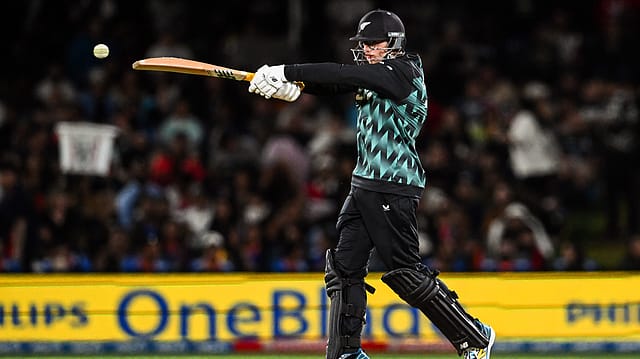
Daryl Mitchell hit Auqib Nabi for six in the 10th over in Wellington. It was the sort of shot a batting side needs when the ball is moving and both openers are back in the dressing room. The other five deliveries in the over were dots. New Zealand ended it at 29/3. Take away the six and they had scored 23 from the other 59 legal balls.
By 20 overs New Zealand were 53/5. The second block of 10 had yielded 24 runs, fewer than the first, and cost them Tom Latham and Glenn Phillips. At 31.2 overs they were 100/5. In a match reduced to 47 overs a side, exactly two-thirds of their batting time had gone.

The Era of Forever Wars
30 Oct 2026 - Vol 05 | Issue 44
Coping with an explosive Middle East
A collapse can happen quickly against the new ball in New Zealand. Wellington was more revealing because the struggle to score outlasted the collapse. India had taken five wickets before the 20-over mark. The next wicket could wait. New Zealand spent another 68 legal deliveries getting from 53 to 100 with the sixth-wicket pair still at the crease.
Where the Hamilton comparison breaks
At 29/3, the obvious parallel was Hamilton on February 25, 2018. England had New Zealand 28/3 after 10 overs that day. Latham was at the crease in both matches, with Ross Taylor in Hamilton and Daryl Mitchell in Wellington. The two scorecards were one run apart, and both batting sides had experienced players in the middle.
By 20 overs in Hamilton, Taylor and Latham had moved the score to 81/3. They added 53 in that block of 10 overs. In Wellington, New Zealand added 24 and lost two wickets over the same stretch. By 31.2 overs, the Hamilton side had reached 145/3. The difference between the two innings had grown from one run to 45, and it had done so through the part of the innings in which an experienced middle order might expect to get some control back.
There was a difference in the assignment. Taylor and Latham knew they needed 285. In Wellington, New Zealand were batting first, trying to work out what they could defend. A shorter innings made each quiet over more expensive. Latham faced 22 balls for seven before Brar had him caught. Phillips lasted four balls without scoring. India had cut into the batting New Zealand needed for the final overs while those overs were still a long way off.
What four overs for four runs bought India
Auqib Nabi dismissed Tim Seifert and Will Young. Anshul Kamboj bowled Henry Nicholls. The three wickets put New Zealand at 23/3 in the ninth over. Arshdeep Singh’s first four overs cost four runs. His wicket column was empty, but the batters could hardly afford to treat his end as somewhere to catch up. The first three men in the order faced 48 balls between them for 17 runs.
That is where New Zealand’s familiarity with home conditions came under examination. Their batters know the cost of following a ball that moves away. Leaving it or defending it buys time. It also makes a single valuable because it forces the bowler to change his plan for the next batter. India gave them little scope to turn defence into runs. At 20 overs, Mitchell had hit three fours and a six for 18 of his 24 runs. His other 43 deliveries had brought six.
Brar’s wickets mattered because a change of bowler is one of the first chances a batting side gets to test whether the pressure will ease. Latham had already spent more than three overs’ worth of balls at the crease when he fell. Phillips’s dismissal left Mitchell batting with Mitchell Santner and five wickets already gone. The longer they stayed together, the more the innings depended on when they could afford to take a risk.
The scorecard from 2013
New Zealand usually needed 19 overs to reach 100 at home. That was the median across 96 home ODI innings in the Cricsheet archive since February 2013 in which they reached three figures. In Wellington, they were 100/5 after 31 overs and two balls.
For a slower hundred, the archive takes you back to Eden Park on February 23, 2013. Steven Finn and James Anderson had New Zealand 18/3 after 10 overs. At the same point in the innings as Wellington, they were still 83/5. They finally reached 100 after 33 overs and five balls, with six wickets gone.
Wellington itself has seen a more violent collapse. South Africa had New Zealand 51/5 after 17 overs at the same ground in 2017 and eventually bowled them out for 112. Even that side crossed 100 in 29.1 overs, with nine down. India’s spell produced a different kind of discomfort. New Zealand had more batting left and took longer to get the runs.
Napier in December 2023 belongs in the comparison. Bangladesh had New Zealand at 98/9 at 31.2 and bowled them out two balls later. New Zealand never reached 100. The contrast is in the wickets that remained. Wellington’s pair survived, but for much of their stand they still had trouble finding the scoring rate an intact partnership usually brings. At 28.5 they were 84/5. Sixteen runs came from the next 15 legal balls, a late lift that made the overall rate look healthier than it had been for much of the afternoon.
That late burst gives the hundred its proper context. By the time Mitchell and Santner could score at about a run a ball, the innings had fewer than 16 overs left. New Zealand had spent most of the afternoon buying time at the crease. India had made sure that time came out of the part of the innings in which the hosts needed to score.