India vs New Zealand | Daryl Mitchell Again? The Banter No One Expects
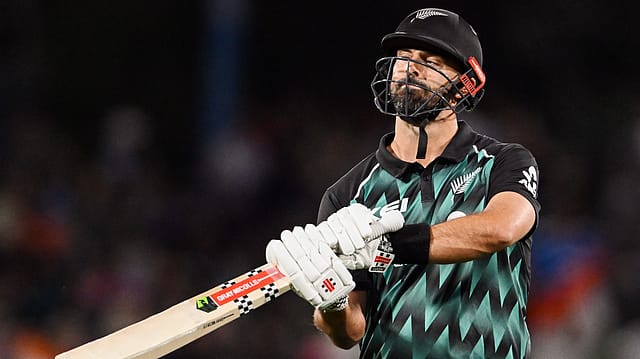
Blair Tickner backed away and showed Gurnoor Brar his stumps. It looked like an invitation to pitch the ball up. Brar had already been hit for six by the New Zealand No. 11, so he had reason to consider the offer. He went short again. Tickner tried to hit him down the ground and edged behind. Brar raised his arms. Tickner smiled.
There was enough at stake to make the exchange worth watching even with the sound off. New Zealand’s last pair had put on 39. Tickner had made 34 off 23 balls, with four sixes. A bowler trying to finish the innings had spent longer than he wanted bowling to a man whose main job was to bowl himself. And here was that man offering him advice on where to land the ball.

The Era of Forever Wars
30 Oct 2026 - Vol 05 | Issue 44
Coping with an explosive Middle East
The detail the clip needs is the six Tickner had already hit off Brar. It came at 36.2. By the time he showed his stumps, he had evidence that Brar could be hit and a reason to see if he could make him change his mind. Brar had a decision of his own. Following a batter who backs away can deny him the room he’s trying to make. The ball that got Tickner followed him towards the leg side, short enough to make a clean strike difficult. KL Rahul took the catch.
Why Mitchell again?
Three days later in Wellington, Brar exchanged words with Daryl Mitchell. We don’t have a reliable account of the words or the delivery. We do have the shape of the contest. Brar removed Tom Latham and Glenn Phillips, and New Zealand were 53/5 after 20 overs. Mitchell was 24 off 47. The bowler had helped strip away Mitchell’s partners, and the batter was one of the few men left who could make that opening count for less.
India had already seen how expensive it can be to let him settle. In Vadodara in January, Mitchell and Harshit Rana came into contact mid-pitch in the 42nd over and exchanged words. Mitchell made 84. He followed it with 131 not out in Rajkot and 137 in Indore, where New Zealand clinched their first ODI series win in India. For anyone inclined to remember only the clip from Vadodara, that’s 352 runs across the three games.
The other Mitchell story belongs here for a reason. In the 2021 World Cup semi-final, he declined a single because he felt he had impeded Adil Rashid. A quick run was valuable, and Mitchell knew it. The same player could decide that Rashid deserved a fair shot at the ball and still have plenty to say when he and an Indian fast bowler crossed paths. That’s a more credible portrait of a competitor than anything we can infer from a few seconds in Wellington.
Why everyone thinks of Australia
Mark Waugh asked how James Ormond could be one of England’s best 11. Ormond waited until the end of the over to tell Waugh that at least he was the best cricketer in his own family. Steve Waugh was in the Australian side. In Mark’s account, he laughed and walked away. Ormond had found a way to make the man questioning his place think about his own.
Tim Paine tried something similar with Rishabh Pant at the MCG, joking about babysitting after MS Dhoni returned to India’s ODI squad. Pant went after Paine’s job title, calling him a temporary captain. Each had picked the thing the other might be sensitive about. The joke held up away from the middle, too. Paine’s wife Bonnie posted a photograph of Pant with their children.
Michael Clarke gave the stump mic something different at the Gabba in 2013. James Anderson was about to face Mitchell Johnson when Clarke warned him to expect a broken arm. Clarke lost 20 per cent of his match fee. The line had a purpose and a penalty. Calling all three Australian exchanges banter would flatten the very thing that makes them worth comparing.
Which brings us back to Tickner. The stumps were visible, the bat was swinging and Brar knew exactly what the batter was asking him to change. Then came the delivery. That’s the bit the highlight needs to keep.