India vs New Zealand: Gurnoor Brar’s 4/30 in Wellington Put Him Between Kumble and Srinath
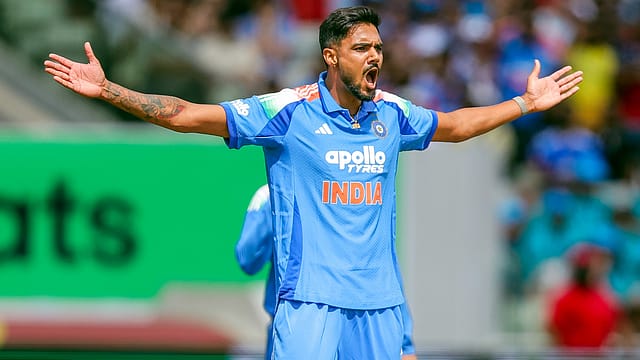
Mitchell Santner pulled Gurnoor Brar for six in Wellington and backed away again. The first ball, a bouncer at 137 kmph, had gone over deep square leg. Santner had bought himself enough room to swing. The next ball came at 143 kmph, back of a length and following him towards the leg side. He tried to steer it behind square. KL Rahul took the edge. Brar had lost a ball to Santner and learnt enough from it to win the next one.
He finished with 4/30, his first ODI four-wicket haul and the third-best figures by an Indian against New Zealand in a men’s ODI in New Zealand. Anil Kumble took 5/33 at Wellington’s Basin Reserve in 1994. Javagal Srinath took 4/23 at Eden Park on Boxing Day 2002. Brar took his four at Wellington Regional Stadium. Only Srinath has better figures among India’s fast bowlers in these games.

The Era of Forever Wars
30 Oct 2026 - Vol 05 | Issue 44
Coping with an explosive Middle East
What the old scorecards tell us
For two decades, the yardstick for India’s quicks against New Zealand on their grounds was Srinath’s 4/23 on Boxing Day 2002. He bowled three maidens at Eden Park and India still lost. Kumble’s 5/33 at the Basin Reserve had helped defend 255 eight years earlier. Kuldeep Yadav’s 4/39 in Napier and 4/45 at Mount Maunganui in 2019 now sit immediately below Brar’s spell. Those were wrist-spin returns. The pace comparisons after Srinath are his own 4/52 and Mohammed Shami’s 4/55 in Napier, then Arshdeep Singh’s 4/70 in Auckland three days before Wellington.
Arshdeep and Brar taking four in successive matches tells us more about India’s attack this week than the ranking alone. At Eden Park, Arshdeep took four and Brar took three. In Wellington, Arshdeep’s first four overs cost just four runs. Auqib Nabi took both openers and Anshul Kamboj bowled Henry Nicholls. Brar came on with the score already slow and the top order damaged. His job was to make sure the middle order still had to take a risk to score.
Two men at the boundary
Brar came on after India’s opening bowlers had made batting a chore. He was four overs in, with six runs conceded and no wickets, when he began the 20th. Tom Latham had seven when he pulled his 22nd ball to Naman Dhir at deep square leg. Glenn Phillips came out, faced four balls and tried the pull himself. His top edge went finer, to Anshul Kamboj. The score stayed at 53.
The two catches explain more about the spell than the speed gun does. Latham and Phillips could both see a scoring shot against the shorter ball. Brar had fielders in place for two ways it could go wrong. One caught the pull square and the other caught it fine. By the end of the over India had taken away two middle-order batters without giving up a run.
Santner later showed what happened when a batter got the pull right. Brar’s answer was to take away the space Santner had made for the shot. He had done something similar to Blair Tickner in Auckland, following the tailender as he backed away and drawing an edge after Tickner had hit him for six earlier in the innings. The ability to follow a moving batter at pace is a specific skill. It gave Brar a way to stay with his plan after the batter had shown him where it could fail.
The month his coach asked him to slow down
Brar grew up playing tennis-ball cricket in Mohali and took up formal training at 15. His father had played basketball at national level. By the time fast-bowling coach Varinder Singh worked with him, Brar had the height, about six feet five, and was already hitting the mid-130s as a teenager. The coach later asked him to spend a month bowling at about 100 kmph. They adjusted his action and worked on keeping him stable through delivery. The idea was to let him feel the changes and work on his swing before turning the speed back up.
He made his first-class debut for Punjab in 2022 and took 4/16 against Railways. An IPL debut for Punjab Kings followed in 2023. In the 2024–25 Ranji Trophy, he led Punjab with 26 wickets in seven matches at 20.30. Gujarat Titans had bought him for ₹1.3 crore at the 2024 auction. He was taking a nap during the 2026 IPL when India named him in their squads to face Afghanistan. His family rang first.
What India can ask of him
His first ODI brought 3/27 against Afghanistan in Dharamshala, his best until Wellington. England then took 97 off his 10 overs at Lord’s without losing a wicket to him. West Indies took 96 off him in Guwahati, where he picked up two wickets. Across those two series he took seven wickets and conceded 445 runs in 58 overs and one ball. In his first two games in New Zealand he took the same number of wickets for 74 runs in 19 overs and two balls. His economy went from 7.65 across six matches to 3.83 across two.
The gap is too wide to put down to a technical change we haven’t seen. The opponents, surfaces and match situations differed. Wellington does show how India made his strengths fit the situation. The new-ball bowlers had made singles difficult. Brar could afford to keep asking Latham and Phillips to hit towards protected boundaries. The shots were available because the ball was short. The catches were available because India had covered the two angles.
Santner made the problem harder. He got underneath one short ball and cleared the man on the boundary. Brar’s next delivery was a little fuller and 6 kmph quicker, and it followed him as he backed away. That change gave Rahul a catch behind the stumps after the earlier plan had brought catches in the deep. In his 11th ODI, Brar showed what India can ask of him through the middle of an innings. Keep the boundary in play when there are men to catch it, then take away the room when a batter shows he can clear them.