With Modi at Helm, BJP's Plans for 2029 Lok Sabha Election are Falling in Place
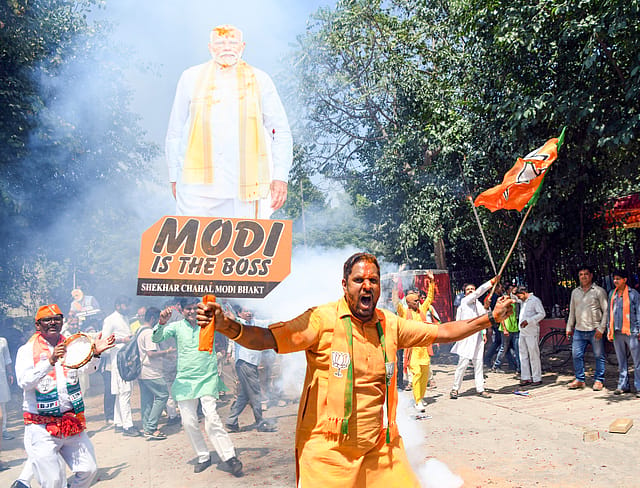
Sensing the mood was turning in the Bharatiya Janata Party’s favour, Prime Minister Narendra Modi decided on an “all in” approach to winning the West Bengal election raising the stakes in a contest that was already at fever pitch. While he held rallies and roadshows and bought jhal muri from a local vendor, home minister Amit Shah parked himself in Kolkata and conducted daily debriefings in the BJP war room that assessed campaign feedback and prepped for polling day on a daily basis.
Carefully considered decisions of how to best use BJP’s firepower in a tight contest paid off with a stunning victory in West Bengal whereas a pragmatic decision to play second fiddle in an alliance with AIADMK worked in Tamil Nadu. Despite BJP being the junior partner, ruling Dravida Munnetra Kazhagam (DMK) bigwigs spent most of the time attacking the saffron party and warning that AIADMK will be reduced to a hand maiden if the NDA comes to power. In the end, neither the federalism-regional identity card work nor frantic efforts to consolidate minority votes or promising enhanced welfare benefits save the two parties from an electoral meltdown.
Winning on Turning Pitches
After Congress and other INDIA bloc parties made significant gains in the 2024 Lok Sabha election, BJP has clawed back ground it ceded by winning a string of state elections. Barring Jharkhand where it failed to unseat Jharkhand Mukti Morcha (JMM), BJP has reversed the momentum not just marginally but turned the tables convincingly subjecting rivals to what in wrestling terminology is called a “dhobi pachad (flipping an opponent all ends up).” The radically altered electoral map has seen BJP rolling back setbacks in areas of its strength and also toppling regional forts that had offered stubborn resistance to the party’s onward march.

Open Minds 2026
26 Jun 2026 - Vol 05 | Issue 26
The power of ideas and arguments in 50 portraits
By the end of 2024, just months after BJP had tumbled to a sub-par 240 Lok Sabha seats, the party beat back the Congress challenge in Haryana winning a third consecutive term. In Maharashtra Congress-NCP-Uddhav Sena came a cropper, winning only 46 of 288 assembly seats. The first post-Article 370 election in Jammu and Kashmir saw National Conference forming the government but BJP retained its bastion of Jammu. This was followed by success in Delhi in early 2025 with BJP convincingly ousting bitter rival Aam Admi Party (AAP) and then NDA retained Bihar by a big margin later that year.
Regional Satraps
West Bengal and Tamil Nadu presented a more daunting challenge since neither Dravida Munnetra Kazhagam (DMK) or Trinamool Congress were push overs. Both parties are ideologically cohesive and organisationally strong outfits with a proven electoral track record. BJP was not seen to be in a winning position in Kerala – a factor that might have cost it support – but a 12 percent vote share offers hope for the future. It is Tamil Nadu and West Bengal that have given BJP a significant boost and can potentially energise the party’s run for the 2029 Lok Sabha. Retaining the 40-seat Puducherry assembly might seem a lesser achievement but it serves to underline the decline of Congress and the DMK even in the small union territory.
Evening the Odds
Of all the states going to poll, West Bengal stood out. It was evident from the start that the contest was not going to be fought in accordance to Queensberry Rules. No holds were barred and neither were knuckle dusters and there was no 10 second count for a knock down. Trinamool’s formidable election machinery that had borrowed and further improvised the Left Front’s stormtrooper model was a tough adversary. The blurring of the line between state government employees and the party meant the polling booth official was often aligned to the ruling party’s interests. Pursuit of the Muslim vote, welfare schemes to woo women voters and a flawed voter roll vulnerable to manipulation made for a winning formula.
The odds began to even as BJP drew on its 2021 lessons after a commendable 18 seats in the 2019 Lok Sabha polls had raised hopes of a regime change. At a time when polling was held under the overhang of Covid, BJP could not man all the booths nor could it counter Trinamool’s muscle flexing. The retribution voters faced after the results were out for not supporting Trinamool was even more demoralising. This time around BJP began its spadework early and ensured it had polling booth committees in almost all stations and despatched dozens of teams to gather feedback ahead of writing its manifesto. The heavy deployment of security forces and the promise they will remain in the state even after polling day worked. Leader of Opposition Suvendu Adhikari’s decision to challenge Chief Minister Mamata Banerjee in Bhabanipur boosted the morale of the BJP rank and file.
A Southern Sunset
Most pollsters missed the Tamil Nadu election by a mile. Even those who detected the undercurrent in favour of actor Vijay did not pick up the intense anti-incumbency against DMK that resulted in his TVK party sharing more than 60% of the vote with the AIADMK-led alliance. In a stunning reversal from the 2024 Lok Sabha where the absence of Vijay and the decision of BJP and AIADMK to contest separately helped DMK candidates win seats with large margins, the ruling party stood reduced to a little more than 50 seats. It is a hard blow for DMK leader M K Stalin to swallow as he framed the contest as one between “Delhi and Tamil Nadu.”
Though the Left Democratic Front (LDF) in Kerala also sought make “federalism” a factor in the polls, Trinamool and DMK positioned themselves firmly as protectors of regional identity and resistance against “monoculture” they said BJP represents. The exceptionalism often enough bordered on separatism. Stalin warned the delimitation proposals accompanying the Modi government’s constitutional amendment on implementing women’s reservations in legislatures would ignite fires all over Tamil Nadu. The shrillness in Stalin’s words seemed to hint he was looking for a distraction as the more astute political observers noted that AIADMK had been quite effective in pinning down DMK over its governance shortfalls.
BJP Plans Work
BJP’s success in replacing Congress and Left as the main opposition in West Bengal should have been evidence that it is overcoming the image of being an “outsider” party. Yet, many political pundits refused to consider the possibility even as voters decided they were no longer buying into a frayed identity narrative that glossed over lack of development and the demographic invasion from Bangladesh. DMK’s record in office is much better and the state has a low unemployment rate. But stories of corruption involving the ruling clan had been doing the rounds and a certain arrogance crept into the behaviour of DMK leaders. Oddly enough, Stalin also failed to see that Congress was an unreliable ally who brought very little to the table.