Tamil Nadu Assembly Election 2026: TVK’s Blockbuster Debut
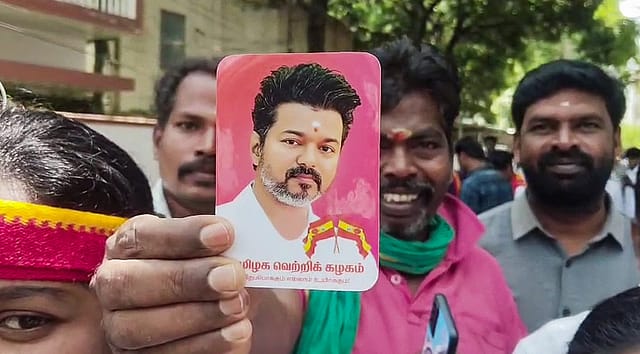
The sun did not rise over Chennai on May 4. A star did — actor-turned-politician C. Joseph Vijay, whose Tamila Vettri Kazhagam (TVK) eclipsed the incumbent Dravida Munnetra Kazhagam’s rising sun symbol in a historic 2026 mandate.
Under a thick blanket of clouds in the capital of Tamil Nadu on Monday morning, all of East Coast Road buzzed to the shrill soundtrack of whistles (TVK’s party symbol) and revving motorbikes, these two-wheelers often carrying more than one pillion rider. All of them were, of course, supporters of TVK, honking delirious in the party’s victory in the Tamil Nadu Assembly elections, all of them dressed in white and waving tall flags of red and yellow. All bikers on this coastal stretch seemed to split instinctively – between Vijay’s Neelankarai residence and the party headquarters in Panaiyur, a few kilometres away.
Despite immense police presence and wrought-iron barricades, both beach-side locations of matter on ECR witnessed heavy crowds, swelling further as the day progressed. At Neelankarai, a cheer tore through the air as Trisha Krishnan, Vijay’s close friend and co-star in several films, passed through the giant brown gates in a white Range Rover. In Panaiyur, a fan named Balamurugan, who had flown in from Kuala Lumpur this morning wearing Vijay’s face on his shirt, choked as he told a clutch of TV cameras: “We are witnessing a revolution. This is democracy at its finest.”
It is, for most unexpectedly, Vijay’s TVK crossed the majority mark in the 234-member Tamil Nadu Assembly, winning over 100 seats and emerged as the single largest party in its electoral debut. Vijay himself secured victories in both constituencies he contested — Perambur in north Chennai and Tiruchirapalli East in central Tamil Nadu — seats previously held by the DMK.

Open Minds 2026
26 Jun 2026 - Vol 05 | Issue 26
The power of ideas and arguments in 50 portraits
The result marked a historic setback for the DMK, with chief minister M. K. Stalin losing his own seat, and pointed to a broader unravelling of the party’s urban strongholds. It also signalled the most significant disruption to Tamil Nadu’s entrenched Dravidian political order in decades, with a first-time party not only breaching the DMK-AIADMK duopoly but doing so with a clear legislative majority, an outcome without recent precedent in the state’s electoral history.
In doing so, Vijay became the first figure since M. G. Ramachandran to convert mass cinematic appeal into a direct, statewide mandate for power, bridging the long-assumed gap between fandom and votes. The scale of that conversion was underscored by the campaign’s more turbulent moments, including the deadly stampede at a rally in Karur that left over 40 people dead — an episode that might have derailed a less consolidated movement. Instead, the constituency returned a TVK victory, reflecting the depth and resilience of the support that had been built. And, significantly, suggesting that the emotional connection between the star and his followers had, by polling day on April 23, hardened into a durable political base that ended up landing an unprecedented surge of votes for a first-time leader and party.
However, as the day and celebrations progressed on Monday, it did not feel like a surge. It felt like something being recognised for what it had been all along.
On the Vijay/TVK campaign trail, there had been signs — everywhere, really — but they were easy to dismiss as spectacle at the time, part of the familiar excess that Tamil Nadu’s insatiable craze for its biggest stars. Only now do they return with a different weight.
Take his roadshow in Perambur, for example, from early April. Vijay was seated in plain sight, in the front passenger seat of his campaign car, a large white recreational vehicle, framed with a massive, tint-free windscreen for best visibility. But it was nearly impossible to see him, sometimes even from a few feet away. Every square inch of the RV’s glass front would be covered in handprints, a fresh supply of palms seamlessly thickening the coat over and over again, until the windscreen itself seemed wholly fogged over, even though it was the stroke of noon in the peak of Chennai’s summer.
At the time, it was written off as mania for a celebrity. Now, it reads like something else.
The motorcade itself was slender — a cop car in the front, followed by a media van and rounded up by Vijay’s RV — but because of the sheer volume of the crowd surrounding the vehicle on foot, it had the feel of something far larger and monstrous, a slow-moving leviathan crawling through the city. Thousands upon thousands had surrounded the moving vehicles, so much so that bodyguards hung perilously on the outside, pressing up against the many entry points into the RV with their bodies. Flowers were thrown onto the windscreen, only for them to be wiped away by more hands so selfies could be clicked. Close or far, all hands in that swell were raised, each of those palms holding a smartphone, lenses trained at a blurry image of Vijay.
What stood out, even then, was how the crowd moved. It did not just gather; it travelled and held tight.
By the time the procession approached Perambur, the thousands surrounding the RV had melted into the waiting crowd of a few thousand more at the local bus terminus. Only once the police had successfully isolated the vehicle did Vijay emerge through the sunroof, microphone in hand, and the blast of noise had a seismic effect.
“Can you hear me?” he had asked, smiling — a pertinent question, for the roar below him was deafening.
He did not wait for the noise to settle, for it never really did. He spoke over it. Through it. The short and sharp speech was about the people’s anger, of what had not been delivered. “There is no rice to eat or water to drink in people's houses. How can we live like this?” he said, the soft features of his face tightening into an angry frown. And then, almost seamlessly, he shifted register.
“On the morning of April 23… wake up, get ready, keep your voter ID in your hand and go to the first booth near your house… vote for the whistle symbol. Because voting for anyone in TVK is akin to voting for me.”
Back then, it was just a rally cry, one among many. It reads now as instruction.
The story of this victory did not begin there, on that road, under that gruelling sun, inside that capsule of noise. It had been unfolding elsewhere, in rooms that did not make for spectacle, in routines that did not announce themselves.
A year earlier, in a small but crowded room in Thiruvanmiyur, TVK’s party office for the district of south Chennai, K.V. Damodaran stood leaning against a table and addressed a fleet of party workers seated cheek by jowl against the walls. Everyone in that office room was a devoted fan of Vijay. But what that man known as Damu was conducting there was not fandom.
“… let’s begin early, elections will come when it has to come. We shall begin our work before others. Tell your people to knock on all doors, rich or poor. You also do so personally,” he said, almost matter-of-factly. “Dairiyama sollunga. Speak without fear… don’t beg for votes, we don’t bow in front of anyone.”
There was devotion everywhere — on the walls, on the table, on the body. At one point, Damu unbuttoned his shirt and exposed his chest, revealing a tattoo of Vijay over his heart. “To me he is like a God,” he had said. “Imagine being lucky enough to be known on a first-name basis by your God. All of this happened because I started a rasigar mandram… that’s all I did.”
Because those rasigar mandrams, the fan clubs, that had once gathered to paste film posters through the night, to celebrate movie releases, to stand in lines for first-day-first-show, had, over time, become something else. Blood donation camps one day, flood relief the next, food drives, local coordination, communication across districts. What looked like devotion had slowly acquired function.
By the time it was named, first as a movement, then as a party — the structure was already there. The offices remained. The hierarchies held. Only the purpose changed. Inside that same room, another worker had put it more bluntly. “We have one shot only,” Prasanth said. “The people are ready to give us votes. It is up to us party workers to ensure we collect it.”
That sentence sits differently now.
Because by the time the campaign arrived in Perambur, the work he was referring to was already underway. The roadshow did not create the wave. It only revealed what had been set in motion. On that day in north Chennai, somewhere along the choked arteries between Perambur and the next halt, the procession simply gave way to its own excess — the crowds swelling beyond control, the police presence thinning against the surge. Word trickled through: the rally had been called off, Vijay had turned back. At the time, it felt like the limits of the movement. Now, it looks more like its scale. Because that excess did not disappear. It found its way, eventually, to where it mattered.
To the polling booths all across Tamil Nadu, where it finally counted.