Tamil Nadu Assembly Election 2026 Result: First Bout, First Blood
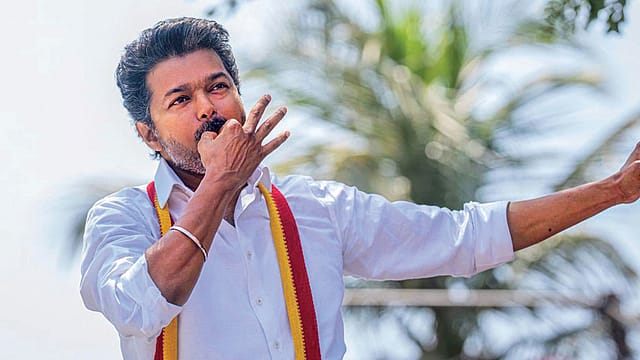
The majority mark in Tamil Nadu’s 234-seat assembly is 118. By midmorning on the fourth of May, the Tamilaga Vettri Kazhagam, launched in February 2024, with no sitting legislators, no coalition allies, and an actor for a president, had acquired a surprising lead. Around noon, TVK was leading in a 100-plus seats. The DMK, which has governed the state since 2021 and spent six decades building the most sophisticated political machine in southern India, was leading in 50-odd seats. The AIADMK was in the 60s. These are trends. But the direction has been consistent, and by noon it had acquired the quality of a verdict. In fact, TVK cadres and C Joseph Vijay’s family had by then commenced celebrations in videos that went viral on social media.
Tamil Nadu has not seen this before. Since CN Annadurai broke the Congress monopoly in 1967, the state has been governed by one of two parties, the DMK and the AIADMK, trading the office between them across 13 elections. Every attempt at a third force has collapsed: the Desiya Murpokku Dravida Kazhagam (DMDK) under Vijayakanth won 29 seats in 2011 and was reduced to zero by 2016; the Makkal Needhi Maiam (MNM) under Kamal Haasan won zero seats in 2021 and withdrew from the 2026 race entirely, backing the DMK-led alliance. The duopoly proved, again and again, that Tamil Nadu’s first-past-the-post system, combined with entrenched caste and community vote banks, made sustained insurgency arithmetically impossible.

Zeroing In on ECI
09 Oct 2026 - Vol 05 | Issue 41
Constitutional legitimacy versus political opportunism
Vijay appears not to have been informed of this. He contested all 234 seats alone, under the whistle symbol, refusing alliance with the DMK, the AIADMK, and the BJP. His instinct, or his adviser’s instinct, was correct: in a three-way contest without seat-sharing agreements bleeding votes to partners, every percentage point of TVK vote share translates cleanly into his own column. The DMK and the AIADMK contested as blocs, absorbing the inefficiencies and accumulated resentments of coalition partners. TVK had none to absorb.
What it had instead was a manifesto aimed at the demographic both Dravidian parties had been taking for granted for a decade: the educated unemployed. Tamil Nadu’s higher education gross enrolment ratio runs roughly twice the national average; its formal job creation has not kept pace. The TVK promised Rs 4,000 a month to unemployed graduates and Rs 2,500 to diploma holders as income support while they search for work. It promised five lakh paid internships annually and five lakh government jobs. It also promised to legislate a fixed 365-day ceiling on all government recruitment cycles, a direct strike at the bureaucratic inertia that has left hundreds of thousands of qualified candidates suspended between examination and appointment for years at a stretch.
The women’s vote, which was presumed to fall into the DMK’s kitty, was also addressed. The TVK’s Rs 2,500 monthly assistance for women homemakers, the manifesto’s flagship, outbid the DMK’s Kalaignar Magalir Urimai scheme, which pays Rs 1,000. Six free cooking gas cylinders annually. Eight grams of gold and a silk saree for brides from families earning under Rs 5 lakh. The fiscal arithmetic of these promises is, charitably, optimistic. At Tamil Nadu’s population scale, the monthly transfer alone is a significant recurring commitment for a state government already servicing a substantial debt load. And yet, the results of this targeting are visible in the trend map. TVK is leading across Chennai’s peri-urban belt, in Avadi, Poonamallee, Tiruvallur, Ponneri, the industrial corridor where young people from interior districts live, work in the organised and informal economy, and vote for whoever addresses the distance between their qualifications and their circumstances.
The comparison Vijay himself invited, repeatedly and deliberately, was to MG Ramachandran in 1977, the film star who left an established party, built his own, and took the government on his first attempt. MGR broke from the DMK after nearly two decades of organisational labour inside it, carrying established cadres and long political experience. Vijay built a party in two years out of fan-club infrastructure. If the trends indeed hold, he will have taken power roughly two years after founding his party. MGR took five. By that single measure, Vijay’s debut exceeds MGR’s.
As a party, TVK has no record of governance at any tier. Its spectacular manifesto pledges including an AI University, India’s first Ministry of Artificial Intelligence, and an AI City to position Tamil Nadu as the global hub for the technology are the kind of promises that mean nothing until someone draws up a tender. The government formation itself, if TVK falls short of 118, will require negotiations the party has no experience conducting.
However, none of this troubled the Tamil voter on April 23. What troubled the voter, evidently, was something simpler: six decades of the same two parties, and the reasonable suspicion that the arrangement had become its own purpose. Vijay gave Tamil Nadu’s electorate the thing it had lacked since Vijayakanth’s brief moment in 2011: a credible place to put the protest vote that was not the BJP. Unlike Vijayakanth, he appears to have built enough of a lead to make the protest consequential.
The duopoly is not dead. The AIADMK’s tally, if trends hold, would leave Palaniswami with a large opposition bloc. The DMK’s performance is a collapse from 159 seats in 2021 but with its caste coalitions and organisational depth, it’s not a party that will give up. Tamil Nadu’s electoral history does not permit permanent disruption; it permits one cycle of disruption before the system absorbs the disruptor or destroys him. Vijayakanth was destroyed. Kamal Haasan faded away. Vijay has arrived, in his first election, with more seats than either managed in a political lifetime. Whether he has arrived with the intelligence to survive what comes next is what the next five years will determine. For now, the counting continues. What comes next will be the real film.