SC Stays Defamation Trial Against Rahul Gandhi Over Remarks on PM Modi
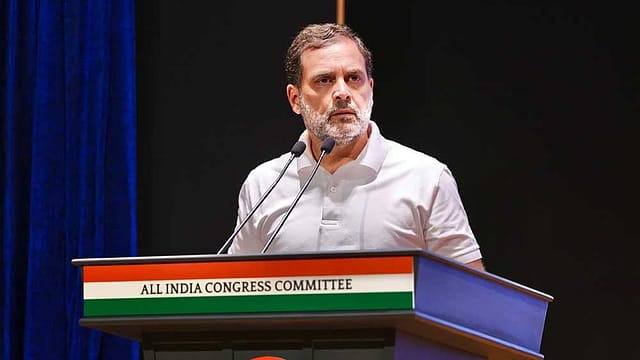
The Supreme Court on Tuesday stayed the trial court proceedings against Leader of the Opposition in the Lok Sabha Rahul Gandhi in a criminal defamation case over his alleged “Chowkidar Chor Hai” remarks about Prime Minister Narendra Modi.
A bench of Justices Vikram Nath and Aparesh Kumar Singh also issued notice to the Maharashtra government and complainant Mahesh Shrishrimal, seeking their responses in four weeks.
“Issue notice. Returnable in four weeks. Stay on trial,” the bench ordered. Senior Advocate Abhishek Manu Singhvi appeared for the Raebareli MP.
Gandhi had come to the apex court against the Bombay High Court’s order of September 8, which refused to quash the case.
THE COMPLAINT
The case stems from a complaint by Mahesh Shrishrimal, a BJP member, who alleged that Gandhi made defamatory remarks about Modi during campaigning. The remarks relate to the Rafale fighter jet deal.

Zeroing In on ECI
09 Oct 2026 - Vol 05 | Issue 41
Constitutional legitimacy versus political opportunism
Shrishrimal claimed they led to Modi being trolled across news channels and social media platforms.
According to the complaint, Gandhi used phrases such as “Chowkidar Chor Hai”, “Choron Ka Sardar” and “Commander-in-Thief”. Shrishrimal said these were defamatory not only to the Prime Minister but to the BJP as a whole, and sought Gandhi’s prosecution under Section 500 of the Indian Penal Code, which deals with defamation.
HOW THE CASE REACHED THE SUPREME COURT
The Girgaon Metropolitan Magistrate ordered proceedings against Gandhi on August 28, 2019. Gandhi says he learnt of the order only in July 2021, when he received the summons. He then moved the Bombay High Court to quash it.
In November 2021, the High Court directed the Magistrate to defer the hearing on the complaint, which meant Gandhi did not have to appear in person. The interim relief was extended several times over the following years.
Gandhi argued that political debate is the lifeblood of a democracy and should not be curtailed by “frivolous” defamation complaints. He said free speech protects criticism of public figures unless a statement is made with actual malice.
He also argued that Shrishrimal had no standing to file the complaint, since defamation can ordinarily be initiated only by the person defamed, and that the Magistrate had issued process mechanically.
Shrishrimal said he had made out a prima facie case by giving evidence in support of his complaint, and that he was himself an aggrieved person. The Maharashtra Advocate General, who assisted the High Court, argued that the material disclosed a prima facie offence, which limited the court’s power to quash the case.
WHAT THE HIGH COURT SAID
On September 8, the Bombay High Court dismissed Gandhi’s petition, saying it found no infirmity in the Magistrate’s order. It relied on a Delhi High Court judgment in a case involving Shashi Tharoor, which held that a registered political party is an identifiable and definite body.
That reasoning was used against Gandhi’s argument that Shrishrimal could not sue on behalf of the party.
The High Court did, however, give Gandhi six weeks of relief from appearing before the Magistrate, so that he could approach the Supreme Court. Tuesday’s order goes further. The stay on the trial means the proceedings before the Magistrate remain frozen until the apex court decides the matter.
The Supreme Court will hear the case again after the Maharashtra government and Shrishrimal file their replies. Until then, the trial court cannot proceed.
With inputs from ANI