Rajya Sabha Polls: BJP’s 8 Fresh Faces Among 12 Candidates In Fray For 10 UP Seats
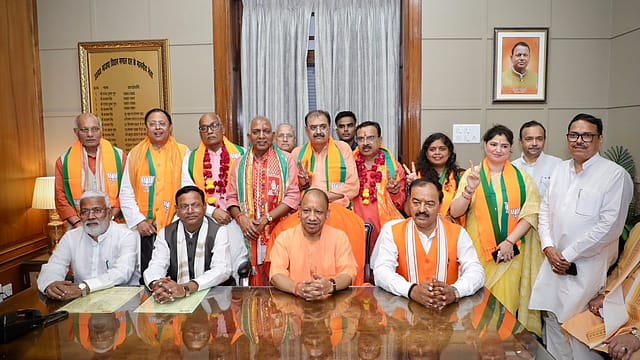
The Rajya Sabha contest in Uttar Pradesh may have produced 12 nomination papers for 10 seats, but the political arithmetic is already pointing towards a much quieter ending than the nomination numbers suggest.
Eight BJP candidates, two from the Samajwadi Party and two Independents have entered the race. The BJP's nominations represent a particularly significant reshuffle: the party has chosen not to renominate any of its eight outgoing members, including Union minister Hardeep Singh Puri and former Union minister BL Verma.
The SP, meanwhile, has nominated veteran parliamentarian Ram Gopal Yadav and Dhanraj Parimal Nathwani, a Reliance Industries executive and sports administrator whose entry into electoral politics has been one of the more unexpected developments of the contest.
With the SP deciding against putting up a third candidate, all 10 seats are now expected to be filled without a vote, subject to scrutiny and withdrawal of nominations.
The Modi Years
02 Oct 2026 - Vol 05 | Issue 40
A Nation Rebuilt
But the list of names is worth examining because it says as much about Uttar Pradesh's political equations ahead of the 2027 Assembly election as it does about representation in the Upper House.
The BJP has nominated Dharampal Singh, Radhakant Ojha, Prakash Pal, Vidyasagar Sonkar, Gopi Krishna Pandey, Priyanka Singh Rawat, Ram Pratap Singh Chauhan and Shruti Gangwar.
The selection has been widely read as an exercise in social balancing. The slate includes three OBC candidates, two Scheduled Caste candidates and three from the general category, besides two women.
More importantly, several of the nominees are drawn from the BJP's state organisation rather than being established national figures. That makes the list relevant not merely to the Rajya Sabha but to the party's preparations for the next Uttar Pradesh Assembly election.
KNOW THE 8 BJP CANDIDATES
Dharampal Singh is the most prominent political figure among the BJP's new nominees. A senior BJP leader from the Aonla region of Bareilly, he is a multiple-term MLA and serves as a minister in the Uttar Pradesh government, handling the Animal Husbandry and Dairy Development portfolios. His nomination gives the BJP a candidate with considerable legislative and governmental experience, while also strengthening its representation of the Lodh OBC community.
Radhakant Ojha brings a legal background to the BJP's list. A senior advocate, he has been associated with the Allahabad High Court Bar Association and has held a prominent position within the legal community.
Prakash Pal is the BJP's OBC Morcha chief in Uttar Pradesh and is therefore an important organisational pick. His nomination carries an obvious political message in a state where caste arithmetic remains central to electoral politics. The BJP has been keen to counter the Samajwadi Party's emphasis on its PDA—Pichhda, Dalit, Alpsankhyak—coalition, and Pal's elevation gives the party a prominent OBC face in the Upper House.
Vidyasagar Sonkar is among the BJP's more experienced organisational politicians. He has served as an MLC and has held senior responsibilities in the Uttar Pradesh BJP organisation. He has also previously been a Member of Parliament.
Gopi Krishna Pandey is one of the less publicly prominent names on the BJP list. He has been associated with the party's Kisan Morcha and has held responsibilities connected with the organisation's farmer outreach in several states.
Priyanka Singh Rawat is one of the BJP's two women nominees and among the more recognisable names in the list. A former Lok Sabha MP, she has also held an organisational position as a vice-president of the Uttar Pradesh BJP. Her selection gives the party both a woman representative and an experienced politician with a previous parliamentary record.
Ram Pratap Singh Chauhan is a senior BJP organisation leader and has served as the party's state general secretary. He has also previously been an MLA from the Etmadpur constituency in Agra. His inclusion reinforces a pattern running through the BJP's list: several of the party's new Rajya Sabha faces have worked inside the organisation rather than being sitting MPs seeking another term.
Shruti Gangwar is the second woman in the BJP's eight-member slate. She is the daughter of Santosh Gangwar, the veteran BJP politician who is currently Governor of Jharkhand. A prominent figure in the Uttar Pradesh BJP, her nomination brings a younger face and a political family connection into the party's Rajya Sabha group.
WHO ARE THE TWO SP CANDIDATES
The Samajwadi Party's two nominees are markedly different from the BJP's largely organisational slate. Ram Gopal Yadav requires little introduction in Uttar Pradesh politics. A veteran Samajwadi Party leader and uncle of party chief Akhilesh Yadav, he has spent decades in Parliament and is one of the SP's most experienced voices in national politics.
His nomination was the predictable part of the SP's Rajya Sabha strategy. His parliamentary experience provides the party with a seasoned hand at a time when the Upper House remains important for opposition parties that lack a majority in the Lok Sabha. Yadav's return also underlines the importance the SP continues to attach to experienced parliamentary representation.
If Ram Gopal Yadav represents conventional SP politics, Dhanraj Parimal Nathwani represents something quite different. A senior executive associated with Reliance Industries, Nathwani is also a sports administrator and has been involved in cricket administration in Gujarat. He succeeded Union Home Minister Amit Shah as president of the Gujarat Cricket Association and has worked across corporate, sports and public-facing initiatives.
His nomination surprised many within political circles precisely because he does not come from the traditional political route associated with SP candidates. Nathwani, 40, described his entry into the Rajya Sabha as a new phase of his public life. His nomination also brings a corporate and sports-administration profile into the SP's parliamentary representation.
His nomination affidavit has attracted attention for another reason. He declared total family assets of more than Rs 373 crore, making him one of the wealthiest recent Rajya Sabha candidates from Uttar Pradesh.
AND THEN THERE ARE THE INDEPENDENTS
Two Independent candidates have also filed nominations, Omkar Nath Chaurasiya and Kante Sayanna. Unlike the BJP and SP nominees, neither has emerged as a significant political contender in the broader public debate around the election. Their nominations nevertheless take the total number of candidates to 12 for 10 seats.
The scrutiny of nominations on October 7 and the withdrawal deadline on October 9 will determine the final field.
The most revealing aspect of this election is not simply who is entering the Rajya Sabha. It is who the BJP has chosen to leave out.
All eight outgoing BJP members from Uttar Pradesh have been dropped from the new list. Among them are Hardeep Singh Puri, BL Verma, Arun Singh, Seema Dwivedi, Neeraj Shekhar, Brij Lal and Geeta Shakya. Dinesh Sharma's seat had already fallen vacant after he resigned from the Rajya Sabha following his appointment as Lieutenant Governor of the Andaman and Nicobar Islands.
That makes the BJP's exercise a complete reset of its Uttar Pradesh Rajya Sabha representation.
Uttar Pradesh is heading towards its next Assembly election in 2027, and the BJP's new slate combines government experience, organisational workers, OBC and Dalit representation, women and regional considerations.
In that sense, the Rajya Sabha nominations are also an early indication of how the BJP is thinking about the much bigger electoral battle ahead.
With inputs from ANI