"Democracy wrecker": BJP hits out at Rahul Gandhi after FIR over Akashvani Bhavan ruckus
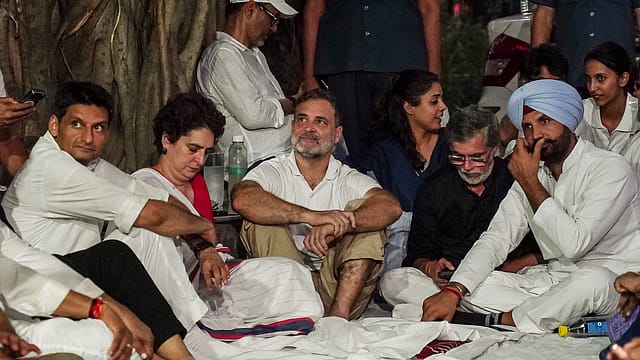
What began as an Opposition march towards the Election Commission of India turned into a prolonged confrontation between INDIA bloc leaders and the Delhi Police, and has now opened another front in the political battle between the BJP and the Congress.
The Delhi Police has registered an FIR against Leader of Opposition in the Lok Sabha Rahul Gandhi, Congress MP Priyanka Gandhi Vadra and others over their alleged entry into the Akashvani Bhavan premises during Tuesday’s protest against the Election Commission.
The action has triggered a familiar political counterattack: the Opposition has accused the government of using state institutions to suppress dissent, while the BJP has accused Rahul Gandhi of deliberately undermining constitutional institutions.
The episode came after Opposition MPs attempted to march from Parliament Street towards the Election Commission headquarters, located only a few hundred metres away.
The Modi Years
02 Oct 2026 - Vol 05 | Issue 40
A Nation Rebuilt
The march was stopped by barricades and a heavy police presence. Several Opposition leaders were detained, but Rahul and Priyanka Gandhi subsequently entered the nearby Akashvani Bhavan premises and continued the protest there.
The standoff eventually continued for hours. Police later detained the Gandhi siblings and other Opposition leaders before releasing them. The FIR has now given the BJP another opportunity to turn the confrontation into a larger political argument over Rahul Gandhi's conduct as Leader of the Opposition.
RAHUL GANDHI IS “CREATING ANARCHY”: BJP
The BJP has mounted a sharp attack on Gandhi, accusing him of turning political protest into an attempt to discredit India's constitutional institutions.
BJP National Spokesperson CR Kesavan described Gandhi as a “spoilsport” and accused him of becoming a “democracy wrecker”, alleging that the Congress leader was resorting to disruptive tactics because he had been unable to defeat the BJP electorally.
“Rahul Gandhi is similar to an unstable spoilsport who flips the game board when they are losing,” Kesavan said, alleging that Gandhi was attempting to create “anarchy and chaos”.
He further accused the Congress leader of playing the “victim card” by attacking constitutional institutions rather than behaving like a responsible Leader of the Opposition.
The BJP's broader argument is that the Opposition's protests are not merely about electoral procedure but are part of a sustained effort to undermine public confidence in the Election Commission.
BJP MLC Parinay Fuke similarly accused Gandhi of using the protests to “defame the country”, arguing that such political confrontations create obstacles to India's development at a time when the government says the economy is expanding, industrialisation is accelerating and foreign investment is increasing.
For the BJP, therefore, the Akashvani episode is being presented as evidence of a larger problem: an Opposition unwilling to accept the legitimacy of institutions when their decisions do not suit it.
OPPOSITION SAYS FIR IS POLITICAL INTIMIDATION
The Congress and its INDIA bloc allies have rejected the allegations of forcible entry and accused the government of attempting to intimidate the Opposition.
Congress MP Imran Masood said Gandhi had entered the premises along with fellow parliamentarians and had not broken any law.
“Rahul Gandhi is the LoP and was accompanied by MPs. He did not enter anywhere forcibly,” Masood said, adding that the Congress would continue its fight despite the FIR.
JMM leader Manoj Pandey went further, accusing the government of behaving like a “dictatorial” regime.
“What can you expect from a dictatorial government?” Pandey said, arguing that Gandhi's decision to take the protest to the streets demonstrated his willingness to fight for public issues.
The competing descriptions of the episode—“democracy wrecker” from the BJP and “dictatorship” from the Opposition—capture the increasingly polarised language surrounding India's electoral institutions.
WHAT WAS THE PROTEST ABOUT?
The immediate dispute goes beyond the Akashvani Bhavan episode.
The INDIA bloc's demonstration was aimed at the Election Commission and Chief Election Commissioner Gyanesh Kumar. Opposition parties have been alleging irregularities in electoral rolls and have repeatedly used the phrase “vote chori” to describe what they claim are problems in the electoral process.
At the centre of the controversy is the Election Commission's Special Intensive Revision (SIR) of electoral rolls and wider allegations concerning the preparation and revision of voter lists. The Opposition has demanded accountability from the Election Commission and, in particular, called for Kumar's resignation.
The BJP and the Election Commission have rejected the Opposition's allegations. The Election Commission has also disputed claims surrounding the protest, with officials saying they had not received a formal request from a political party seeking a meeting with the poll panel at the time of the standoff.
That disagreement over the electoral rolls has increasingly become a political battle over the credibility of the institution itself.
Tuesday's protest took a dramatic turn after the Opposition march was stopped near the NITI Aayog office.
Rahul Gandhi climbed a police barricade and waved the Tricolour as Opposition MPs and supporters raised slogans against the Election Commission. As police began detaining protesters and moving them into buses, the demonstration appeared to be winding down.
Then came the unexpected move.
Rahul and Priyanka Gandhi entered the Akashvani Bhavan premises, where they continued the protest. Other Congress leaders, including KC Venugopal and Pawan Khera, subsequently joined them. The move reportedly caught even some Opposition leaders by surprise and prolonged a protest that police had been attempting to disperse.
The Gandhi siblings remained inside the premises under a banyan tree as security personnel surrounded the area. Congress leaders insisted they would not leave unless they were allowed to meet the Election Commission.
The police eventually detained the protesters. More than 250 people, including around 50 MPs, were detained during the wider protest, according to reports, although the exact numbers varied across accounts. Rahul and Priyanka Gandhi were subsequently released.
A NEW FLASHPOINT IN THE FIGHT OVER EC
The significance of the FIR extends beyond the immediate allegations of unauthorised entry.
For the Congress, the episode reinforces its argument that the government is unwilling to allow the Opposition to directly challenge the Election Commission. For the BJP, the same incident demonstrates what it describes as Gandhi's disregard for institutional boundaries.
The confrontation also comes at a politically sensitive moment. The Opposition has increasingly made the Election Commission and alleged electoral irregularities a central part of its political messaging. Gandhi has repeatedly framed the issue as a question of protecting democratic representation, while the BJP has accused him of making unsubstantiated allegations against institutions that are constitutionally expected to function independently.
The Akashvani Bhavan episode has therefore become more than a dispute over where protesters were allowed to go. It has become another contest over the political meaning of dissent itself.
The Congress says it is defending democracy by challenging an institution it believes has failed to answer legitimate questions. The BJP says Gandhi is damaging democracy by attacking the credibility of that very institution.
With the FIR now formally registered, that battle is likely to move from the streets of central Delhi into another, potentially longer political and legal confrontation.
With inputs from ANI