Assembly Election 2026 Result: Assam is Now a Saffron Fort in the North East
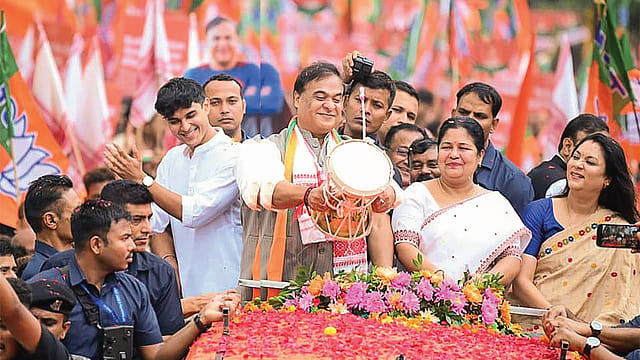
The BJP’s comfortable sweep towards victory in Assam is along expected lines. In March and April, just before the rains hit the state, the Opposition was not only missing in action but was still trying to figure coalition arrangements. In Lower Assam—the state’s most demographically challenged region—the All-India United Democratic Front (AIUDF), the party of Bengali Muslims—was in retreat. In Upper Assam, the Raijor Dal (RD) of Akhil Gogoi was in no position to challenge the BJP except for some pinpricks here and there.
What undid the Opposition was the utter disarray in the Congress party, the alleged anchor for the Opposition. The spate of exits from the party, the series of errors by its leadership and the total disregard for the wishes of the electorate led the party to its Waterloo. Perhaps it would be more accurate to say that the party’s boat collapsed on some unknown char, as riverine islands in the Brahmaputra are known in Assam.

Losing Memory
16 Oct 2026 - Vol 05 | Issue 42
The making of a medical and social emergency
The trends show this very clearly. Of the 124 out of 126 trends made available by the Election Commission in the afternoon, the BJP was leading in 79 seats. Its alliance partners, the Asom Gana Parishad (AGP) and the Bodoland People’s Front (BPF) at 8 seats and 10 seats, respectively, gave the National Democratic Alliance (NDA) a lead in 97 seats. In contrast, the Congress was way behind at 25 and its alliance partner, the RD in another two seats. The total number of seats in the Assam assembly is 126. It is a foregone conclusion that the BJP will return to power in Dispur for the third successive time since its first victory in the saddle in 2016.
The situation for the Congress is so bad that, Gaurav Gogoi, the face of the party in Assam and its candidate from the prestigious Jorhat constituency, was trailing behind Hitendra Nath Goswami—a veteran politician and a former Speaker of the assembly—after 12 rounds of counting. Goswami had told Open earlier in April that he wanted to call it a day but that he found duty-bound to answer the challenge posed by the Congress.
HINDUTVA RESPLENDANT?
The people of Assam dislike being described as “communal” merely because they vote for the BJP. But given the scale of demographic inversion of the Hindu population in the state due to mass migration from Bangladesh and erstwhile East Pakistan, it is not surprising that there is Hindu consolidation in the state.
The electoral trend clearly shows this.
Of the 25 candidates of the Congress party who are leading in different constituencies, 19 are Muslims. The BJP outsourced the problem of attracting Muslims to its partner, the AGP. Of the 26 seats given to the AGP, the party fielded 13 Muslim candidates. Most of these were in Lower Assam and a handful elsewhere. In the trends until afternoon, where the party was leading, none of its Muslim candidates were in the lead.
The campaign did not witness aggressive pitch for Hindutva by chief minister Himanta Biswa Sarma or any other leaders. The campaign was in favour of the massive development and the build up of infrastructure in the state carried out in the past five years. Yet, the undercurrent of illegal migration and the warring interests of the “migrants’ parties” and those championing the rights of indigenous peoples is obvious to any observer of Assam’s politics.