Why the Yamuna Expressway Keeps Turning Deadly, and What the Data Reveals
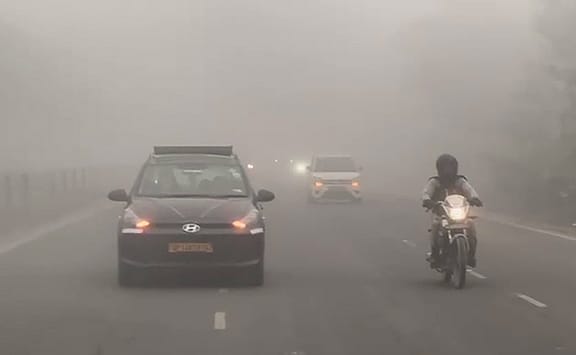
The latest tragedy on the Yamuna Expressway unfolded in the pre-dawn hours of December 16, 2025, when a massive 11-vehicle pile-up near Mathura killed at least 13 people and left dozens injured. The crash, which occurred around 4 am at Milestone 127, was triggered by near-zero visibility as a dense fog descended suddenly on the highway. Eight buses and three smaller vehicles rammed into one another in a chain reaction that ended in a raging fire.
Stretching 165 kilometres from Greater Noida to Agra, the Yamuna Expressway has quietly earned a deadly reputation. RTI data obtained by activist KC Jain shows that between 2012 and 2023, the expressway recorded 7,625 accidents, resulting in 1,320 deaths and 11,168 injuries. In 2023 alone, the road averaged one death every four days and two injuries daily.
Despite CCTV cameras every five kilometres and speed-monitoring systems, the severity and frequency of crashes continue to rise. In fact, 2023 saw nearly 100 more accidents than the previous year, highlighting the limits of existing safety measures.
Drowsy Driving: The Biggest Killer on the Expressway
Contrary to popular belief, speed is not the primary culprit. RTI data reveals that driver fatigue is the single largest cause of accidents on the Yamuna Expressway. Cases where drivers “dozed off” account for 3,364 crashes—44% of all accidents—claiming 522 lives through 2023, with the trend continuing into 2024 and 2025.

The MissOil Strike
03 Apr 2026 - Vol 04 | Issue 65
The War on Energy Security
The expressway’s smooth, monotonous surface and long overnight journeys induce what experts call “highway hypnosis”. While speed cameras can flag violations, they are incapable of detecting microsleep episodes, where drivers lose awareness for seconds—often with fatal consequences.
A Pattern of Preventable Tragedies
Several accidents have seared themselves into public memory. In July 2019, a sleeper bus plunged into a 40-foot drain, killing 29 passengers after the driver fell asleep. In November 2024, dense fog led to a truck-bus collision near Tappal, killing five. The December 2025 pile-up, with victims burned beyond recognition, is the latest in a long line of disasters.
Each incident points to the same failure: an inability to manage high-risk conditions such as night driving and winter fog.
Built at a cost of ₹12,839 crore, the expressway was meant to be a showcase of modern engineering. Yet a CSIR–CRRI road safety audit found that 23% of fatal crashes involved median impacts, often due to incorrectly installed or damaged guardrails. Many recommendations—repairing barriers, repositioning signboards, and redesigning crash-prone stretches—remain largely unimplemented even years later.
Fog Turns the Expressway Into a Death Trap
Running parallel to the Yamuna river, the highway becomes especially hazardous in winter. Visibility often drops to zero, yet the expressway lacks variable speed limits, fog sensors, and early-warning systems. The result is predictable: sudden pile-ups involving buses and trucks hurtling into stationary traffic before drivers even realise what’s ahead.
Another neglected danger is pedestrian movement. Despite being an access-controlled highway, 39 pedestrians were killed between 2012 and 2023, with 16 deaths in 2023 alone. Illegal bus stops and weak enforcement have forced passengers to board and disembark directly on the expressway—turning it into a shared space it was never designed to be.
Speed Cameras Miss the Real Threat
While over-speeding contributes to about 23% of crashes, fatigue-related accidents are nearly twice as common. Yet enforcement remains fixated on speed violations—over 2.33 crore cases in the early years—without addressing driver exhaustion, long-haul schedules, or overnight bus operations.
The data points to clear solutions: mandatory rest stops every 50 km, fatigue-monitoring systems in commercial vehicles, variable speed limits during fog, and stricter controls on overnight bus travel. As early as 2015, CRRI recommended rumble strips, better crash barriers and safety audits—most of which remain on paper.
The Yamuna Expressway was built to save time. Today, it urgently needs reforms to save lives. Without them, India’s deadliest highway will continue to exact a brutal toll.
(yMedia is the content partner for this story)