Why is the SSB Warning Its Jawans About Honey Traps and APK Files?
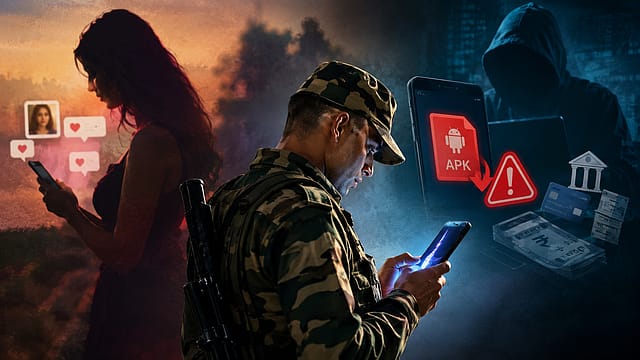
The Sashastra Seema Bal (SSB), which guards India’s borders with Nepal and Bhutan, has told its personnel to beware of online honey traps, suspicious APK files and cyber fraud.
The advisory, issued at the end of a cyber security awareness week, urges them not to share private photographs or videos, not to entertain suspicious video calls, never to give out OTPs, PINs or passwords, and to report fraud at once on the 1930 helpline or at cybercrime.gov.in. Its mantra is “Stop, think, check, then act.”
What exactly is a “honey trap”?
It is a lure in which a stranger, usually posing as an attractive woman, builds trust with a target through flattery and emotional closeness, then exploits it. The aim may be money, compromising material to blackmail the target, or secrets.
The SSB’s advisory says fraudsters “use fake identities and emotional manipulation to gain trust” before compromising personal, sensitive and financial information.

Zeroing In on ECI
09 Oct 2026 - Vol 05 | Issue 41
Constitutional legitimacy versus political opportunism
Is this about spies, or about scammers?
Both, and the same trick serves each. Foreign intelligence operatives use fake profiles to extract military information. Criminal gangs use the same script to extort money, often through a video call that is recorded and then used for blackmail. That is why the advisory warns about “suspicious video calls” and “demands for money” in the same breath as sharing private photographs.
Why is this being flagged now?
The timing is close to a live case. On October 7, Andhra Pradesh Police said 18 people, 13 of them Navy personnel, were being investigated in an alleged espionage conspiracy for Pakistan, under an operation called Firewall-2026.
Police said female Pakistani intelligence operatives approached defence personnel through fake Facebook and Instagram profiles, and paid some of them for ship movements and other sensitive information.
One accused is alleged to have shared an OTP that was used to activate a WhatsApp account for a Pakistani operative.
That detail explains the OTP warning. A one-time password is not only a way to steal money. It can also hand an adversary an anonymous communication channel.
Is this a new problem for the forces?
No. In 2018, a BSF jawan was arrested after being drawn into a long online chat with a woman who posed as a defence reporter. In 2019, an Army jawan in Jaisalmer was arrested after chatting with a suspected ISI operative using the profile “Anika Chopra,” and the Army began tracking multiple accounts to see who else had been contacted.
The government told Parliament in 2019 that Pakistan’s ISI was honey-trapping armed forces personnel, and the Army was reported to have tracked nearly 150 profiles used to target them.
A DRDO scientist was arrested in 2023 after what investigators called a Pakistani honey trap, though he has said he was a victim of it.
In March 2026, the Uttar Pradesh ATS arrested a Navy man posted in Kochi for allegedly spying for the ISI.
What has changed is reach. Social media lets a handler in another country contact hundreds of serving personnel at almost no cost.
What’s wrong with an APK file?
An APK is the file format Android uses to install apps. Apps from the Play Store are screened, while one sent over WhatsApp or SMS is not. Criminals disguise malicious APKs as a KYC update, a courier notice or an electricity-bill fix.
Once installed, such a file can read messages, including OTPs, and let a stranger operate the phone. A police report cited in a roundup of recent cases describes a Mumbai KYC-app scam that hit 2,993 victims and cost Rs 63.69 crore.
Security forces have faced this threat for years. India told Parliament in 2017 that Pakistan’s agencies were seeding malware in mobile games and music apps to spy on Indian security forces, and the Army reportedly asked its personnel in 2020 to delete about 50 apps.
How big is the cyber fraud problem?
According to Ministry of Home Affairs data, losses to cyber fraud rose from Rs 7,465 crore in 2023 to Rs 22,845 crore in 2024, and complaints on the national portal rose from 24 lakh to 36 lakh.
Cumulative losses reported on the portal since 2021 have passed Rs 55,000 crore across more than 65 lakh complaints. The 1930 system, which freezes stolen money in bank accounts, has saved over Rs 11,000 crore across more than 32 lakh complaints.
The Home Ministry’s own agency, the Indian Cyber Crime Coordination Centre, has also warned that the real losses may be several times higher than the reported figures.
Why are border-force personnel especially exposed?
Personnel are often posted far from home for long stretches, rely heavily on phones to stay in touch with their families, and have a regular salary. Those are the conditions in which online friendship, a romantic approach or an urgent request for money can work.
A border force has the added problem that its members hold information that matters, such as postings, movements and local intelligence. The SSB guards 1,751 km of the Nepal border and 699 km of the Bhutan border.
What is the SSB?
It was set up as the Special Service Bureau on May 15, 1963, after the 1962 war with China, and was brought under the Home Ministry on January 15, 2001. It was given the Nepal border on June 19, 2001, and the Bhutan border on March 12, 2004.
Its charter includes promoting a sense of security among border residents, preventing trans-border crime and illegal crossings, and checking smuggling.
What should we do?
Verify before any transaction, install apps only from trusted stores, never share OTPs, PINs, passwords or banking details, and stay wary of unknown calls, links and QR codes. If cheated, call 1930 at once, since quick reporting is what allows banks to freeze the money, and file a complaint at cybercrime.gov.in. The advice is the same for civilians as for soldiers.
With inputs from ANI