Yogi Calls Congress “Farcical”; Ashwini Vaishnaw Dares Opposition to Debate in Parliament
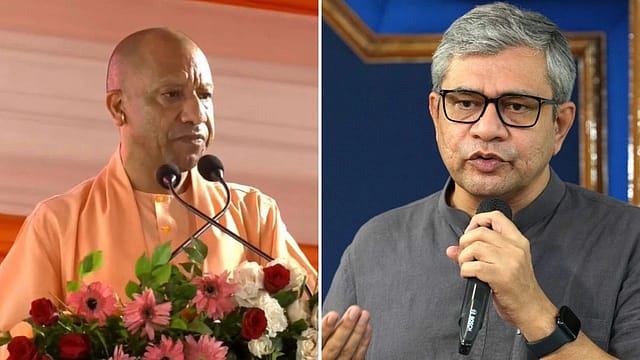
Uttar Pradesh Chief Minister Yogi Adityanath and Union Minister Ashwini Vaishnaw hit out at the Congress on Thursday over its criticism of the Election Commission and EVMs, with the first calling the party’s lessons on democracy “truly farcical” and the second challenging the Opposition to bring its arguments to Parliament.
“TRULY FARCICAL”: YOGI IN GHAZIABAD
Adityanath led the BJP’s “Loktantra Bachao, Arajakta Hatao” (Save Democracy, Remove Anarchy) padyatra in Ghaziabad. He accused the Congress of undermining the credibility of India’s democratic institutions for its “selfish interests.”
“Today the Congress is lecturing us about democracy. This is the very same Congress that imposed an Emergency in the country in 1975,” he said. “For the Congress, a party that once harboured designs to impose an Emergency, to lecture us on democracy today creates a truly farcical situation.” The party, he said, claims a win as a testament to its own merit, but blames the EVMs when it loses.

The Era of Forever Wars
30 Oct 2026 - Vol 05 | Issue 44
Coping with an explosive Middle East
He said that making derogatory remarks about constitutional institutions has become a habit for the Congress, and that doing so insults the legacy of India’s freedom fighters.
Adityanath credited Prime Minister Narendra Modi with a transformation since 2014. “Before 2014, there was such a pervasive sense of distrust, chaos, Naxalism, terrorism, and corruption that no individual felt safe,” he said. India, he said, is no longer part of the “Fragile Five” and now stands among the world’s top four economies.
He also accused the Congress and the Samajwadi Party of opposing the Ram Temple in Ayodhya, saying they “fought against it in the courts and confronted the devotees on the streets.” He set the temple beside Kashi Vishwanath Dham, Kedarnath’s reconstruction and the Bharat Mandapam, and the 4 crore homes built under the Pradhan Mantri Awas Yojana.
The march was part of a three-day BJP campaign across six organisational regions of Uttar Pradesh, held from November 3 to 5.
“COME TO PARLIAMENT”: VAISHNAW IN JAIPUR
Speaking at the BJP’s campaign event in Jaipur, Vaishnaw, the Union minister for Railways, Information and Broadcasting, and Electronics and IT, made a veiled attack on Leader of the Opposition Rahul Gandhi. “Come to the Parliament, we will debate on whatever topic you want,” he said. “Come on, let’s go at it; we aren’t scared of you.”
The debate, he said, should be in the House and not on social media. He said PM Modi had raised India to a position where it can deal with any country on equal terms, and that “we are now taking the fight to the very dens of our adversaries.”
On EVMs, Vaishnaw said the people criticising them are the ones who introduced them. “Before the advent of EVMs, one never knew what was being stuffed into the ballot boxes once the clock struck 5 PM,” he said. In 50 years in opposition, leaders such as Atal Bihari Vajpayee and LK Advani never made allegations against an institution, he said. “Look at what happened in Keralam; who won there? It is a classic case of a ‘bad workman quarrelling with his tools’.”
He added that Home Minister Amit Shah has dismantled Naxalism and said the government is committed to ending the drug menace across the country, not only in Punjab.
Rajasthan Chief Minister Bhajanlal Sharma, who welcomed Vaishnaw at his residence and discussed development projects with him, asked what the Congress could know about democracy, pointing to the number of governments it had toppled. The party, he said, will one day become a laughing stock, and it keeps levelling accusations at institutions such as the CBI, the ED and the Election Commission.
EVMs were first used in 1982 in a by-election in Kerala’s Paravur constituency. The Supreme Court held that they could not be used without a legal provision, and the Rajiv Gandhi government amended the Representation of the People Act in 1989 to allow them. They were used in all constituencies in a Lok Sabha election for the first time in 2004.
With inputs from ANI