Why a Corporate CEO Walked Away to Tell Stories Through Bharatanatyam, Books and Film
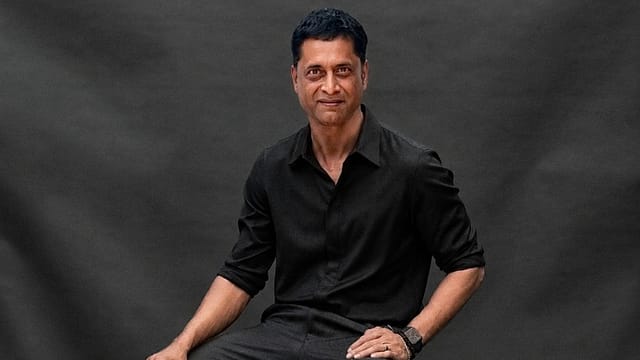
AK Srikanth spent years learning how to run companies. Now he runs fictional worlds.
The difference, he jokes, is that characters can be removed with a well-timed plot twist. Corporate personnel problems rarely offer that luxury.
Humour makes the transition sound easier than it was. Srikanth followed a trajectory that Indian families understand and approve of: engineering at BITS Pilani, an MBA from Case Western Reserve University in the United States and a long corporate career that eventually took him to the corner office. He became CEO of KLAY Schools, one of India’s better-known childcare and early education companies.
Then he walked away. He did not leave to enter a creative industry waiting to receive him. There was no large studio, publishing advance or guaranteed audience on the other side. What he had was a parallel life he had been quietly constructing for nearly a decade.
That life began with Bharatanatyam.

Zeroing In on ECI
09 Oct 2026 - Vol 05 | Issue 41
Constitutional legitimacy versus political opportunism
Srikanth was neither a dancer nor someone raised for a career in the classical arts. He entered that world as a writer and producer, working with dancer and choreographer Savitha Sastry on contemporary dance-theatre productions. Soul Cages, Yudh, The Prophet and Chains: Love Stories of Shadows used the grammar of Bharatanatyam to tell stories that moved beyond its conventional mythological and religious repertoire.
The experiment gradually expanded from stage to screen. Since 2018, Srikanth has written and directed a series of short films, including Dvija, Beyond the Rains, Slow Rivers and Ghost of the Lighthouse. His films have circulated through independent festival networks, although their journey has remained far removed from the publicity machinery and commercial reach of mainstream cinema.
His most ambitious attempt at crossing mediums is A Song for Eresha. The story, set around a fictional classical arts institute, follows a revered artist whose carefully ordered existence begins to unravel after the arrival of a young exchange student. Srikanth first shot it as a 125-minute feature and then developed the screenplay into a 418-page novel.
The film is available for rental or purchase on Apple TV and Amazon Prime Video in several international markets. The novel has been released in print, digital and audiobook formats, with Srikanth narrating the audio edition himself. Neither has yet become a mainstream commercial or critical breakout.
That may be precisely what makes his journey worth examining.
Leaving a corner office to become an independent storyteller is not simply a change of profession. It is an exchange of certainty for work whose value may remain subjective, whose audience must be found one reader or viewer at a time, and whose success cannot always be captured on a spreadsheet.
In a conversation with Open Digital, Srikanth discusses why he chose the blank page over the boardroom, why Bharatanatyam became his creative language and why one story demanded to be written and filmed. Excerpts:
You had reached the position many professionals spend their careers chasing. Why leave the corporate world for the uncertainty of writing and filmmaking?
In my head, I have always been a writer. I do not remember this myself, but some of my older relatives still talk about a series called The Adventures of Capt. John that I apparently wrote when I was seven or eight. Unfortunately, no copies have survived.
For about a decade, I balanced my corporate career with work in the arts. I was writing scripts that eventually became theatre productions or short films. By the time I started working on A Song for Eresha, the writing and filmmaking had begun demanding much more of my time and energy. I had reached a point where I had to decide whether this would remain something I did alongside my career or become the centre of my life.
That was when I made the leap and committed myself full-time to what had always been my first love. I am fascinated by human emotions and the many shades of human nature. Most of my stories are deliberately not tied to a particular period. Circumstances change across generations, but the emotions driving people remain remarkably consistent. Exploring those emotional landscapes is what keeps drawing me back to writing.
Why did Bharatanatyam become central to your storytelling when you were neither trained nor working as a dancer?
It is a world I have come to know intimately. I have spent many years within the classical arts ecosystem, although as a producer and writer rather than as a performer. That position allowed me to observe its beauty, discipline and traditions, but also its ambitions, relationships and tensions.
It is an extraordinarily layered world populated by artists who are also complicated human beings. Those experiences naturally began entering my stories. I do not treat Indian classical dance as an exotic setting meant to attract attention. It is simply one of the communities I know best. The backdrop may be distinctly Indian, but questions of identity, ambition, love, sacrifice, belonging and legacy are not confined to one culture.
What made A Song for Eresha different from the stories you had already written for the stage and screen?
It is probably the only story I have worked on in which the novel and the film offer two genuinely different experiences despite following the same narrative.
For the novel, I created a fictional town called Azhagankarai, inspired by the mangrove marshlands of Muthupet in Tamil Nadu. I also created Aalayam, the institute that forms the heart of the story. In the book, the setting becomes almost as important as the characters. Its landscape, atmosphere and rhythms shape the narrative.
The film takes a tighter route. It concentrates on the central characters and pulls the viewer immediately into their emotional conflict. Cinema demands a different economy. It cannot always accommodate the kind of interiority and world-building available to a novel. The book allows readers to inhabit the world. The film brings them closer to the conflict. I do not see one as a substitute for the other. They are two different routes into the same story.
Did the film lead to the novel, or was the plan always to create the story in two forms?
They were developed almost simultaneously. The film was shot first and the novel was adapted from the screenplay after principal photography, but both belonged to the same creative journey. The release sequence differed between markets. In some places, the film and book arrived together. In the United States, the book preceded the film by about a month. In India, the book is available ahead of the film. Readers have particularly responded to the descriptions, pacing and deeper development of the characters. Those are precisely the elements that made me believe the story needed to exist as a novel. A film can show you a world, but a book can sometimes allow you to remain inside it longer.
Indian classical arts are culturally specific. What makes you believe these stories can travel beyond Indian audiences?
Human emotions travel more easily than cultural explanations. Stories ultimately revolve around relationships, choices, aspirations and circumstances that affect people everywhere. Every person is capable of tremendous heroism and profound failure, sometimes simultaneously. That contradiction is what makes human beings interesting to me. An audience does not necessarily need to share a character’s language, profession or cultural background to recognise love, ambition, insecurity, sacrifice or longing. The setting gives a story its texture. Emotion gives it the possibility of travelling.
Which identity now matters most to you: CEO, director or writer?
The writer, without question. Everything begins there. It is where characters come alive and entire worlds emerge from imagination and observation. Before there is a film, production or business around a project, there is the story. I am also extremely possessive of my stories, which is probably why I direct their screen versions myself. Every project I have directed has originated from my own script. For me, directing is an extension of writing and a way of protecting the essence of the story as it moves from page to screen.
Being a CEO in the conventional corporate sense does not figure anywhere on my list now. Those years taught me a great deal, but I find myself repeatedly returning to the blank page. That is where I feel most at home. Of course, I remain the CEO of every world I create. I set its rules, determine people’s fates and occasionally solve difficult personnel issues with a plot twist.