US Trade Deal Nears ‘Landing Point’, China Ties Need Stable Border: EAM Jaishankar
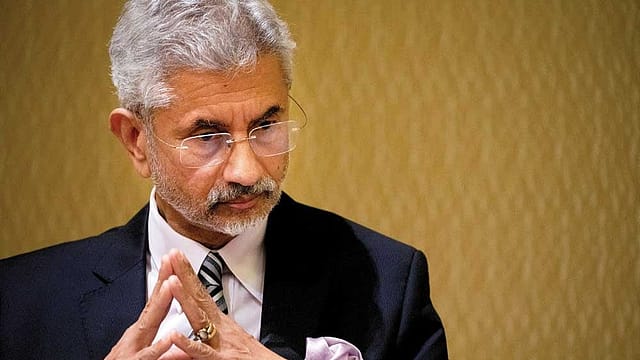
India’s trade negotiations with the United States are heading towards a “landing point”, External Affairs Minister S Jaishankar said on Tuesday, while making clear that improving relations with China would depend on stability along the border.
Speaking to Bloomberg’s John Micklethwait in New Delhi, Jaishankar outlined how India was pursuing closer economic ties with Washington and Europe while maintaining its longstanding relationship with Moscow. The approach, he said, rested on partnerships that preserved India’s freedom to make its own strategic choices.
His assessment of the US talks was positive but stopped short of announcing a breakthrough. Trade officials were still working through outstanding issues, including how India’s eventual terms would compare with those secured by competing economies.
“They’re ironing it out. My sense is that this is an issue which is heading towards a landing point,” he said.

Zeroing In on ECI
09 Oct 2026 - Vol 05 | Issue 41
Constitutional legitimacy versus political opportunism
US TRADE TALKS ADVANCE, BUT NO DEAL ANNOUNCED
Jaishankar said negotiations were “pretty far advanced”, although some elements remained unsettled.
“When countries negotiate with an economy like the United States, obviously one part of it is what you work out between yourselves and the US, and one part of it is how you fare vis-a-vis competitive economies,” he said.
That second calculation remained uncertain because other countries had yet to finalise their agreements with Washington.
His remarks followed US Trade Representative Jamieson Greer’s assessment earlier this month that negotiations were approaching their final stretch. Greer had nevertheless cautioned that an announcement was not imminent, saying both sides had identified the sticking points and were working to resolve them.
Jaishankar placed the negotiations within a wider shift in American economic policy. Washington’s use of tariffs, he argued, reflected its determination to rebuild its industrial base and change the terms on which other countries accessed its market.
“The reality is the United States has repositioned itself. It’s changed the manner in which it engages the world, the basis on which it engages the world,” he said.
India’s underlying convergence with the US remained intact, he added. Unlike treaty allies renegotiating the terms of their alliances, India was managing a strategic partnership built around shared interests.
CHINA: BORDER PEACE COMES FIRST
On China, Jaishankar drew a distinction between resolving the boundary dispute and maintaining the conditions needed for business and broader engagement.
India was not demanding a final border settlement before economic relations could progress, he said. It was insisting on peace and tranquillity along the frontier.
“If you want a normal relationship, if the rest of the relationship is to move, it’s common sense. It’s a no-brainer that the boundary has to be stable,” he said.
Jaishankar recalled that no lives had been lost in border clashes between 1975 and 2020, a period during which bilateral relations expanded. The deadly confrontation in 2020 marked a profound break and damaged the wider relationship.
He said conditions had settled considerably since 2024 following prolonged negotiations, allowing ties to move towards normalcy.
Greater Chinese investment was under active discussion, he added, while business, investment and market-access policies would be addressed separately from negotiations over the boundary itself.
TRADE IMBALANCE REMAINS A CHINA PROBLEM
A calmer border would not resolve India’s economic concerns with Beijing.
Jaishankar pointed to the heavily skewed trade balance and barriers facing Indian businesses in sectors where they had succeeded elsewhere.
“We do believe today that we’re not getting a level playing field in China in the manner in which we have given a level playing field to them,” he said.
The message was that rebuilding the relationship required attention to both security and commercial reciprocity. Improved diplomatic engagement had not removed India’s concerns about access to the Chinese market.
EUROPE OFFERS A BIGGER ECONOMIC OPENING
Alongside the US negotiations, Jaishankar presented the India–European Union free trade agreement as a major opportunity to reach a large, affluent market.
Calling 2026 India’s “Europe Year”, he pointed to the visits of the European Commission and Council presidents for Republic Day and the momentum behind the trade agreement.
“We have closed out our FTA with Europe,” he said, expressing hope that it would enter into force by the end of this year or early next year.
“What it does for us is that it actually opens up an enormous and mature market with great purchasing power,” he added.
The EU’s publicly stated timetable has been more cautious. Ambassador to India Jean-Eric Paquet said on October 9 that the aim was to conclude the agreement by the end of 2026 and bring it into force during 2027.
Paquet also expressed hope that an investment protection agreement, still under negotiation, would accompany the FTA and help strengthen supply chains and reduce strategic dependencies.
Jaishankar said India’s European engagement should be understood on its own terms. The trade negotiations had been well advanced before Canadian Prime Minister Mark Carney’s Davos remarks on the changing global order.
“I won’t force-fit what I’m doing with Europe into Prime Minister Carney’s paradigm,” he said.
RUSSIA NEEDS OPTIONS BEYOND CHINA
India’s expanding Western partnerships, Jaishankar argued, were compatible with maintaining its relationship with Russia.
He described Moscow’s relationship with Europe as “broken” and “embittered” by the Ukraine war, pushing Russia increasingly towards Asia, particularly China.
It was in India’s interest, and the wider world’s, for Russia to retain other consequential partnerships in the region, he said.
“We are a natural option in that regard because we’ve had very decent relations with Russia from pretty much the early start,” Jaishankar said.
Maintaining those ties reassured Moscow that a relationship built over 75–80 years remained steady despite changes in its dealings with the West.
“It has had a steady impact on the balance of power and overall status quo in Asia, and we think that’s a good thing,” he said.
The remarks came as the EU expanded sanctions against Russia’s military-industrial network, underscoring the increasingly different approaches taken by Moscow’s European and Asian partners.
AI NEEDS GUARDRAILS AND A WIDER SAY
The discussion also turned to another source of global power: artificial intelligence.
Calling AI the “mother of all technologies”, Jaishankar said its reach would be far broader than that of nuclear technology, making comparisons between their regulatory models imperfect.
“AI is, in that sense, the mother of all technologies. It’s going to be far more pervasive. It is going to be far more impactful on our everyday life,” he said.
Debate needed to move beyond chips, computing capacity, financing and energy consumption to the consequences of applying AI to people’s lives, he argued. Democratic societies also had legitimate concerns about its effects on politics and the credibility of political processes.
Jaishankar called for regulation, safeguards and a more serious discussion of responsibility. Just as importantly, he said, people needed access to the technology and a voice in how it affected them, rather than leaving control entirely with forces beyond their influence.
With inputs from ANI