What is Climate Injustice? Why CJI Surya Kant Says the Poor Are Paying Twice for a Crisis They Barely Created
The smoke rose in Manchester. The bill can arrive in Mumbai.
Coal powered British factories, steamships and railways. Oil propelled American cars, aircraft and suburban expansion. Europe and North America burnt fossil fuels for generations while accumulating the capital, technology and infrastructure that made them rich.
Now countries still attempting their own industrial ascent are being told that the furnace must cool quickly.
The planet cannot wait. The carbon budget is shrinking. Temperatures are rising. Yet the demand creates an argument that cannot be settled by science alone: who must move first, who should move fastest and who pays for the transition?
Chief Justice of India Surya Kant has supplied the dispute with two words: Climate injustice.

Zeroing In on ECI
09 Oct 2026 - Vol 05 | Issue 41
Constitutional legitimacy versus political opportunism
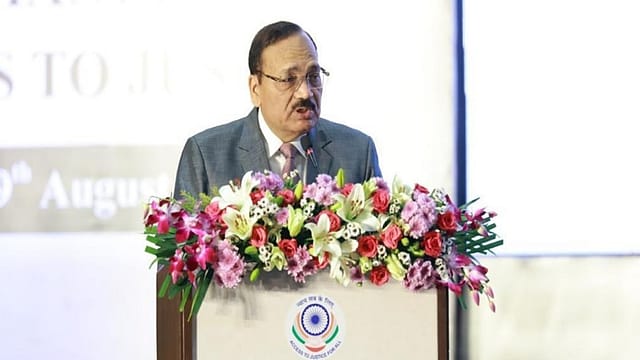
Addressing the High-Level Commonwealth Policy Dialogue on Climate Justice at Marlborough House in London, Kant said developing countries were being pushed to abandon fossil fuels rapidly and criticised when they failed to move fast enough. The countries demanding that acceleration, he pointed out, had spent two centuries building economic power on coal and oil.
His argument went beyond unequal responsibility for causing global warming. He described two connected injustices: the poor face a disproportionate share of climate damage, and then shoulder an unfair share of the cost of preventing it.
A small farmer can lose a harvest to a drought he did little to create. His country may then borrow money to build irrigation, reinforce roads and install renewable power. Interest accumulates on the loan. The atmosphere accumulates somebody else’s carbon.
The Global South is handed two bills. One for surviving the damage. Another for escaping the fuel that caused it.
Why is the Chief Justice Talking About Climate Change?
Climate change once appeared to belong mainly to scientists, diplomats and environment ministries. It now enters courtrooms disguised as dozens of different disputes.
A village challenges a mine that threatens its water. Residents sue over lethal air pollution. An island nation demands accountability for rising seas. A renewable-energy project collides with wildlife protection. A community displaced by a dam asks whether development can erase its rights.
Judges must then weigh electricity, employment and infrastructure against land, health, biodiversity and survival.
“The role of a Judge is therefore changing,” Kant said. “It is no longer enough to know what the law says; we must also understand the world to which that law is being applied.”
That world brings hydrology reports, emissions models, geological assessments and public-policy choices into litigation. Courts increasingly encounter questions on which legislatures have offered incomplete guidance and scientists can provide probabilities rather than certainty.
India’s Supreme Court has already crossed an important threshold.
In its March 2024 judgment in MK Ranjitsinh and Others versus Union of India, delivered during litigation over power lines threatening the Great Indian Bustard, the court recognised a right against the adverse effects of climate change under Articles 14 and 21 of the Constitution.
The judgment also revealed the difficulty of converting that right into decisions. Undergrounding power cables could protect an endangered bird. Overhead transmission lines could help carry renewable electricity and reduce emissions. Ecological protection and climate action, usually presented as allies, had collided.
The court modified an earlier blanket approach and appointed an expert committee to examine where undergrounding was feasible. It did not discover a painless answer. It created a process for choosing between competing environmental claims.
Kant’s London speech places that Indian experience within a larger judicial movement.
In July 2025, the International Court of Justice delivered a unanimous advisory opinion describing climate change as an urgent and existential threat. The ICJ held that states have legal obligations to protect the climate system, regulate private actors and cooperate on mitigation and adaptation. A breach of those obligations could constitute an internationally wrongful act and potentially trigger reparations where legal responsibility and causation can be established.
The opinion does not operate like an enforceable judgment against a particular country. Its authority lies in changing the vocabulary of climate diplomacy. Emissions are no longer only a policy preference or a voluntary promise. They can produce questions of duty, injury and liability.
That explains why judges are speaking about climate justice. Climate change is becoming law.
Who Consumed the Carbon Budget?
Kant’s argument begins with history.
Carbon dioxide can remain in the atmosphere for centuries. Present warming is driven by the accumulation of emissions over time, which means the date on which a country industrialised matters.
Data compiled by the Global Carbon Budget and presented by Our World in Data show that the United States has contributed roughly a quarter of cumulative fossil-fuel and industrial carbon dioxide emissions since 1751. Europe is another major historical contributor.
In 1900, Europe and the US produced more than 90 per cent of annual global carbon dioxide emissions. Even in 1950, their combined share remained above 85 per cent. China, India, Brazil and much of Africa entered the industrial story much later.
The contemporary picture has changed. China is now the largest annual emitter. India overtook the European Union to become the third-largest source of energy-related carbon dioxide emissions in 2023, according to the International Energy Agency.
Yet national totals conceal another inequality.
The IEA estimated India’s per-capita carbon dioxide emissions at around two tonnes in 2023, less than half the global average. Per-capita emissions in advanced economies remained about 70 per cent above the world average.
India’s position captures the climate argument in miniature. It is too large to be treated as a minor emitter, too poor to be measured as though every Indian consumes energy like an American, and too vulnerable to pretend that delaying action carries no domestic cost.
The distinction between annual, historical and per-capita emissions determines how responsibility is framed.
If only current national emissions matter, China and India must make enormous reductions quickly. If historical emissions matter, the US and Europe carry a much larger obligation. If per-capita emissions matter, poorer nations retain a stronger claim to the remaining atmospheric space.
Climate diplomacy attempts to reconcile these measures through “common but differentiated responsibilities and respective capabilities”, or CBDR-RC.
The principle was embedded in the 1992 UN Framework Convention on Climate Change. Every country must protect the climate, but developed nations should lead because they contributed more to the problem and possess greater financial and technological capacity. Kant’s speech translates that diplomatic phrase into plain language: countries that took two centuries to become rich cannot demand that poorer nations complete the same energy transformation in a few decades without supplying money, technology and room to develop.
The Money Promised and the Money Delivered
Climate justice begins to fracture when the speeches end and the invoices arrive.
Developing countries need money to close coal plants, expand electricity networks, install renewable energy, electrify transport and redesign industries. They also need money for damage that can no longer be prevented: flood defences, heat-resistant cities, drought-proof crops, stronger hospitals and the relocation of communities exposed to rising seas.
The world calls the first task mitigation and the second adaptation.
Funding falls far short of both. The United Nations Environment Programme estimates that developing countries will require between $310 billion and $365 billion annually for adaptation by 2035. International public adaptation finance flowing to them amounted to only $26 billion in 2023, down from $28 billion a year earlier.
The requirement is 12 to 14 times the available flow. At the 2009 Copenhagen climate summit, developed countries promised to mobilise $100 billion a year for developing nations by 2020. The target was achieved only in 2022, according to the UN, two years late. A large share arrived through loans rather than grants, adding debt to countries already paying to recover from disasters.
At COP29 in Baku in 2024, governments agreed on a new goal of at least $300 billion annually by 2035 and called for wider public and private flows to rise to $1.3 trillion.
Developing nations attacked the core figure as inadequate. Their complaint was not simply about its size. It concerned who supplies the money, whether it arrives as grants or debt, how easily it can be accessed and whether private investment is being counted as a substitute for public responsibility.
A vulnerable country can therefore experience climate finance as another injustice. It borrows to reconstruct infrastructure destroyed by emissions generated elsewhere, then diverts future revenue to repay the loan.
The cyclone passes. The debt remains.
When Clean Energy Leaves a Dirty Mine
Kant introduced a second complication that receives less attention.
A wind turbine, electric car or solar-storage system may operate without burning fossil fuel. Manufacturing it still requires the earth to be opened.
Copper carries electricity. Lithium, cobalt, nickel and graphite feed batteries. Rare-earth elements help power motors and turbines. As the green transition accelerates, demand for these minerals rises.
The environmental costs frequently fall on communities far from the consumers enjoying cleaner technology.
The International Energy Agency warns that poorly managed mineral development can cause water depletion, pollution, biodiversity loss, contaminated waste and social disruption. Mining has also been associated with worker deaths, corruption, human-rights abuses and child labour.
Cobalt extraction in the Democratic Republic of the Congo has become the most familiar example. Lithium mining has provoked disputes over water in arid regions. Copper, nickel and bauxite projects can displace communities and strip forests.
The clean-energy economy can consequently reproduce an old colonial pattern. Poorer countries supply raw material. Wealthier economies control technology, finance, processing and brands. The mine keeps the scar; the final product collects the green premium.
UN Trade and Development found that trade in critical minerals reached $2.5 trillion in 2023. Africa supplied 12 per cent of global mineral exports but captured only 4 per cent of the value generated by green supply chains.
That is the new frontier of climate injustice. A transition designed to end one form of extraction could deepen another.
Kant warned that the pursuit of a cleaner future must not create “new forms of environmental hardship” in places where transition minerals are mined. His intervention asks the green economy to account for the entire chain, from the village that loses water to the consumer who buys an electric vehicle.
A battery cannot be called clean if its pollution has merely been moved out of sight.
Justice Is Not Permission to Keep Polluting
Climate justice, however, can become politically convenient.
Governments can invoke historical emissions to protect present industries, postpone difficult reforms and resist scrutiny. The legitimate demand for equity can slide into an alibi for extending coal dependence.
India cannot argue only from the past.
It is already the world’s third-largest annual carbon dioxide emitter. Its total emissions continue to rise with its economy and energy demand. Coal still supplies the majority of its electricity, even as the country rapidly expands solar, wind and other non-fossil capacity.
The damage from fossil fuels is also domestic. Indians breathe polluted air, endure extreme heat, lose crops to shifting rainfall and face increasingly destructive floods. A slower transition does not merely preserve development. It prolongs health and climate costs borne heavily by poorer citizens.
India has announced a target to reduce the emissions intensity of its economy by 47 per cent from 2005 levels by 2035 and raise clean sources to 60 per cent of installed power capacity. Reuters reported in March that India had already pushed non-fossil sources beyond half of installed capacity, although analysts described the new targets as conservative because the energy system appeared capable of moving faster.
The fair argument, therefore, is not that developing countries should receive a turn to pollute.
It is that rich nations must cut emissions faster, provide affordable finance, share technology, support workers displaced by the transition and allow poorer countries to expand energy access without recreating the carbon-intensive route the developed world followed.
Responsibility must change with capability. So must scrutiny.
Who Pays for the Green Future?
Climate injustice is ultimately a dispute over the distribution of three things: danger, development and sacrifice.
Those who contributed least frequently face the greatest danger. Those still pursuing development are asked to make the sharpest technological leap. Those with the least fiscal room may pay the highest borrowing costs.
Courts cannot build power grids or negotiate climate-finance agreements. They can force governments to explain decisions, protect communities from arbitrary harm, recognise climate-related rights and establish that historical responsibility has legal consequences.
Kant has called on Commonwealth courts to borrow useful ideas from one another while adapting them to different constitutional and social realities. He has also urged judges to work more closely with scientists, economists and policymakers.
That cooperation will become unavoidable. Climate cases will increasingly require judges to understand how a glacier moves, how an emissions pathway is calculated, how a mine alters groundwater and how a policy distributes costs across generations.
The law will still ask who possesses a right and who carries a duty.
Climate change adds two harder questions. Who used the fuel? And who received the bill? The planet needs every country to move. Climate justice determines who has already travelled, who consumed the road and who is now being asked to climb the steepest part. Surya Kant’s warning is that a green future cannot earn its name by transferring the mine, the hardship and the cost to the poor.
With inputs from ANI