VIP Guests at This Kerala Temple's Onam Feast? Monkeys Get the First Serving of Sadya
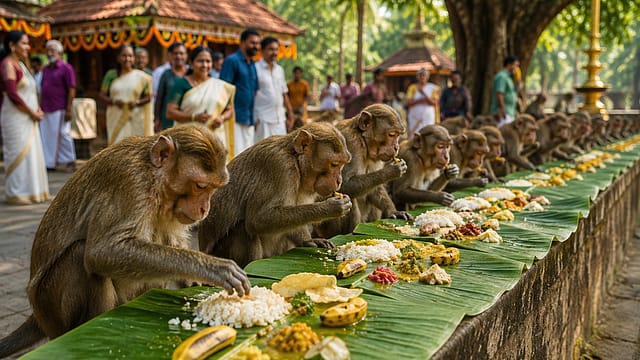
What Happens When Onam's Most Elaborate Feast Is Served to Monkeys?
Picture a traditional Onam sadya.
Rows of banana leaves. Rice piled neatly in the centre. Pachadi, avial, pappadam and payasam arriving one after another.
Now remove the humans.
At the Sasthamkotta Sree Dharma Sastha Temple in Kerala's Kollam district, the guests of honour are monkeys.
Every year on Uthradam and Thiruvonam, the most important days of the Onam festival, temple volunteers prepare a full-fledged Vanara Sadya—literally, a feast for monkeys. The ritual has become one of Kerala's most unusual and endearing festival traditions.
And no, the monkeys do not crash the party.
They're invited.

Zeroing In on ECI
09 Oct 2026 - Vol 05 | Issue 41
Constitutional legitimacy versus political opportunism
The Monkeys Know the Rules Better Than Some Humans
Here's the remarkable part.
The monkeys don't simply charge at the food the moment it appears.
According to reports from the temple, they watch from rooftops, compound walls and nearby trees while volunteers carefully lay out the feast. Then they wait. Patiently.
Only after the rice and the final dishes have been served—and the humans have stepped away—does the first diner make an entrance.
Locals call him Murivaalan, the senior member of the troop.
Like a restaurant critic inspecting a new menu, Murivaalan approaches first and samples the spread. Only then do the others descend and begin eating.
For a few minutes, the temple dining hall transforms into what may be Kerala's most exclusive Onam banquet.
Why Does This Kerala Temple Feed Monkeys During Onam?
The tradition is more than a quirky photo opportunity.
According to temple accounts, the practice began more than five decades ago when local resident Aravindakshan Nair noticed that the monkeys around the temple often struggled to find food during the festival season. Rather than celebrating abundance while the animals went hungry, he decided they should get their own feast too.
What started as a simple act of kindness gradually became an annual ritual.
Today, the Vanara Sadya is one of the temple's most anticipated Onam events.
Why Are Monkeys Considered Special at Sasthamkotta Temple?
The monkeys are not merely visitors.
They're part of the temple's identity.
The Sasthamkotta Sree Dharma Sastha Temple is famous across Kerala for its resident monkey population, which has lived around the shrine for generations. Local legends connect them to the Ramayana. One popular belief holds that members of Lord Rama's vanara sena remained behind in the area after returning from Lanka, becoming the ancestors of the monkeys that inhabit the temple today.
Temple monkeys are treated with unusual respect. In fact, they are often referred to locally as ambalakkurangukal—"temple monkeys"—and are regarded as part of the shrine's living heritage.
What's on the Monkeys' Onam Menu?
No shortcuts here.
The feast closely resembles the traditional sadya served to humans during Onam.
According to Kerala Tourism and temple accounts, the menu includes rice, pappadam, pachadi, avial, payasam, banana chips and other festive dishes. Some reports even note that the monkeys have particular favourites, including payasam and avial.
It's probably one of the few places in the world where monkeys can enjoy a multi-course festival meal served on banana leaves.
The Bigger Story: An Onam Tradition That Includes Everyone
Every culture has stories about sharing.
But the Vanara Sadya takes that idea a step further.
The feast is built around a simple belief: if Onam celebrates prosperity, gratitude and togetherness, why should the celebration stop with humans?
That philosophy has helped keep the tradition alive for more than 50 years. Kerala Tourism describes the ritual as an example of equality among living beings, where animals are included in the joy of the festival rather than treated as outsiders.
In an age of viral videos and attention-grabbing festival stunts, that may be what makes this tradition so charming.
Nobody created it for social media.
A group of people simply looked at some hungry monkeys and decided they deserved an Onam feast too.
And every year since, the monkeys have been showing up for dinner.