US Panel Targets RSS Before Mohan Bhagwat Visit, Revives India’s Charge of Selective Bias
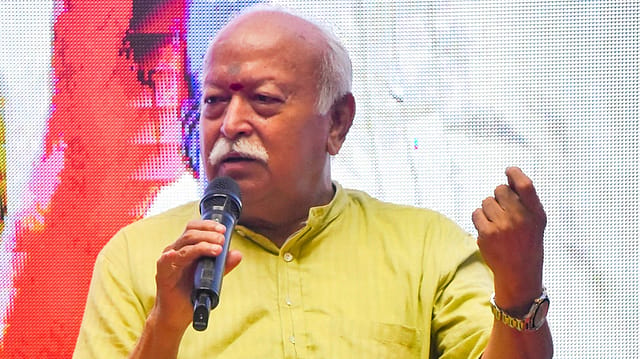
Days before RSS chief Mohan Bhagwat begins a three-country outreach tour, a US federal advisory body has urged Washington to deny the organisation’s leaders high-level meetings and diplomatic courtesies.
The United States Commission on International Religious Freedom, or USCIRF, has also renewed its call for sanctions against RSS members it considers responsible for violations of religious freedom.
The timing has sharpened a long-running confrontation between the commission and New Delhi. India accuses USCIRF of using selective evidence to target the country while paying insufficient attention to attacks on Hindu temples and growing intimidation of Indian communities inside the United States.
Bhagwat is scheduled to visit the US, Canada and the UK from August 25 at the invitation of diaspora and community organisations. The tour forms part of the RSS’s centenary outreach and is expected to include interactions with Indian-origin groups and local institutions.
Zeroing In on ECI
09 Oct 2026 - Vol 05 | Issue 41
Constitutional legitimacy versus political opportunism
Before he arrives, USCIRF Commissioner Gene Mills said RSS leaders should not be “honored with high-level meetings or diplomatic courtesies”, even when they are associated with the Indian government. He called instead for targeted sanctions against RSS members found responsible for violations of freedom of religion or belief. USCIRF also linked Prime Minister Narendra Modi to the organisation, describing him as an RSS member and accusing groups associated with the Sangh of attacks on Christians and Muslims.
The RSS rejects portrayals of itself as hostile to religious minorities and describes its work as centred on national service, social cohesion and India’s civilisational identity.
A Recommendation, Not a US Government Ban
USCIRF cannot cancel Bhagwat’s meetings, prevent private organisations from hosting him or impose sanctions on its own.
It is an independent, bipartisan federal commission established by the US Congress. Its job is to monitor religious freedom abroad and recommend action to the White House, State Department and Congress.
Its latest intervention is therefore political and advisory. Any visa restriction, asset freeze, meeting boycott or formal sanction would require action from the US administration. That distinction matters because describing the commission’s statement as a US government decision would overstate its authority. The panel is seeking to shape Washington’s response to the visit, not implementing one.
Bhagwat’s itinerary has not yet indicated any meeting with the US government. His engagements are primarily expected to involve diaspora, cultural and community organisations. His American programme reportedly includes a Universal Oneness gathering in New York on August 29. The event will focus on social cohesion, civic participation, interfaith engagement and global harmony, according to The Times of India.
USCIRF Revives Its Sanctions Demand
The commission’s statement follows its 2026 annual report, which recommended that India be designated a “Country of Particular Concern” over alleged severe religious-freedom violations.
The USCIRF report asked Washington to impose targeted sanctions on individuals and entities, naming the RSS and India’s external intelligence agency, the Research and Analysis Wing.
It proposed freezing assets, barring entry into the US, linking security assistance and trade policies to religious-freedom conditions and halting arms sales to India.
Those recommendations went significantly beyond criticism of particular incidents. They sought to attach consequences to the wider India-US strategic relationship, including defence and trade.
USCIRF placed India in the same recommended “Country of Particular Concern” category as Afghanistan, China, Iran, North Korea, Pakistan, Russia and Saudi Arabia, among others.
The US State Department is not bound by the commission’s recommendations and has previously stopped short of accepting its demand to place India in that category.
India Calls the Panel’s Lens Distorted
New Delhi rejected the 2026 report as a “distorted and selective” account built on questionable sources and ideological narratives.
The Ministry of External Affairs also turned the scrutiny back on the United States.
“USCIRF would do well to reflect on the disturbing incidents of vandalism and attacks on Hindu temples in the United States, selective targeting of India, and growing intolerance and intimidation of members of the Indian diaspora in the US,” MEA spokesperson Randhir Jaiswal said in the government’s formal response.
That countercharge cuts to India’s central objection. New Delhi does not merely dispute USCIRF’s conclusions; it questions the panel’s credibility and the asymmetry of a US institution passing judgment abroad while religious communities face hostility within America.
USCIRF’s mandate is expressly international, which explains why its annual country assessments do not investigate domestic American conditions. But that legal distinction does not settle India’s political argument: a country invoking religious freedom in foreign policy must confront failures at home with comparable seriousness.
Why the Timing Matters
The intervention arrives as the RSS tries to expand its global dialogue during its centenary year.
Bhagwat’s tour is designed to engage the Indian diaspora and present the organisation’s worldview directly to overseas audiences. USCIRF’s statement attempts to frame that outreach before he reaches the US.
It also risks converting a community visit into a diplomatic test. If American officials meet Bhagwat, critics may accuse them of legitimising the RSS. If they avoid him under public pressure, supporters of the organisation can point to the decision as evidence of ideological prejudice.
The panel’s demand places the Biden-era template of rights-based pressure into the present India-US relationship at a time when Washington also needs New Delhi on defence, technology, supply chains and the Indo-Pacific.
India, meanwhile, is unlikely to accept an American advisory commission deciding which Indian social or political figures deserve diplomatic access.
USCIRF sees the RSS as an organisation whose influence demands scrutiny over the treatment of religious minorities.
The RSS is over century-old social movement rooted in service, cultural confidence and national reconstruction. The disagreement stretches beyond one visit or one possible meeting. It is a contest over whether India should be interpreted primarily through Western rights reports or through its own political, constitutional and civilisational arguments.
The commission has every right within the American system to make recommendations. India has equal reason to challenge their evidence, consistency and political effect. But if USCIRF wants its criticism to command trust in India, it must confront the perception that its scrutiny runs in only one direction. Mohan Bhagwat has not yet landed in America. The battle over who should meet him, and who gets to judge the organisation he leads, has already begun.
(With inputs from ANI)