Non-Tariff Barriers Biggest Hurdle in India-China Trade: Nirmala Sitharaman
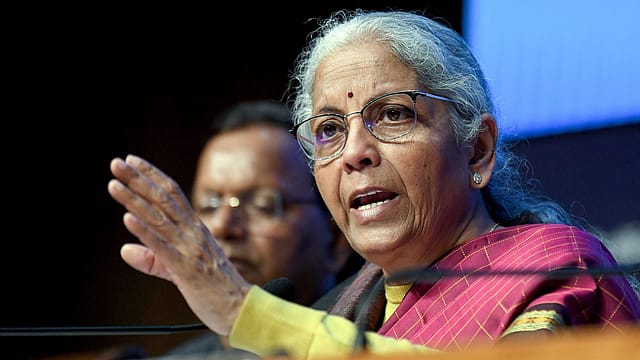
Non-tariff barriers remain the biggest obstacle to trade between India and China, with restricted market access for Indian goods contributing to a widening trade imbalance, Union Finance Minister Nirmala Sitharaman said on Friday.
Speaking at an interactive session with Michael Kugelman of the Atlantic Council on India’s Economic Edge, held on the sidelines of the World Bank-IMF Annual Meetings in Bangkok, Thailand, Sitharaman said India had repeatedly raised concerns over the barriers faced by its products in the Chinese market but had seen limited progress.
“So non-tariff barriers are the biggest hurdle in the trade between India and China,” she said, adding that the trade imbalance continued to grow despite years of engagement between the two countries.
Sitharaman said Indian products faced restrictions even in sectors where the country was globally competitive and where demand in China offered significant opportunities.

Zeroing In on ECI
09 Oct 2026 - Vol 05 | Issue 41
Constitutional legitimacy versus political opportunism
“We are global leaders in generic drugs, bovine meat, vegetables and perishables and very many such goods which have huge potential in China,” she said.
She alleged that China used measures such as phytosanitary requirements to restrict market access, arguing that these issues could be addressed through investigations and bilateral discussions.
INDIA FAVOURS DIALOGUE OVER RETALIATORY TARIFFS
Sitharaman said India had chosen to pursue discussions rather than respond to trade barriers with countervailing duties or similar restrictions.
She contrasted India's approach with that of countries that impose tariffs to address what they consider unsustainable trade imbalances.
“That approach we have never taken,” she said, adding that negotiations could be slow but remained India's preferred way of resolving trade disputes.
The remarks highlight a longstanding challenge in India-China economic relations: despite substantial bilateral commerce, the trade balance is heavily tilted towards China. India has repeatedly sought greater access for its exports while raising concerns about dependence on Chinese imports.
Non-tariff barriers include regulatory requirements, product standards, licensing procedures and other restrictions that can affect the movement of goods across borders, even when tariffs are not the principal obstacle.
INDIA-US TRADE AGREEMENT ALSO IN FOCUS
Beyond China, Sitharaman expressed hope that India and the United States would conclude their proposed trade agreement at the earliest opportunity.
She referred to recent remarks by India's commerce minister indicating that both sides wanted to move towards signing the agreement soon.
“I hope, in the interest of global trade and in the interest of trade between the two partners, India and US, the trade agreement gets concluded at the earliest,” she said.
India has been pursuing trade agreements with several partners as part of its efforts to expand export opportunities, improve market access and diversify economic relationships.
Sitharaman reiterated India's commitment to multilateralism while highlighting its trade engagements with the United Arab Emirates, Australia, Canada and the European Free Trade Association (EFTA) bloc, alongside negotiations with the US.
Her comments come as governments worldwide reassess trade relationships amid tariff disputes, supply-chain concerns and efforts to secure more favourable terms for domestic industries.
With inputs from ANI