The Peaceful Valley: Seven Years After the End of Article 370 in J&K
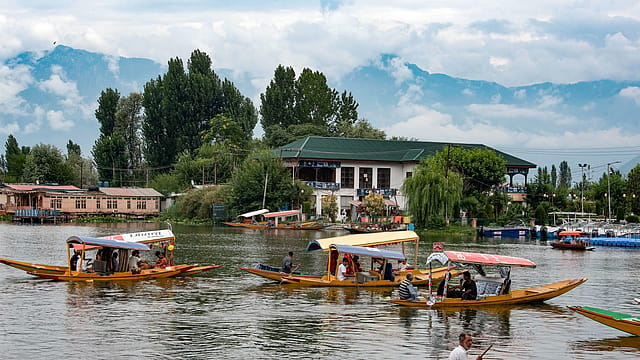
Another year has passed since the end of Article 370 and the special status for the erstwhile state of Jammu and Kashmir (J&K), marking seven years since 5th August, 2019. The date is interesting not just as another anniversary but a striking marker of the contrast between J&K proper and the Pakistani occupied portion of J&K. While peace and development prevail on the Indian side, bullets, killings, and destruction are the order of the day under Pakistan’s colonial occupation of the former princely state.
The data is unambiguous: Since August 2019, the number of incidents of killings has come down substantially. In the seven years since 5th August, 2019 the number of incidents of killings stand at 650; in the previous seven years that number stood at 922. But as was to be expected, there was no one-to-one correlation between Article 370 being rendered defunct and the downward graph of terrorist atrocities and killings. The “peace dividend” began flowing from 2023 when the number of killings reduced dramatically compared to the previous four years since 2019.
Look Who's Talking Regime Change
23 Oct 2026 - Vol 05 | Issue 43
The nature of the insurgency, too, has changed. Kashmir proper—the districts of North and South Kashmir—are by and large quiescent even as insurgents have shifted to the densely wooded areas of Jammu division. Insurgency is not a political force in the sense of enjoying overt support in the districts of Kashmir but more a terrain-dictated phenomenon. There are other, interesting, patterns on inter-district variations in violence and separatism but the overall trend is clear: secessionism as an organised political force has been ended.
The demand from J&K’s political parties now is for the restoration of statehood. This is, to put it mildly, an unreasonable demand. The quelling of insurgency is largely due to the security forces being given a free hand, free from the political diktats of governments in power in Srinagar. Kashmir’s mainstream political parties had perfected the art of keeping insurgency simmering even as the pledged loyalty to India. The end of this Janus-faced politics required—and continues to require—that political parties of Kashmir Valley have no say in security matters.
The apparatus of separatism was quite intricate. At the root lay the mix of local and Pakistani insurgents with each fulfilling a certain function. Then came the Valley’s Reserve Army of Labour that could be summoned by a whistle to indulge in stone-pelting and other subversive activities. On top of this was the curious mix of the “separatist leadership” and the Valley’s “mainstream” politicians who had their own political division of labour. Finally, there was an ideological layer—in Srinagar and New Delhi—that continuously made a case for “soft” or “hard” separatism, depending on the “needs of the day.”
As is obvious to anyone, a part of this apparatus has been dismantled while another part has been tamed. It will take time to render the entire structure defunct; restoring statehood poses grave dangers of its resurrection. What India’s security forces broke down, gun-by-gun and stone-by-stone, should not be undone by restoring statehood.
Pakistan’s colony
The situation in the part of J&K under Pakistan’s jackboot is wildly different from Kashmir Valley proper. There, Pakistan has killed more than 30 persons and the true extent of the military crackdown is not known as the press and media have not been given access to the restive region. One thing though is clear: there is a mass unrest in that part of J&K due to economic mismanagement and ruin and the total unwillingness of the Pakistani establishment for a political compromise with local leader.
Much has been written about India’s alleged rigging of elections in J&K and its alleged spawning of a “pliable” Kashmiri political elite. This alleged “destruction” of Kashmir’s political life by India pales into insignificance when compared to what Pakistan has done in all the decades since 1947. Srinagar has had a string of chief ministers who have been pretty much governed as they have wanted to. For obvious reasons, security matters were never fully under their preview. In Muzaffarabad, “selection” and not “election” has been the order of the day.
What is interesting to note about the current situation is that there have been no organized voices on the Indian side against the atrocities in Pakistan occupied J&K. Srinagar’s political class, the so-called civil society groups and people-at-large, have not even whimpered about the atrocities against their brothers and sisters under Pakistani colonial rule. That silence tells a story.