The Math of Growing Sustainability
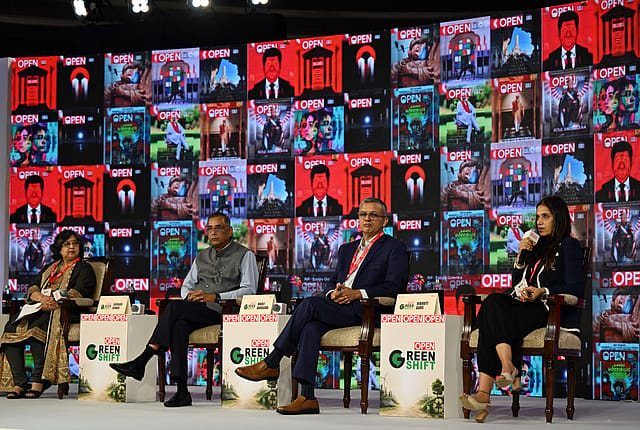
India needs to cut its pollution levels by roughly 60% just to meet its own clean air standards, a figure that came up more than once through the evening. More than 20 speakers gathered at Hyatt Regency, New Delhi, on July 23 for The Green Shift 2026, hosted by Open and the RP-Sanjiv Goenka Group, to talk about energy, air, finance and the choices that will decide whether India's growth story and its climate deadline can coexist. Opening the summit, Open editor-in-chief S Prasannarajan set the tone for what followed. "We are all environmentalists today," he said, arguing that sustainability had stopped being a niche concern and become central to how societies think about growth and the future. What we need, he said, "is not environmental absolutism. What we need is environmental empathy," before adding the line that stuck: "To remain green is to remain human." Does India actually have a plan to grow without wrecking the planet it's growing on, or just a plan to talk about one?
The first panel opened with energy security. Saurabh Kumar, an energy transition enabler and former Vice President of the Global Energy Alliance for People and Planet, argued that India's shift to cleaner power depends on how well the country manages that security through the transition, not after it.
Mohit Bhargava, Country Director of the India Energy and Climate Center, picked up the thread. Much of India's domestic gas use, he said, could simply be swapped for electricity. The bigger obstacle is money and infrastructure. Bhargava was clear that the government now has to do more of the heavy lifting, through investment and policy that support long, unglamorous shifts rather than quick wins.

Losing Memory
16 Oct 2026 - Vol 05 | Issue 42
The making of a medical and social emergency
That investment gap runs deep. Vibhuti Garg, Director of South Asia at IEEFA, said commercial investors won't back clean energy at scale until the technology has matured and proven itself financially, so public money has to carry the early stages. She cited a study putting India's clean energy investment need at roughly $256 billion between 2026 and 2070, and said the government needs to start green budgeting now to plan for it.
Kumar returned to make one more point: AI has a role here too. Used well, he argued, it can optimise electricity demand and grid management, making the whole system more efficient and, in turn, speeding up decarbonisation.
The next panel moved from energy to infrastructure. Amit Thakur, Associate Director and Head of CSR at TERI, told businesses in the room that decarbonisation needs to sit inside long-term financial planning, not get treated as a side project. Joshua Wycliffe, Director of the Global Biofuels Alliance, made the case for biofuels as one part of a wider mix of solutions rather than a competitor to solar or wind. Scaling them up is a policy problem as much as a technical one, he said, pointing to India's new mandate requiring 1% of aviation fuel to come from sustainable sources as a small but real push in that direction.
Then the conversation turned to something Delhi residents already live with. The panel "Can India Breathe Better?" dealt with air quality, and it didn't pull punches. Anumita Roychowdhury, Executive Director of CSE, explained how pollution gets trapped near the ground by atmospheric conditions and spirals upward fast. India needs roughly a 60% cut in pollution to consistently meet clean air standards, she said, with vehicle emissions the biggest single source. Pollutants from power plants, vehicles, industry and fires don't just add up either, they react with each other in the air to form secondary pollutants that can be worse than what caused them. Anant Mohan, Head of Pulmonology at AIIMS, New Delhi, said the health toll shows up everywhere, in the eyes, the skin, the lungs, the whole respiratory system.
Amitabh Kant's keynote opened with a number. The former G20 Sherpa and NITI Aayog CEO said that to hit the Prime Minister's target of a fully developed economy by 2047, GDP needs to grow around ninefold, manufacturing sixteenfold, urbanisation twenty-two-fold. Roughly 500 million people will move from villages to cities over the next three and a half decades, he said, thirty Indians every single minute. He didn't treat that as alarming. He treated it as India's one real shot, a chance to build sustainable cities from scratch instead of retrofitting ones the West built around cars and then spent decades regretting. Kant reserved his sharpest lines for the world's polluters. A small number of companies, he said, account for a hugely disproportionate share of global emissions, and get away with it because nobody's tracking the number the way markets track earnings. His answer was blunt: put the emissions on the balance sheet, and let the stock price do the punishing.
The final speaker of the evening, Ricky Kej followed Kant's observations with something much smaller. The musician and UN Goodwill Ambassador talked about habits instead of numbers. He sold every car he owned back in 2013, he said, and hasn't driven since, not even after winning a Grammy, not even now. He gets his own carbon footprint audited every quarter, the way some people check a bank balance, and offsets what's left through tree plantation and renewable investment. Then he went after fast fashion, and the simplest line landed the hardest: the most expensive clothes anyone owns are the ones they wore only once.