‘Don’t hang us, shoot us’: PM Modi revisits Bhagat Singh’s letter to the British on his birth anniversary
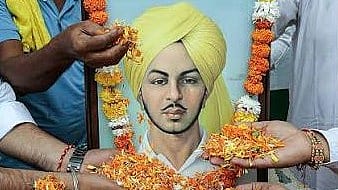
What would you write if you knew you were about to die? For Bhagat Singh, the answer was not a plea for mercy. It was a demand.
On Bhagat Singh's 119th birth anniversary, Prime Minister Narendra Modi chose to remember not just the revolutionary's sacrifice, but a letter that continues to fascinate historians nearly a century later. In a video message shared on X, Modi recalled how Singh had asked British authorities to treat him and his comrades as prisoners of war and execute them by firing squad rather than hanging. According to ANI, the Prime Minister described the letter as proof of Bhagat Singh's "indomitable courage" and called him a source of inspiration for India's youth.
The reference has once again drawn attention to one of the most extraordinary documents from India's freedom movement.
The Bhagat Singh letter that refused to ask for mercy
The popular image of Bhagat Singh is familiar: A young revolutionary in a hat, defiant, fearless, ready to embrace death for the country.
But the letter he wrote shortly before his execution reveals something deeper. Addressed to the colonial authorities before his execution in March 1931, Bhagat Singh argued that he and his fellow revolutionaries were not ordinary criminals. They were combatants in a war against British rule.
Losing Memory
16 Oct 2026 - Vol 05 | Issue 42
The making of a medical and social emergency
According to historical records cited by scholars and archives of Bhagat Singh's writings, he demanded that the British government recognise this reality and execute them by shooting rather than hanging. The request was never accepted. Instead, Bhagat Singh, Rajguru and Sukhdev were hanged in Lahore Jail on March 23, 1931.
For many historians, the letter was not about the method of execution. It was about asserting political legitimacy until the very end.
Why PM Modi highlighted the letter in his tribute
In his message, PM Modi focused on the revolutionary's fearlessness. "Before dangling from the gallows for the country, Bhagat Singh ji had also written a letter to the British. He had said that I want you to treat me and my companions like prisoners of war. Therefore, our life should be taken not by hanging, but directly by shooting. This is proof of his indomitable courage," the Prime Minister said.
PM Modi also described Bhagat Singh as "a source of inspiration for every Indian," particularly young people, and praised his willingness to sacrifice everything for the nation. The tribute came as political leaders across the country remembered the revolutionary on his birth anniversary, underlining how Bhagat Singh remains one of the few freedom fighters admired across ideological and political divides.
Bhagat Singh was only 23 when he became immortal
It is easy to forget how young he was. Bhagat Singh was born on September 28, 1907, in Banga, now in Pakistan's Punjab province. By his early twenties, he had become one of the most recognisable faces of India's revolutionary movement.
His involvement in the Hindustan Socialist Republican Association, the assassination of British police officer John Saunders following the death of Lala Lajpat Rai, and the dramatic Central Legislative Assembly bombing alongside Batukeshwar Dutt turned him into a symbol of resistance against colonial rule. Yet what made him different was not only his willingness to take risks. He also wrote extensively about revolution, freedom, nationalism and social change. His prison writings, essays and notebooks continue to be studied decades after Independence.
The revolutionary who became a national icon
Most freedom fighters become part of history. Bhagat Singh became part of popular culture. His image appears on posters, murals, T-shirts and protest banners. His slogans still echo at political rallies. His life has inspired books, films, documentaries and academic debates. The title "Shaheed-e-Azam", the Great Martyr, remains closely associated with him even today.
Perhaps that is why his birth anniversary continues to resonate nearly a century after his death. Every generation seems to discover its own version of Bhagat Singh. Some see the fearless revolutionary whereas others see the intellectual. Some remember the young man who challenged an empire.
But on his 119th birth anniversary, it was a final letter from a prison cell that captured national attention once again. A letter that did not ask for life, a letter that demanded dignity. A reminder that even in the shadow of the gallows, Bhagat Singh was still fighting on his own terms.
(With inputs from ANI)