'The Global Power Balance is Changing': PM Modi Asks IIT Graduates to Build an Atmanirbhar India
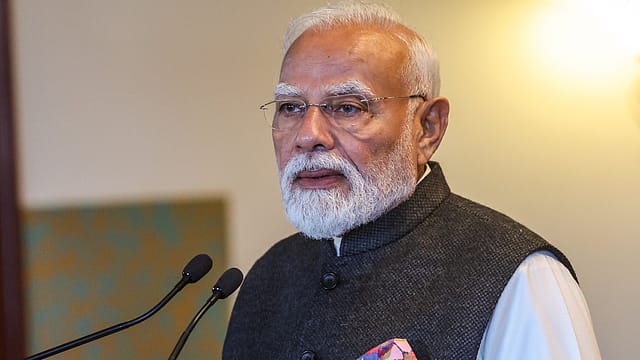
The world's next superpower may not be decided by armies alone. It could be decided by algorithms, chips, drones and scientific breakthroughs.
That was the message Prime Minister Narendra Modi delivered to graduating students at IIT Delhi on Saturday, as he urged India's brightest young minds to recognise that technology is rewriting the global balance of power and that the country's future will depend on its ability to become self-reliant across critical sectors.
Addressing the 57th Convocation of IIT Delhi, Modi said no one can predict what the world will look like over the next two or three decades because technology is transforming industries, economies and geopolitics at unprecedented speed.
"The global strategic equation is shifting swiftly. The global power balance is evolving by the moment, driven primarily by the pace of technological advancement," he said.

Losing Memory
16 Oct 2026 - Vol 05 | Issue 42
The making of a medical and social emergency
Against that backdrop, he urged students to keep learning and ensure that every major career decision also answers a larger question: How will it help build India?
Modi said the next 30 to 35 years of the graduating class would coincide with India's journey towards becoming a Viksit Bharat, making this generation's choices critical to the country's future.
He argued that economic, technological and industrial self-reliance must become the foundation of that ambition.
"Everything from chip to ship will be built right here, by your own hands," he said, pointing to India's growing capabilities in semiconductors, drones and advanced manufacturing.
Highlighting the expanding role of technology, the Prime Minister noted that drones are no longer confined to defence. They are increasingly transforming agriculture, delivering medicines and opening new opportunities for young innovators across the country.
He also made a strong pitch for research, urging graduates to pursue scientific innovation instead of limiting themselves to conventional career paths. Modi highlighted initiatives such as the Prime Minister's Research Fellowship, the National Research Foundation, the Research, Development and Innovation Scheme and the One Nation One Subscription programme, saying the government is investing up to ₹1 lakh crore to strengthen India's research ecosystem and improve access to global scientific journals.
The convocation also marked the inauguration of Param Pragya, an AI-powered supercomputing facility at IIT Delhi aimed at accelerating advanced research in artificial intelligence and high-performance computing.
While presenting the institute's highest academic honours, Modi struck a personal note, expressing disappointment that only "one or two" women featured among this year's medal winners and saying he hoped to see far greater representation in the years ahead.
His broader message, however, remained clear.
In an era where technology is becoming the defining currency of global influence, India's greatest strategic advantage will not be natural resources or geography. It will be the minds graduating from institutions like IIT Delhi.
(With inputs from ANI)