Death by Selfie
In July this year, a 34-year-old man from Bijapur, Karnataka, arrived at Goa’s Baga beach for a holiday along with his girlfriend. It was the peak of monsoon, the tide was high and tall red flags peppered the coastline every 30 metres or so, prominent physical cautions to remind beach-goers to not enter the water. The man not only made his way into the lashing foam of the Arabian Sea, he climbed on to a claw of laterite rocks jutting out far deeper, somewhere by the breaking waves. Perching precariously on the slippery rocky outcrop, he signalled to his girlfriend to make a video of his daredevilry.
In the footage, which went viral on Instagram as such reels tend to do, the girlfriend pleads with him to return to the shore, but he asks her to keep filming. That’s exactly when a high wave crashed against the rocks, fatally swept him off his post and pulled him deep into the turbulent sea. A few hours later, his body was recovered by the shoreline.
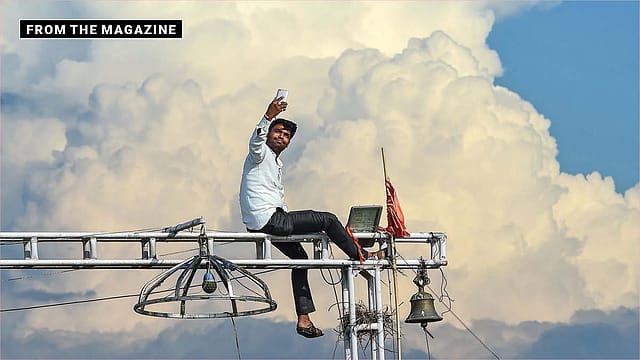
Despite the severity of this widely watched incident, the appeal of posing for selfies and videos in perilous settings remains just as potent and alluring. When I visited the rocky coastline of Cola in south Goa just a couple of months after the aforementioned tragedy, I watched in horror as scores of selfie-takers would risk it all to climb atop a laterite outcrop, even as strong waves lashed at their feet just inches below. The frustrated lifeguard on duty would whistle them down from afar and then from a lot closer. But as soon as he would make his way back to his post, the selfie-clickers were promptly drawn towards their scenic backdrops, camera phones in hand.
“I cannot begin to explain how tiring it is to continuously have to police these tourists from committing self-harm. What even is it about a photo or a video that makes us Indians risk the lives of not only ourselves, but our families and children as well? So often I see fathers asking their children to pose too close to the water during high tide or even on top of a wet rock,” says Vinod Prakash, a lifeguard in north Goa’s Morjim-Mandrem stretch. In Goa particularly, the easy access to alcohol doesn’t help and the deadly combination of lowered inhibitions and a high-risk pose is too tempting to pass up. Prakash adds: “Every other month there is an incident like the one at Baga. Yet, it barely serves as a warning.”
There are cautionary tales, and then there are cautionary tales—like the Ramesh Walanju incident in Mumbai, who unfortunately had to die a hero for the authorities to wake up and take strict action to further prevent selfie deaths. Back in 2016, 37-year-old Walanju, a taxi driver by profession, happened to walk by Bandra’s Bandstand exactly when three college girls struck a pose for selfies a little too close to the edge of a rock. When they fell into the sea, Walanju jumped into the choppy waters to save them. He brought two back to safety but drowned while trying to save the third.
This was a line-in-the-sand moment for the Mumbai Police, who immediately identified 15 no-selfie zones across the city, including at Marine Drive and Girgaum Chowpatty, both major tourist attractions. The no-selfie zones were an attempt to impose a physical boundary on a risk people seemed either unwilling to recognise or happy to ignore. Research suggests the problem extends far beyond Mumbai’s shoreline—or even India’s for that matter.
A study published in JMIR Formative Research in 2023, titled ‘Social Media and Selfie-Related Mortality Amid COVID-19: Interrupted Time Series Analysis’, identified 332 selfie-related deaths worldwide between March 2014 and April 2021. India, astonishingly, accounted for 153 of them, or roughly 46 per cent of the global total. The US, with 28 deaths, and Russia, with 20, were a long way behind. The numbers are drawn from media reports rather than official mortality records, so they are likely to represent an undercount. Even so, India’s share is striking.
The victims were also overwhelmingly young. Of the 332 people who died, 296 were under 40, while two-thirds were men. Drowning was the leading cause of death, accounting for 118 cases, followed by falls, with 101, and transport-related incidents, with 68. The settings varied, but the underlying pattern was familiar: people moved too close to water, the edge of a precipice or a moving vehicle to capture an image, completely misjudging the danger in the process.
The study also offered an unusual glimpse into the circumstances that make these deaths more likely. Before the Covid-19 pandemic, the researchers recorded an average of 4.3 selfie-related deaths a month. During the pandemic, that figure fell to 1.3, coinciding with lockdowns and restrictions on travel. The finding suggests that reducing access to hazardous locations can save lives, even without changing the technology or the impulses that draw people towards them.

An India-specific study published in the Journal of Current Research in Scientific Medicine in 2026, ‘Killer clicks: A retrospective 8-year media-based analysis of demographic and circumstantial determinants of selfie-related fatalities in India (2014–2021)’, found a similar demographic pattern. Its researchers identified 151 deaths across 81 incidents. More than half the victims were aged between 21 and 30, while another 37.7 per cent were under 20. Men accounted for 84.1 per cent of the fatalities. One of them was a Japanese tourist in 2016 who slipped down the stairs at the Taj Mahal in Agra while his focus was on his selfie-stick.
In India, water bodies were the most common setting, associated with 57 per cent of deaths, while railway-related incidents accounted for 18 per cent. The Southwest Monsoon and the months immediately after it were particularly dangerous, with July recording the highest number of cases. Maharashtra reported the most deaths, followed by Uttar Pradesh and Tamil Nadu. The study recommended measures such as warning signs, public awareness campaigns and designated no-selfie zones at hazardous tourist spots.
Perhaps most disturbing is the fact that the person taking the photograph is not always the only one to die. The 2026 study recorded 29 incidents involving accompanying friends or bystanders that resulted in 70 additional fatalities. A person slipping into the sea can prompt good Samaritans to rush in to help, as was the case with Walanju in 2016; a group attempting the same photograph can expose several people to the same hazard. What begins as an individual pursuit of a memorable image can swiftly turn into a collective tragedy.
But the question remains: what makes the photograph worth the risk? Social media has transformed the selfie from a personal memento into a form of public performance. The image is not merely proof that someone visited a place, but that they experienced it in a way others might not dare to. A picture beside a waterfall is ordinary; one taken on a slippery rock above it offers something more dramatic. The hazard becomes part of the attraction, a visual cue for courage, adventure and the ability to push boundaries.
The research discusses social recognition and attention-seeking as possible motivations, although neither study can establish why each individual took a fatal risk. The appeal is nevertheless easy to understand. The reward—a striking photograph, the reactions it attracts, the brief thrill of having captured something extraordinary—is immediate. The danger remains abstract until the moment it isn’t. And unlike a photograph that fails to attract attention, a fatal mistake offers no second attempt—as evidenced on October 19, a day before this story went to press.
News emerged that the death toll in a selfie-related accident in Varanasi had risen to five. A group of friends returning from a visit to the Vindhyachal temple had stopped their SUV on an overbridge near Rupapur, on the Prayagraj-Varanasi highway, to take photographs. A speeding truck rammed into their stationary vehicle, killing four people at the scene and leaving four others injured. One of the injured later died in hospital. The incident was a grim reminder of how little separates an ordinary moment from an irreversible tragedy.
But then, the traffic on the Varanasi overbridge will carry on as before, the rocks at Cola will remain slippery and the exasperated lifeguards all around Goa will keep whistling into the wind. Tourists will continue to arrive, phones in hand, drawn towards the same views and the same precarious vantage points. The danger is hardly a secret. Yet, for one more photograph to share as a flex on social media, people keep edging closer to it, convinced that the perfect frame is worth its inherent risk.